The lumber market in recent years has been a roller coaster. For those operating logging businesses, lumberyards, and mills, or for contractors and homeowners looking to replace a few planks on the deck, not knowing which way the market will shift has been stressful.
“The price drop might have been greater—but two of North America’s biggest sawyers said ... they would curtail output, slowing the decline.
“Crashing wood prices are troubling because they have been a reliable leading indicator on the direction of the housing market as well as broader economic activity.”
Why they are such an indicator is a reflection of the U.S. construction industry.


Historically, in most of the United States, wood has been a local and affordable material for building houses. From the first European settlers, the hardwood forests that covered much of the continent were a bounty of material for houses, ships, furniture, and anything else, as well as a key export commodity.
But wood’s continuing ubiquity as a building material makes lumber prices a good bellwether for the construction economy. Housing in the United States is overwhelmingly wood-framed. An estimated 90 percent or more of new residential construction in the United States is wood-framed, whereas in Europe, houses tend to be brick-built, but with many regional variations (Norway, with ample trees, favors wood for housing).
A hundred years ago, kit homes were more common in the United States. They were sold by Sears, Montgomery Ward, and other local firms. Buyers received the plans and the pieces for a house and put it together themselves. Economies of scale made these a viable option for someone looking to build a house in the expanding suburbs.
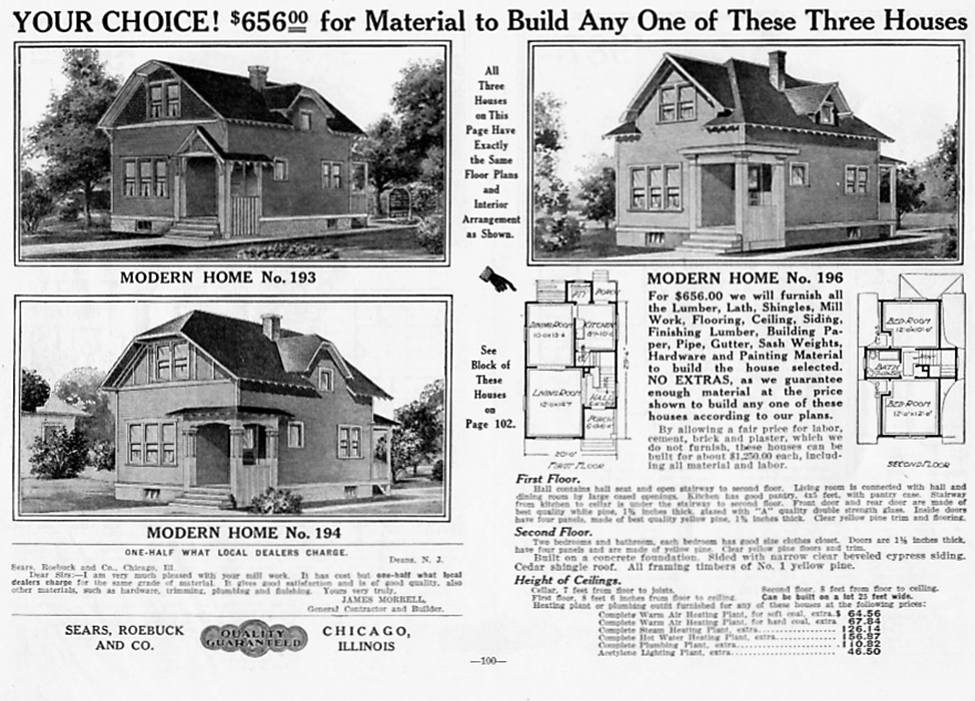
The 1914 Sears Modern Homes catalog shows three homes that could each be bought for $656 (the small print admits that your outlay would be more like $1,250 all-in, including brick, cement, and plaster—which the company would not supply—and labor). Your kit house would be delivered by rail; it was generally assumed that householders would be handy enough (or know whom to hire) to put it all together from the supplied plans.
Those kit homes included wood, metal, and glass and reflected both the tastes of consumers and the economies of bulk production. The various styles in the catalog over the years included craftsman, Dutch Colonial, federal, and cottage—styles that have continued to be popular in the residential architecture of the United States.
The Sears catalog of 1936 stated: “This is the age of modern efficiency. No longer can human hands compete with machine precision and production. ‘Speed with accuracy’ is the watchword in any department of our great factories.”
Today’s prefab homes include different products with the same economies of mass production. In European kit homes, concrete, glass, metal, and synthetics make up about half of the materials used. But wood-and-stick-framed homes continue to dominate the U.S. market.
If the housing market softens, which it looks to be doing, demand for wood will slow and prices will drop. The Wall Street Journal stated, “Residential building permits dropped in July to a seasonally adjusted annual rate of about 1.4 million units, the fewest since June 2020.”
That doesn’t bode well for timber sellers, but prospective builders could be looking at alternative materials, too.