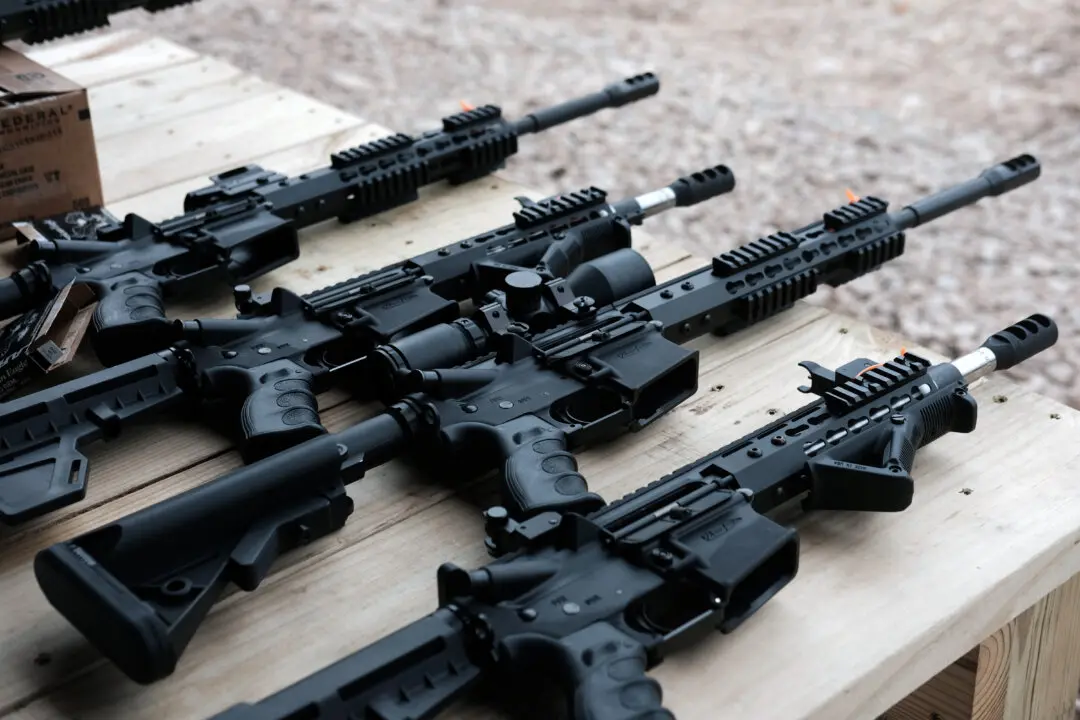
Alessandra Coote was walking on a trail with her 2-year-old daughter and dog 2 1/2 years ago when a man began yelling at her and threatened to kill her dog. When the petite single mom made it back to her Utah home, she decided she needed a firearm for protection.
A few months later, while living in what she described as a “shady part of town,” a homeless man threatened her. After that encounter, she began regularly carrying a firearm under Utah’s constitutional carry law.
Coote, who just graduated this spring from the University of Utah, said carrying the gun has given her the confidence to feel safe in public.
“It’s been life-changing,” she told RealClearInvestigations (RCI).
Although she has never had to draw or fire the weapon, she has faced a threatening individual when she was armed, but she stopped the attack by merely letting the man know she was carrying.
Both polls were commissioned by the group I lead, the Crime Prevention Research Center, and have a margin of error of 3.1 percent.
Since 2021, 13 states, covering 34 percent of the U.S. population, have adopted constitutional carry laws. As a result, 29 states do not require law-abiding citizens to obtain a permit to carry a concealed handgun. A little less than two-thirds of those who are carrying a concealed handgun in these states have a permit.
“It doesn’t surprise me that while the country is experiencing record-low murder and violent crime rates, we are also experiencing a record high number of people legally carrying concealed handguns for self-protection,” Alan Gottlieb, the executive vice president and founder of the Second Amendment Foundation, told RCI.
Sheriff Gordon Smith of Bradford County, Florida, said lowering crime rates “isn’t rocket science.”
He told RCI: “You reduce crime by putting more cops on the street, increasing arrest and conviction rates, and imposing meaningful prison sentences. But you also cut crime by empowering law-abiding citizens to defend themselves and their families through constitutional carry.”
Black People, Hispanics, and Women
The CPRC survey also found that politically engaged citizens are more likely to carry firearms. Respondents who identified as general election voters were twice as likely to have concealed handgun permits as other adults.Black people and Hispanics also carry at disproportionately high rates. Black people make up 11.0 percent of likely voters but account for 15.9 percent of those who carry all or most of the time. Hispanics carry even more, accounting for 18.8 percent of frequent carriers despite making up only 11.0 percent of likely voters. By contrast, white people and Asians carry at rates below their shares of likely voters. White people constitute 72 percent of likely voters but only 62.6 percent of those who carry all or most of the time, while Asians account for 4.0 percent of likely voters but just 2.0 percent of frequent carriers.
Audrey Bodiford, a 5-foot-2 black woman living in Lansing, Michigan, told RCI she owes her life to her handgun and having a concealed handgun permit. On Valentine’s Day in 2022, she said, the over 6-foot-tall man she had been dating “kind of went crazy,” threatened to kill her, and pulled a knife on her. Fearing for her life, she shot him in self-defense.
Because she lives in what she describes as a “not good” neighborhood, this was not the only time she relied on her firearm for protection. In another incident, she said she accidentally let a door slip from her hand while trying to hold it open for a man leaving a store. The man became verbally abusive, followed her, and aggressively closed in on her. She turned slightly so he could see that she was armed. He immediately backed off, ending the confrontation.
Asked whether carrying has given her more confidence, she said, “I feel more safe, definitely.”
The survey found relatively small differences between men and women. While women make up 52 percent of general election voters, they account for 45.1 percent of Americans carrying concealed weapons; men are 48 percent of the electorate and 54.9 percent of those who carry all or most of the time. The breakdown for constitutional carry states is relatively higher for women, with 47.5 percent of those carrying all or most of the time being women and 52.5 percent men. Constitutional carry may benefit women who suddenly face threats from a stalker or former partner and often do not feel they can wait the months it takes for officials to approve a permit application.
More Guns, Fewer Violent Crimes
After the Supreme Court struck down a New York state law in 2022 that had sharply limited the number of people who could carry concealed weapons, six states—California, Hawaii, Maryland, Massachusetts, New Jersey, and New York—were forced to make it easier to get a concealed handgun permit by eliminating arbitrary discretion and establishing objective rules on training and other qualifications.“The data clearly show that concealed carry permit holders are among the safest and most responsible users of firearms,” David Mustard, a distinguished professor at the University of Georgia who researches extensively on crime, told RCI.
Smith confirmed that this is his experience with constitutional carry: “The data is clear: The vast majority of concealed carriers are among our most responsible residents, not the problem.”
“Too often, women who are being stalked or threatened are told to limit their movements, alter their routines, or rely on a piece of paper to stop someone determined to harm them,” Robyn Sandoval, the president of A Girl & A Gun, told RCI. “Women deserve better than living in fear. By learning to responsibly carry a firearm, they can gain the confidence and means to protect themselves and live their lives without fear.”
“Every day, more law-abiding citizens choose to legally carry firearms because they refuse to be victimized by criminals and thugs,” Sheriff Wayne Ivey of Brevard County, Florida, told RCI. “Responsible gun owners know that even the best police response times [take] minutes, while violent criminals can take a life in seconds!”