This copy is for your personal, non-commercial use only. Distribution and use of this material are governed by our Subscriber Agreement and by copyright law. For non-personal use or to order multiple copies, please contact The Epoch Times Reprints.
Chinese authorities continue the demolition, started a couple of days earlier, of a Christian church in Oubei town, outside of Wenzhou city, China, on April 30, 2014. Mark Ralston/AFP via Getty Images
What’s the motivation behind Beijing’s campaign to target underground Christians?
In a word, it’s “fear.”
Sinicization of Christianity
Under the Chinese Communist Party (CCP) and its leader, Xi Jinping, any independent source of meaning, loyalty, or community is viewed as a potential political threat. The outcome of that way of thinking—often called the “sinicization” of religion—has moved from slogan to hard policy.
The U.S. Commission on International Religious Freedom concluded in a 2024 fact sheet that sinicization has become an explicit, coercive state agenda that alters worship, installs Party loyalists in religious institutions, and criminalizes non-state activity.
In terms of the number of converts, Christianity could be viewed by the CCP as a significant threat, aside from the flagging economy. Some estimates put the number of Christian Protestants at roughly 109 million (many of whom are not sanctioned by the Party) in 2020, while others put it at 30 million to 70 million.
Whatever the actual numbers may be, the reality is that for many tens of millions of Chinese, the First Commandment asserts and confirms the primacy of God over all other authorities, which includes the state, the CCP, and Xi. The prophet Isaiah said: “Woe to those who make unjust laws, to those who issue oppressive decrees.”
New Legal and Administrative Weapons
It’s no wonder that, in recent years, CCP authorities have tightened church registration systems, rolled out databases of “approved” clergy, and updated administrative measures to curtail non-state religious work.
It’s become even more restrictive over the past several months, for both Protestants and Catholics. That includes limiting foreign missionary activity and classifying unsanctioned religious organizing as a security risk.
The official explanation is that these steps protect “social stability” and guard against “cults,” but the reality is that these measures criminalize house churches and independent congregations.
In 2024–2025, for example, watchdogs and church-focused nongovernmental organizations have documented the closures and forced mergers of unregistered church communities, arrests and imprisonment of priests and pastors, and directives to change hymns and church music to reflect communist core values. The CCP is targeting independent Catholic and Protestant congregations with campaigns in cities such as Wenzhou.
In fact, earlier this month, Chinese authorities arrested 30 leaders of one of China’s largest underground church networks. That list includes several pastors and Zion Church founder Jin Mingri, who was arrested after 10 officers searched his home. The Trump administration has urged Beijing to release the detainees and respect religious freedom.
The truth is that these are not isolated events but part of a coordinated enforcement effort. Humanitarian and religious-freedom organizations have documented increasing use of surveillance, detention, and physical abuse of religious leaders.
Why the CCP Fears Christianity
The CCP mainly fears organizations that operate independently of state supervision and control, which is precisely what Christian churches are. They’re self-organizing social networks that transmit transcendental truth, moral clarity, and values. They foster devotion and loyalty to the Eternal Creator and emphasize redemption through the death and resurrection of Jesus Christ, who, by definition, is quite independent of—and infinitely superior to—the Party.
In short, Christian churches can establish and sustain enduring alternative communities that are far removed from and antithetical to the CCP. That’s why Xi and the CCP view these autonomous ties as rival sources of authority that could mobilize people or erode ideological loyalty—especially at a time of heightened nationalism and national economic decline.
With the CCP anxious about social stability, official state speeches are urging religions to be “adapted” to the communist path, in language that legitimizes stricter Party control over them.
Xi’s Attempt to Reshape Religious Identity in His Own Image
Beyond restrictions and enforcement of tighter rules, the Party wants to reshape religious practices according to Xi’s own personal predilections. That includes the Party overseeing the training and certification of pastors, rewriting permissible liturgy in accordance with CCP standards, and mandating patriotic education in hymns and sermons.
This is less about theological debate and more about co-opting institutions to legitimize Xi’s political projects. The objective, of course, is to reshape the Christian faith into one that supports CCP narratives rather than an independent source of knowledge, authority, and religious instructions based on the enduring truth of God’s Word in this life and the next.
What This Means Going Forward
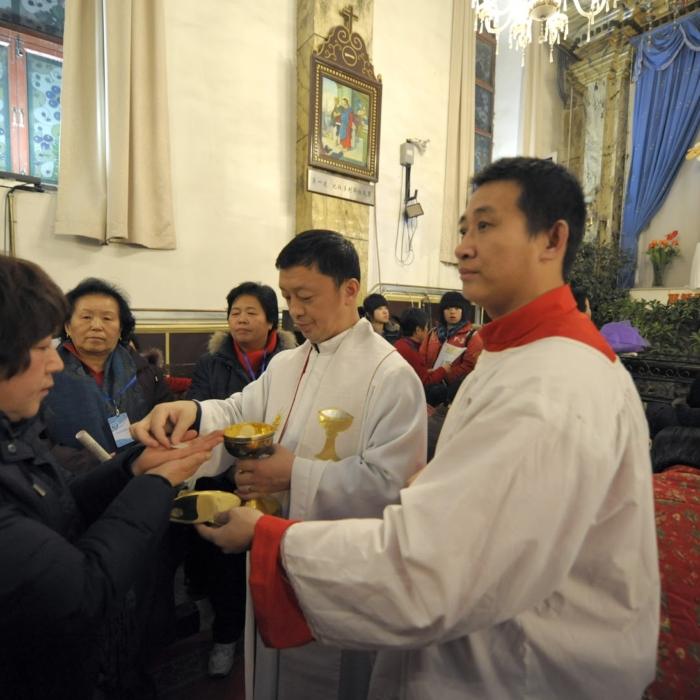
Despite all of these efforts, Christianity retains deep roots and social appeal in China. Historical growth since the 1980s has built large Protestant and Catholic communities, especially among urbanites and rural migrants seeking community and moral frameworks in a rapidly changing society.
As a result, the CCP is trying to control and politicize Christianity through tighter rules, more surveillance, and by absorbing it into state institutions. The countermove among believers will remain adaptive. Small house churches will shift meeting patterns, meet digitally in creative ways, and find new homes, apartments, and other obscure locations in which to worship the Lord.
As societal and economic pressures build against the CCP, the Party’s persecution of Christians will likely continue and even worsen. This collision is as inevitable as it is historical and is no surprise to Christians.
Views expressed in this article are opinions of the author and do not necessarily reflect the views of The Epoch Times.