Deciphering Chinese leader Xi Jinping’s periodic public statements could be a cottage industry. Some of his assertions and urgings are head-scratchers, given their divergence from easily verified facts. Take his pronouncement in July that Chinese Communist Party (CCP) members “need to advance full, rigorous self-governance of the Party by fostering good conduct.”
Fostering Good Conduct and Governance of the Party
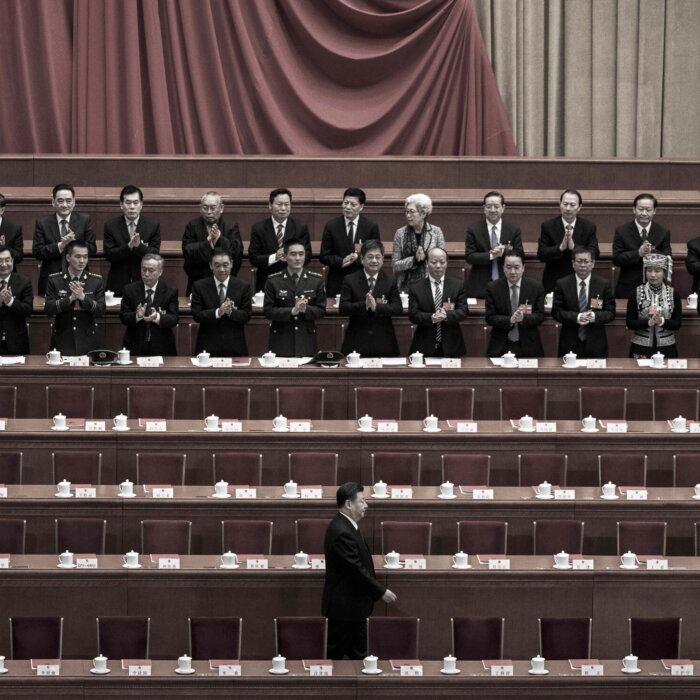
Xi made his remarks during a “group study session” of the Political Bureau of the CCP’s Central Committee.Was there any dissent? Or, to phrase it more accurately, was any CCP apparatchik present foolish enough to risk his career—or health—by questioning the claims of “Xi Dada” (an affectionate nickname for Xi)? Of course not, as those remarks reinforce the CCP’s never-ending quest for political and moral legitimacy and total control over every element of Chinese society forevermore—in this case, by pushing and reemphasizing internal Party discipline (through training and indoctrination), ideological purity (as interpreted only by the Central Committee), and government effectiveness (while weeding out endemic corruption).
The Chinese Dream is a nationalist proposition introduced by Xi that aims to return China to its so-called historical role as a leading global power—economically, militarily, and culturally—all while reinforcing the CCP’s authority and prestige and erasing perceived historical grievances (especially China’s grievances against Japan and the United States).

That “dream” underpins all of Xi’s strategic initiatives, from the Belt and Road Initiative to the Global Security Initiative to the Global Civilization Initiative (and other such schemes), all of which are intended to lead to replacing the U.S.-led post-World War II international order with a Chinese new world order based on socialist principles that kowtows to Beijing.
The other key element of the dream is decidedly nationalistic and is aimed at boosting national pride, countering Western cultural influences, and establishing a confident, unified national identity under the CCP.
Social harmony in CCP parlance means having achieved a state of societal stability, unity, ideological conformity, and balanced social and economic development under the Party’s rule with happy people and no dissent, as well as the means and political will to enforce the CCP’s socialist vision for China. To achieve social harmony, Xi regularly resorts to sloganeering that resonates with average Chinese, including language of advocating for “common prosperity” (another term under the China Dream banner), reducing inequality, and ending corruption by Party members and non-communists alike.
The CCP’s definition of good conduct is a blend of Confucianism and socialist ideology. It involves fostering loyalty to the Party’s ideals, maintaining discipline and one’s duty to the state, and ensuring that all actions by Party members are taken in accordance with the CCP’s principles, such as so-called prosperity, democracy, civility, and harmony.
Good conduct with Chinese characteristics means actions taken for the collective good, as defined by the state and the Party, with emphasis on loyalty to the Party, national unity, and social stability. It also involves supporting all state policies (no matter how contradictory or detrimental) and avoiding and suppressing any and all dissent and criticism of communist authorities.
While the CCP focuses on the collective good, traditional Western concepts of good conduct emphasize individual rights, personal integrity, and universal ethics. These are almost completely disregarded in communist China, where individuals are required to serve the state, not the other way around.
What About Self-Governance?
Self-governance in China differs greatly from the Western concept of self-governance. What Xi means by “improving self-governance of the Party” involves internal actions to maintain the CCP’s (and Xi’s) authority and moral legitimacy. Everything else is a distant second. It is certainly not about Western concepts such as individual autonomy or decentralized power.The Chinese variant is conducted through top-down Party control, with self-governance occurring within Party-approved frameworks, such as village elections or grassroots consultations that are carefully managed for public consumption by Party apparatchiks. This means that the 7 percent of the Chinese people who are Party members effect self-governance with Chinese characteristics on behalf of the general population.
The CCP allows eight minority political parties (officially termed democratic parties) to exist. This is what passes for democracy with Chinese characteristics. However, those parties are operated under the CCP through the Chinese People’s Political Consultative Conference and have virtually no input into the self-governance of the Party about which Xi pontificates. Those minority parties are part of the notorious United Front Work Department; their leaders are appointed by the CCP’s United Front Work Department and they are required to support the CCP’s leading role and the policies put forth in local governments and the National People’s Congress, the country’s rubber-stamp legislature.
The minority parties themselves only represent a fraction of the Chinese population; the largest is the China Democratic League, which had a membership of nearly 357,000 people as of 2023. Thus, the facade presented by these minority democratic parties, which are thoroughly penetrated and controlled by the CCP, is doubly ironic.
The reality of the CCP’s authoritarian controls undermines the lofty claims about “self-governance” made by Xi and his understudies. The 7 percent of the Chinese who are CCP members are the only people able to practice a bastardized form of self-governance; the rest of the people are nonparticipant observers and victims of Party policies aimed at perpetuating the authority of the CCP to rule China. The collective good about which the communists preach means the collective good of the Party, not the good of the Chinese people as a whole.
The Chinese people will only be able to employ the civilized concepts of self-governance that protect individual rights, personal integrity, and universal ethics if the CCP is swept into the dustbin of history. For the Chinese people and the world, the sooner that happens, the better.