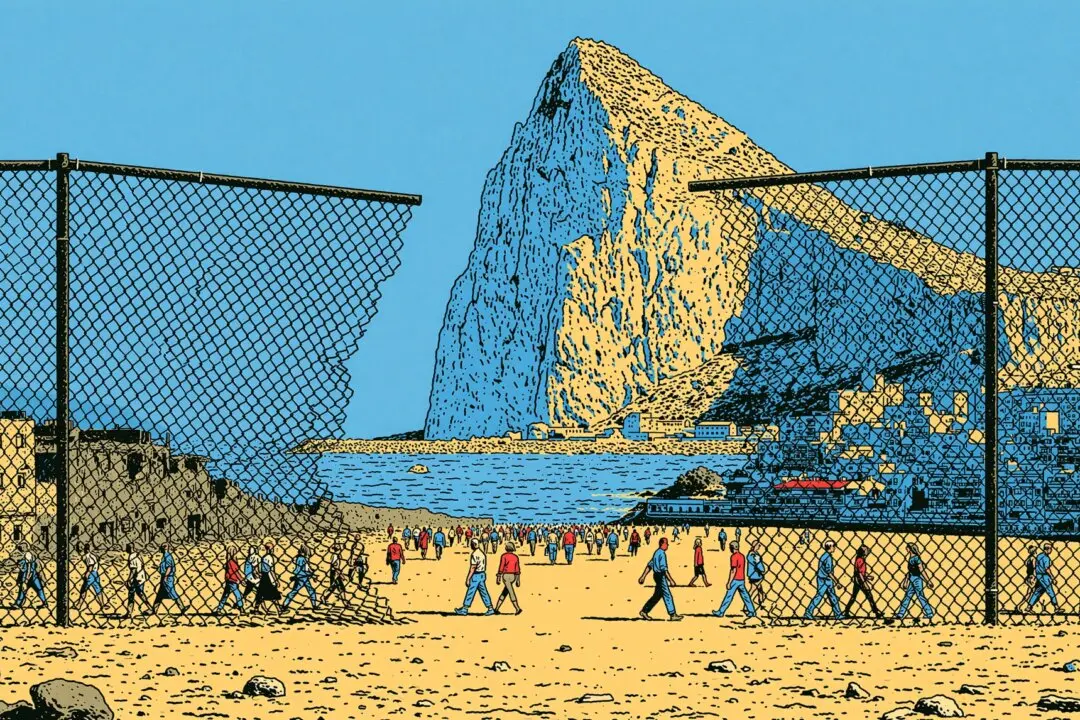
Ever since Britain voted to leave the EU in 2016 in a referendum dubbed “Brexit,” Gibraltar has been in limbo. A British Overseas Territory on the southern tip of the Iberian Peninsula, the Rock (as it’s commonly known, after its most salient geographical feature) presented formidable problems. One major challenge was finding a solution that respected the wishes of Gibraltarians, 96 percent of whom voted to remain in the EU; another was ensuring that the 15,000 people who cross the border with Spain daily (10,000 of them Spaniards who work in Gibraltar) would not face massive queues at passport control. But the governments of the UK, Spain, and Gibraltar had drawn political red lines they insisted could not be crossed. Negotiations sometimes became hostile or stalled completely. A lasting agreement appeared impossible.
The latest group of representatives deserve credit for swerving the divisive debate about sovereignty, and focusing instead on Gibraltar’s border with Spain (and now the EU). Gibraltar’s chief minister Fabian Picardo and the EU’s trade commissioner Maros Sefcovic both hailed the agreement as “historic,” while the UK’s foreign secretary David Lammy said it cleared up “the last major unresolved issue from our decision to leave the EU.” Even if that proves true (which seems unlikely), the new deal won’t end the historical dispute over Gibraltar, which has been running intermittently for more than three centuries. Spain’s Socialist prime minister, Pedro Sánchez, praised the new accord, but added that Spain had no intention of renouncing its “claims to [Gibraltar].” It was a rare moment of alignment between Sánchez and the opposition leader, Alberto Feijóo, who said that the Conservative People’s Party (PP) would also “continue to demand sovereignty over Gibraltar.”
But instead of being praised, the Spanish government has been accused of surrender. José García-Margallo, Spain’s Conservative minister of foreign affairs between 2011 and 2016, called the new deal an “absolute renunciation” of Spanish claims to the Rock. According to Ángel Gordillo Moreno, a Vox representative in Spain’s upper house, “any agreement that doesn’t contemplate the complete reintegration under Spanish sovereignty of that territory is illegal, illegitimate and unjust” (again, Gibraltar is probably the only issue on which the Socialists agree with a right-wing party that they routinely—and mistakenly—label as “fascist”).


Spain might yearn for the return of the Rock, but Gibraltarians have no desire to live under Spanish jurisdiction. In a 1967 referendum, 99.64 percent of the population rejected the idea. Placing Gibraltar under joint sovereignty between Spain and the UK—the second-best option, as far as the Spanish government is concerned—was also put to a popular vote in 2002; again, it was opposed by an overwhelming majority of almost 99 percent. The Gibraltarian Constitution of 1969 guarantees that sovereignty cannot be transferred from the UK—to Spain or any other nation—against the democratically-expressed wishes of Gibraltarians, which are clearly to remain a self-governing part of Britain, independent in all respects except defense and foreign policy. This is arguably the only arrangement that preserves what is most important to Gibraltarians: their political autonomy, as reflected in the territory’s distinct cultural identity, comparable to, yet different from, those of both Britain and Spain.
By invoking historically loaded terms such as “surrender,” hardline factions in both Spain and the UK fail to appreciate what’s actually best for Gibraltarians, or for Spaniards who work on the Rock. Both groups would have suffered from ongoing uncertainty over Gibraltar’s post-Brexit status or, in the worst-case scenario, from a hard border; and both will benefit from the new arrangement. The only losers are adherents of the historical approach, for whom Gibraltar is either fully British or fully Spanish—politicians supposedly campaigning on behalf of a population that identifies as neither.