



Canada is entering a period of accelerated defence investment. The new federal government has committed to NATO spending benchmarks, and operational commanders must deliver tangible capabilities quickly. Nowhere is the gap more visible than in the Arctic, where maritime awareness remains fragile despite its centrality to sovereignty, security, and alliance credibility.
The threat posed by Russia, China, and the weakening of the rules-based order highlight the urgency of deploying sensing capabilities in the region—capabilities that can offer persistent maritime awareness beyond the line-of-sight, complementing patrols and force presence.
The Gap in Today’s Toolkit
Commanders face a puzzle of partial solutions:- X-band radars: precise but limited to line-of-sight; impractical to cover the exclusive economic zone (EEZ).
- Satellites: valuable but constrained by revisit times, weather, and cost.
- A-OTHR: a huge investment; excellent for long-range detection of airspace, but not for monitoring surface vessels.
Canada’s Hidden Asset: 35 Years of World Leadership
Canada’s High-Frequency Surface Wave Radar capability reflects more than three decades of investment and development, led by Raytheon Canada in close partnership with the federal government. This foundation created a world-class radar technology and proved its operational maturity first at Hartlen Point, Nova Scotia, and most recently at Cape Race, Newfoundland.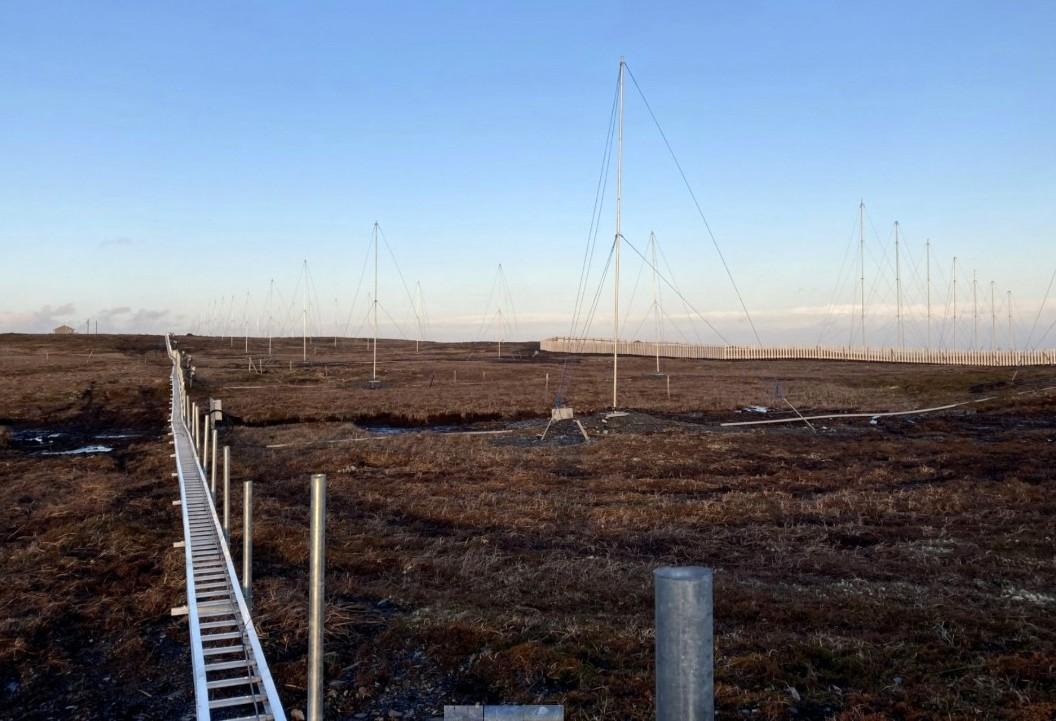
Unlike conventional radars limited to line-of-sight, HFSWR uses seawater’s conductivity to bend radio waves along the ocean surface, detecting ships out to the full 200 nautical miles (350 km) of Canada’s EEZ.
Rapid Deployment Pathways
The urgency of today’s defence environment requires capabilities that can be fielded quickly. HFSWR is uniquely suited to meet that demand:- Deployment in weeks to a few months: reactivate existing facilities like Cape Race and Hartlen Point.
- Deployment in 12–18 months: establish new arctic sites on current National Defence facilities.
- Scalability: a handful of sites can cover vast approaches and direct aircraft and patrol vessels where they are most needed.
Strategic Relevance for Canada
The benefits extend far beyond technology:- Arctic sovereignty: Persistent surveillance is the foundation of sovereignty. Without it, presence and enforcement are reactive at best. With it, Canada can demonstrate control over Arctic waters in real time.
- Alliance credibility: Closing northern gaps strengthens NATO and NORAD contributions.
- Civil-military synergy: Alongside the Department of National Defence, HFSWR supports Coast Guard missions—search and rescue, fisheries, interdiction, environmental stewardship.
- Canadian innovation: A home-grown, ready-to-deploy solution signals sovereignty and technological leadership, while creating significant export potential as suggested by Prime Minister Carney.
Protecting the Northwest Passage
A key challenge for Canada is to exert its sovereignty in the Arctic and to ensure vessels transiting its waters do not threaten Canadian safety or the environment. The entrances to the Northwest Passage on the east and west coasts are the choke points for this traffic. X-band radars with 10–30 nautical mile range cannot fully monitor across these entrances. A small number of HFSWR systems can.Cost and Life Cycle
Though not the primary argument, cost matters. HFSWR delivers wide-area coverage at a fraction of the expense of aircraft patrols, with minimal personnel needs, remote operation, and long service life. In an era of rising budgets, it represents visible capability without multi-billion-dollar price tags.Now is the Time to Act
Canada has made a public commitment to increase defence spending, to meet NATO obligations, and to secure the Arctic. The challenge is not whether to spend, but how to spend wisely and rapidly.High Frequency Surface Wave Radar is not a concept on a whiteboard. It is Canadian-developed, Canadian-owned, operationally proven, and available now. With existing assets ready to be deployed in weeks or months, and new Arctic installations feasible in 12–18 months, HFSWR offers Ottawa a rare opportunity: to deliver real capability in the near term, while reinforcing both sovereignty and alliance credibility.
This is not about choosing between A-OTHR and HFSWR. It is about building a layered radar toolkit that gives Canada the strategic depth of A-OTHR and the persistent sovereignty coverage of HFSWR. Together, they form a continuum of awareness from the nearshore to the continental edge.
For Canada’s operational commands, Coast Guard, and policymakers, the message is clear: The technology is proven, the need is urgent, and the time to act is now.