This copy is for your personal, non-commercial use only. Distribution and use of this material are governed by our Subscriber Agreement and by copyright law. For non-personal use or to order multiple copies, please contact The Epoch Times Reprints.
A Washington–New Delhi Alliance Is a Perfect Storm Against China, for India
As China’s trade with the U.S. shrinks and its economic problems deepen, India’s trade and strategic ties with the U.S. are set to expand significantly.
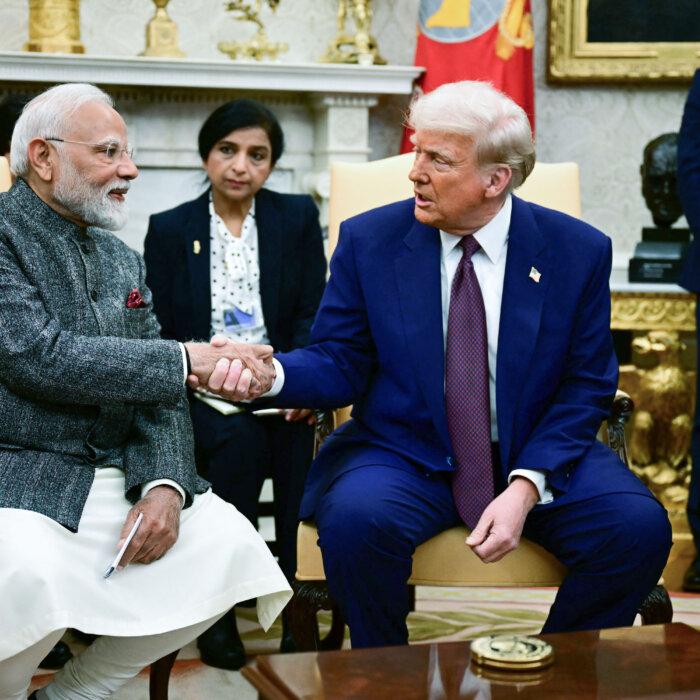
U.S. President Donald Trump shakes hands with Indian Prime Minister Narendra Modi during a meeting in the Oval Office in Washington on Feb. 13, 2025. Jim Watson/AFP via Getty Images
As China’s trade with the United States continues to diminish, Beijing is anxious to stabilize trade relations with Washington—and has done so, at least for a while. But how long will any trade agreement last if the Chinese regime continues to violate it?
Beijing’s Jitters: A Shifting Trade Landscape
The harsh reality is that the Chinese Communist Party (CCP) is aware of its precarious position. On the one hand, China desperately needs to stabilize its trading relationship with the United States. On the other hand, it can’t live up to agreements because it has to cheat on trading terms, as structural weaknesses prevail in driving the economy downward. As a result, the trust level between Washington and Beijing is low.
Lack of trust isn’t the only factor against China, of course. The Trump administration’s antipathy toward the Chinese regime as a strategic rival is well understood, and that’s unlikely to change. Furthermore, direct foreign investment is dwindling, and foreign companies are exiting China as quickly as possible.
Many of them are relocating to India. The list of companies choosing India over China is significant and has been steadily growing, even before U.S. President Donald Trump won a second term in office. In 2024, dozens of major companies, including Dell, HP, Intel, Samsung, LG Electronics, Nike, Hasbro, Blizzard Entertainment, Stanley Black & Decker, and many more, have already relocated their factories to India or plan to do so in the near future.
That trend isn’t likely to change, either. According to a 2024 survey by the American Chamber of Commerce in China, 45 percent of U.S. companies in China have initiated plans to diversify their suppliers outside of China, while 38 percent are considering doing so. The writing is on the Great Wall of China: The trade gap is widening, not narrowing. Their days of leading the world in manufacturing and the strategic clout that comes with it are on their way out.
India’s Big Opportunity With the US
In the meantime, to Beijing’s great concern, India is strategically pivoting to fill that widening gap by expanding its trading relationships with the United States. The United States is equally intentional in steering trade away from China and toward India.
India’s intentions are aligned with those of the United States. In April, U.S. Vice President JD Vance visited India to establish a broader bilateral trade agreement between the two countries. The goal is to increase the current trade of $190 billion to $500 billion by 2030.
The growing U.S.–India relationship extends beyond trade. Prior to Vance’s visit, U.S. Director of National Intelligence Tulsi Gabbard was in India for a geopolitical conference. Perhaps even more telling, Indian Prime Minister Narendra Modi was among the first world leaders to visit with Trump after he returned to the White House. At the time, Modi mentioned a “mega partnership” with the United States and began negotiations to address Trump’s tariffs on Indian products.
Notably, Modi had already reduced tariffs on some U.S. goods before he met with Trump. That may help explain why Indian officials have described trade negotiations as “very active” and “intense,” supporting the perception of a fast-track trade deal being worked out between the United States and India.
The Strategic Ripple Effects
China may be unaware of these developments and can already see several strategic ripple effects unfolding. As noted, the United States is keen on “friend-shoring,” or restructuring global supply chains out of China and into India. One additional impact may be diminishing Beijing’s ability to support Russia in its war against Ukraine.
Although a trade reset of sorts appears to be in place between Washington and Beijing, the trend of businesses leaving China en masse remains undeniable. Apple has announced that it will relocate up to 25 percent of its iPhone production from China to India by 2025, and a significant portion of its U.S. phone production will also be moved out of China.
But other ripples are occurring as well.
A closely related issue is China’s dominance of the rare-earths market. Like the United States, India is dependent on China’s rare-earth monopoly. One of Modi’s policy shifts is to focus on India’s potential to increase its rare-earth production capacity and potentially become a key supplier to the United States. That would be a huge blow to China and a big win for both India and the United States.
Another significant issue is India’s increasing involvement in U.S. defense planning in the region. India will play a growing role in U.S. security arrangements in the Indo-Pacific region.
Beijing’s Double-Edged Response
In response to these developments, the CCP is getting creative. For example, in contrast to the trade barriers that it put up after the Galwan incident involving exchanges between the Chinese and Indian militaries in a disputed region, Chinese state media has floated the possibility of reducing trade restrictions and encouraging engagement between China and India. That’s a direct result of India’s rising profile in the region and engagement with the United States.
Perhaps more importantly, China’s ambassador to India recently pledged to stop dumping Chinese products into Indian markets, ease trade deficits, and possibly even remove tariff and non-tariff barriers on Indian imports. This announcement comes alongside resumed diplomatic dialogue, high-level engagement, direct flights, and even the potential for enhanced access to rare-earths for India.
On the flip side, in an effort to counter the friend-shoring trend, China is restricting machinery exports and equipment transfers to India in order to minimize its ability to handle incoming manufacturing demands. Beijing is also warning New Delhi that its deeper engagement with Washington—both in trade and in strategic alliances such as the Quad, as well as significant cooperation in evolving U.S.-led defense postures—could threaten its cordial relationship with China.
Another card for the CCP to play would be to increase support for Pakistan, India’s nuclear-armed regional rival. That’s a threat with a very thin veil, but unlikely to work because both Pakistan and India are nuclear-armed nations. Beijing’s support doesn’t fundamentally alter the status quo.
Will any or all of these potential countermeasures by Beijing be enough to sway New Delhi away from its tilt toward Washington? Will the Chinese regime be able to thwart India’s rise, even as its economy continues to collapse?
Not likely.
China is facing a multifront storm, mainly of its own making through the CCP’s policies, and that storm is only getting worse. To carry the metaphor, it’s a perfect storm against China and for India.
Views expressed in this article are opinions of the author and do not necessarily reflect the views of The Epoch Times.