It began with a school bullying incident in Jiangyou, a small city in southwestern China. It ended with chants of “Down with the Communist Party” and “Xi Jinping step down.”
The mass fury erupted after a video went viral showing a 14-year-old girl being bullied by several school girls, and her family’s pleas for justice went unanswered. What could have been a straightforward local dispute escalated quickly—partly because of the authorities’ heavy-handed response—into an openly political act of defiance against the Chinese Communist Party (CCP).
Analysts say the incident has gone beyond a local grievance. Instead, it has become an example of the deep structural crisis gripping Chinese society, where political power shields itself from accountability, the law bends to serve the powerful, and ordinary people have no safe or trusted channel to seek redress.
Authorities’ Indifference
At first, the case was a tragic but familiar story: A child is bullied, the public sympathizes, and calls grow for accountability. People demanded the truth, justice for the girl, and punishment for the perpetrators. But the authorities’ cold and condescending attitude changed everything.From Seeking Justice to Protesting Against the CCP
When demonstrators took to the streets, the CCP didn’t try to defuse tensions. Instead, authorities deployed armed police, who beat protesters and used pepper spray. Detainees were reportedly hauled away in livestock trucks.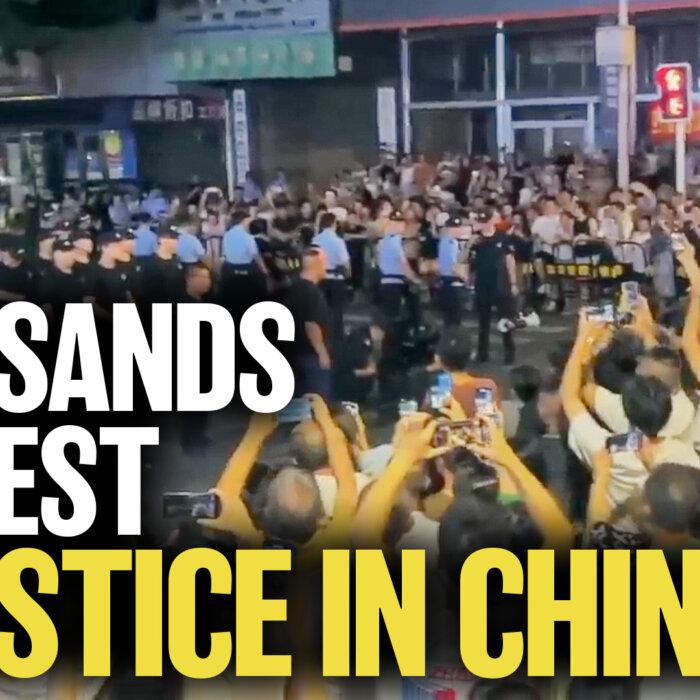

These acts of violence had unintended consequences. Protesters began chanting political slogans such as “Down with the Communist Party” and “Xi Jinping step down.”
One man filming the chaos remarked bitterly: “This is how they serve the people—beating citizens and carting them away by the truckload. But when the people wake up and unite, they can’t be defeated.”
Is Beijing Afraid?
Inside the CCP, the incident has reportedly been dubbed the “Jiangyou version of the Weng’an incident”—a reference to the 2008 uprising in Guizhou Province triggered by the alleged rape and murder of a teenager.The authorities reportedly refused to conduct a complete autopsy as requested by the deceased victim’s family. It was later learned that the three suspects—who were released within eight hours of being detained—were connected to the local police and officials. In response to the local government’s cover-up of the incident, at least 10,000 people took to the streets and torched the police station and government buildings. Images of the unrest quickly spread online.
But the Jiangyou incident is different: It appears to have rattled the CCP.
‘People Wake Up and Unite’
For years, the CCP has relied on censorship and brute force to maintain stability, or rather, suppress and smother public dissent. But the Jiangyou incident shows the limits of that playbook. The locals no longer feared. Spectators didn’t just watch—they joined in. Chants once considered taboo rang out openly. Videos of the protests spread quickly online, drawing solidarity from across the country.China observer and political commentator Cai Shenkun noted that the bullying incident proves that ordinary people’s sense of justice is awakening. Confronted with injustice, more people are choosing to act instead of remaining silent. That spark of solidarity—once ignited—can resonate far beyond a single city.
When a government ignores justice and turns its police against its own people, more and more citizens will take to the streets. As one protester said in video footage of the incident, “when the people wake up and unite, they can’t be defeated.”
In the grand context of history, Jiangyou may appear as just another name on the map. But the anger, the awakening, and the defiance it represents could signal the beginning of a new chapter in China’s story.