



Aug. 8, 2026, marked the 51st anniversary of the collapse of the Banqiao Dam in China’s central Henan Province—an incident that killed roughly 230,000 to 240,000 people and remains, by any measure, the deadliest dam failure in recorded history.
Yet the day passed in near-total silence in China. The state media said nothing. There was no memorial, no acknowledgment, no mention of the quarter-million lives lost.
Confucius said: “The past is studied in order to understand the present.”
But the Chinese Communist Party (CCP) has consistently chosen amnesia over reckoning—burying the story along with the people who died so that people forget both the decision-makers’ grave errors and the greater flood risks that large reservoirs still pose today.
‘The Largest Known Dam Disaster in Human History’
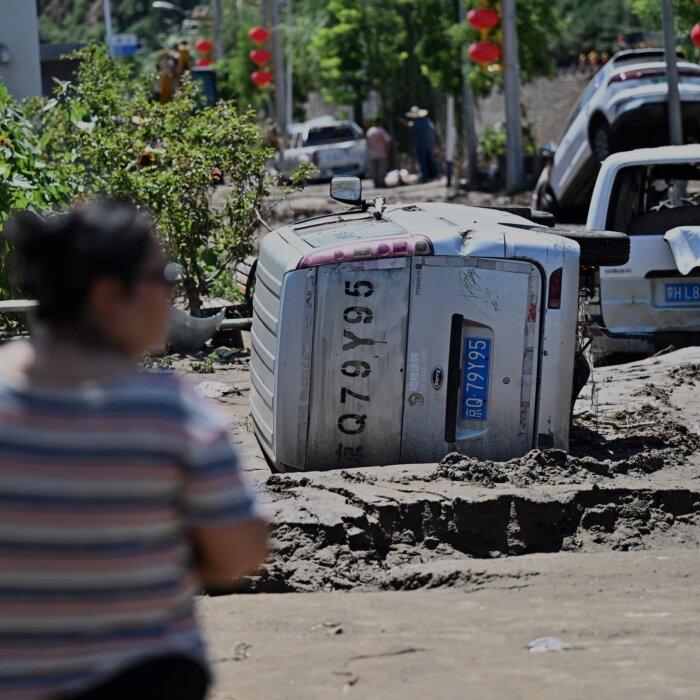
At 1 a.m. on Aug. 8, 1975, the Banqiao Dam gave way. An estimated 600 million cubic meters of water surged downstream in a wall higher and faster than any natural flood, destroying bridges, roads, railways, villages, and towns in its path.
The flood submerged 29 counties and cities, swallowed roughly three million acres of farmland, destroyed 6.8 million homes, and left over 10 million people affected.
A hundred-kilometer stretch of the Beijing-Guangzhou railway was torn apart, its rails twisted beyond recognition.
Floodwaters traveled as far as Anhui province, submerging the town of Linquan, which is about 130 miles downstream from the dam.
Human Rights Watch, in a 1995 report, described the Banqiao collapse as “by far the largest known dam disaster in human history.”
‘Man-Made Catastrophe’
Banqiao Dam was built on the upper Ru River in Henan’s Zhumadian region, beginning construction in 1951 with Soviet technical guidance and a workforce of more than 42,000 laborers.
It was completed in 1952—one of five major reservoirs the CCP built across the Huai River basin with Soviet assistance as part of a sweeping flood-control campaign.
None of these projects, however, were built on reliable meteorological or hydrological data; the figures handed to Soviet engineers were largely rough estimates.
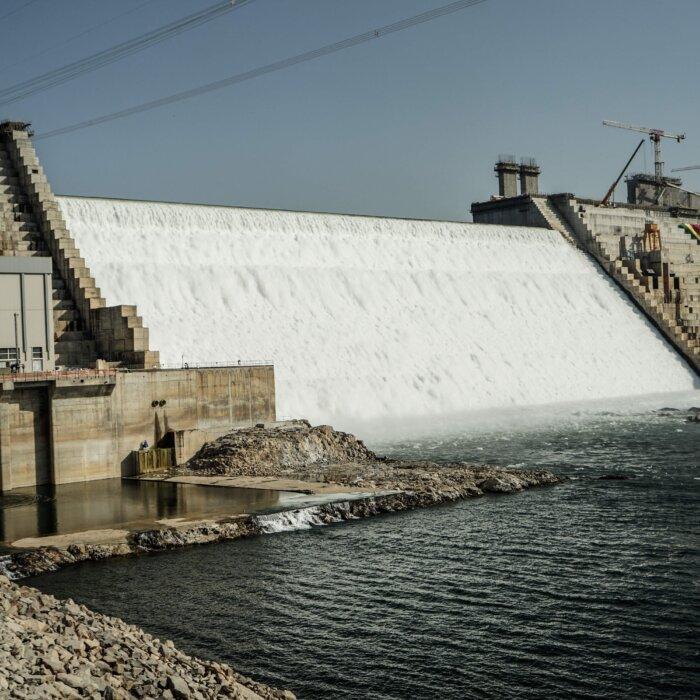
According to the U.S.-based Association of State Dam Safety Officials (ASDSO), the dam was designed with a clay core and sand shell, standing roughly 80 feet high, with a normal storage capacity of 399,000 acre-feet plus another 304,000 acre-feet reserved for flood control, and five sluice gates capable of discharging up to 62,000 cubic feet per second.
Cracks appeared in the dam body and sluice structures almost immediately, the result of construction and design flaws.
In 1956, the dam underwent reinforcement and was raised nearly 10 feet to meet Soviet engineering standards. After that, it was promoted as essentially indestructible, earning the nickname “Iron Dam” for its supposed ability to withstand a thousand-year flood.
That reputation collapsed—literally—on Aug. 8, 1975.
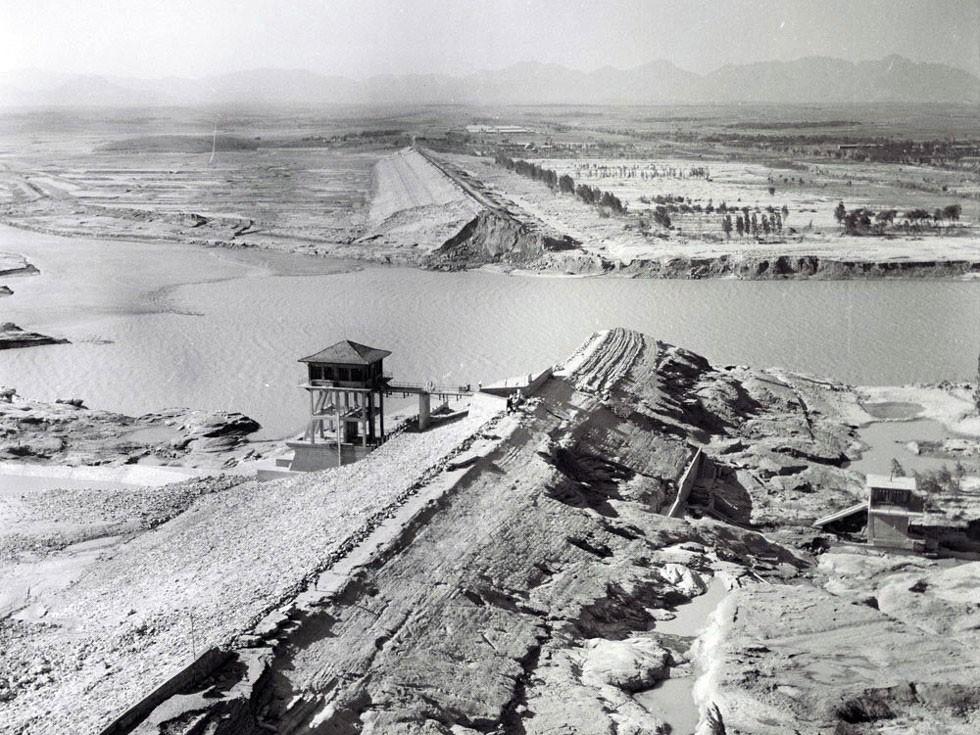
When Typhoon Nina struck on Aug. 5, 1975, it brought rainfall authorities described as exceeding “one-in-a-thousand-year” levels, and reservoir levels climbed rapidly toward capacity. Even so, the three days between the onset of heavy rain and the dam’s collapse offered a real window for evacuation—one Chinese authorities failed to use.
A 2015 report by the U.S. Bureau of Reclamation laid out the timeline in stark detail: water reached the crest of the dam by 9:30 p.m. on Aug. 7, topped the wave-protection wall roughly ninety minutes later, and the breach itself began at 1:30 a.m. on Aug. 8, fully forming over the next five and a half hours.
Interviews conducted years later paint a picture of paralysis on the ground. Chen Xubin, a former reporter for the CCP’s mouthpiece Xinhua News Agency, wrote in a 2012 retrospective that flood-response personnel recalled an emergency stockpile with almost nothing in it—no shovels, no sandbags, not even basic explosives, just a handful of wooden sticks and a few practice hand grenades.
Separately, state-run media China Energy News published an account from Hu Defeng, a technician who managed the reservoir’s irrigation system at the time, describing a chain of command too paralyzed by uncertainty to act: operating procedure called for releasing water, he said, but no one above him would give the order, and officials hesitated to fully open the spillway gates even as the danger became obvious to those on-site.
ASDSO’s own case study on the disaster is blunt in its conclusion, stating plainly that the failure was an entirely man-made disaster, pointing to inadequate safety margins in the original design, political pressure during the Great Leap Forward to cut costs by underestimating flood risk, and a communications breakdown that left officials unable to coordinate a response.
Former Water Resources Minister Qian herself later acknowledged significant institutional failures: complacency born from the fact that no large dam had ever failed before; safety standards and flood calculations that were never adequately researched; poor oversight of reservoir management; and no clear protocols for emergency communication, backup power, or warning systems.
At the most critical moment, she claimed, communications between Banqiao and downstream authorities broke down entirely, leaving commanders unable to act.
Rebuilding to Bury the Truth
In the aftermath, Chinese authorities moved quickly to reconstruct Banqiao Dam on the same site—before the causes of the collapse had even been fully investigated. The apparent goal was to let the reservoir’s waters submerge not just the ruins, but the memory of the disaster itself: the government’s failures, and the risks still posed by large dams built without adequate safeguards.
The true death toll from the collapse was suppressed for years, leaving foreign observers largely unaware of the disaster’s real scale.
Reconstruction resumed in 1987 and passed state inspection in June 1993. But the rebuilt dam has proven no more reliable than the original.
It was officially classified as a hazardous structure in both 2012 and 2018, triggering two separate rounds of emergency reinforcement. According to the Zhumadian Municipal Water Resources Bureau, the most recent reinforcement project began in 2019, cost roughly 199.7 million yuan, and passed unit-level completion inspection in March 2022.
Yet the story doesn’t end there. In July 2025, the Huaihe River Commission—a body under the Ministry of Water Resources—issued a brief notice stating that reinforcement work on Banqiao Dam had passed final completion inspection on May 15, 2025.
Taken together, these two announcements suggest reinforcement work continued well into last year. What exactly needed fixing, or what safety issues remained, has not been disclosed to the public.
An Unanswered Question
More than three decades after its reconstruction, Banqiao Dam has never achieved lasting safety. Its problems have surfaced again and again, addressed each time with reinforcement projects whose full scope the public is never shown.
That leaves an uncomfortable question, one Chinese authorities have shown little interest in answering: is the flaw in the dam itself, in the Soviet-era engineering that shaped its design, in the political era that built it, or in the totalitarian system that keeps rebuilding without ever fully confronting what went wrong?


