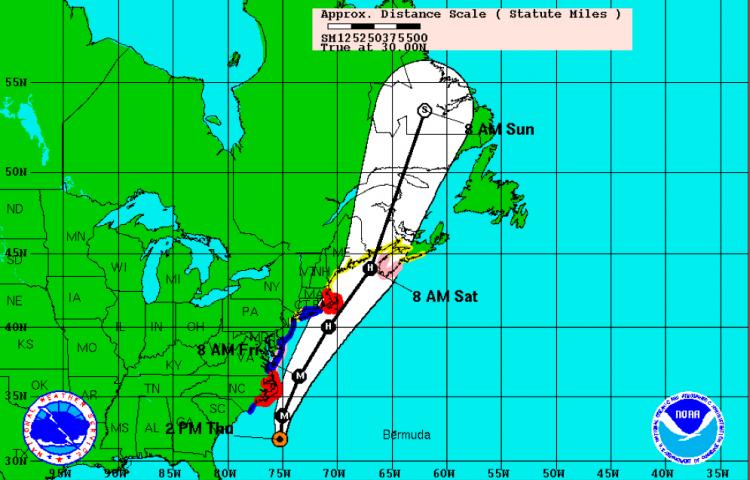
As Hurricane Earl spins near North Carolina, the Canadian Hurricane Centre has issued on Thursday a hurricane watch for parts of Nova Scotia and a tropical storm watch for parts of New Brunswick.
The Category 3 Hurricane Earl is currently situated about 365 km south of Cape Hatteras, N.C. It is spinning toward North Carolina at 30 km/h with maximum sustained winds of 205 km/h, according to U.S. National Hurricane Center.
As Earl travels northward, it will weaken to a Category 1 storm by the time it crosses the Maritimes on Saturday, according to Environment Canada. A Category 1 storm—the lowest category on the Saffir-Simpson Hurricane Wind Scale—can bring “very dangerous winds” and produce “some damage.”
Environment Canada will assess the details of public impact later Thursday night.
“It is very likely that high wind and heavy rain will affect the Maritimes on Saturday,” Environment Canada warned. “Rainfall amounts in the 40 to 70 mm range are possible near and to the left of Earl’s track and wind speeds possibly gusting as high as 130 km/h to the right of the track on Saturday.”
Some offshore buoys have reported longer swells—rolling waves and higher waters—caused by Earl. This swell is expected to reach the cost of Nova Scotia Thursday night.
The expected arrival of Earl will bring to the Maritimes high waves, pounding surf, heavy rainfall, high water levels, and gusty winds.
In the United States, President Barack Obama declared on Thursday an emergency in North Carolina; the North Carolina National Guard is deploying 80 troops to alleviate the situation.
The officials have issued a mandatory evacuation for 30,000 residents and visitors on Hatteras Island and 5,000 people on Ocracoke Island, which is only accessible by ferry and airplane.
The Category 3 Hurricane Earl is currently situated about 365 km south of Cape Hatteras, N.C. It is spinning toward North Carolina at 30 km/h with maximum sustained winds of 205 km/h, according to U.S. National Hurricane Center.
As Earl travels northward, it will weaken to a Category 1 storm by the time it crosses the Maritimes on Saturday, according to Environment Canada. A Category 1 storm—the lowest category on the Saffir-Simpson Hurricane Wind Scale—can bring “very dangerous winds” and produce “some damage.”
Environment Canada will assess the details of public impact later Thursday night.
“It is very likely that high wind and heavy rain will affect the Maritimes on Saturday,” Environment Canada warned. “Rainfall amounts in the 40 to 70 mm range are possible near and to the left of Earl’s track and wind speeds possibly gusting as high as 130 km/h to the right of the track on Saturday.”
Some offshore buoys have reported longer swells—rolling waves and higher waters—caused by Earl. This swell is expected to reach the cost of Nova Scotia Thursday night.
The expected arrival of Earl will bring to the Maritimes high waves, pounding surf, heavy rainfall, high water levels, and gusty winds.
In the United States, President Barack Obama declared on Thursday an emergency in North Carolina; the North Carolina National Guard is deploying 80 troops to alleviate the situation.
The officials have issued a mandatory evacuation for 30,000 residents and visitors on Hatteras Island and 5,000 people on Ocracoke Island, which is only accessible by ferry and airplane.