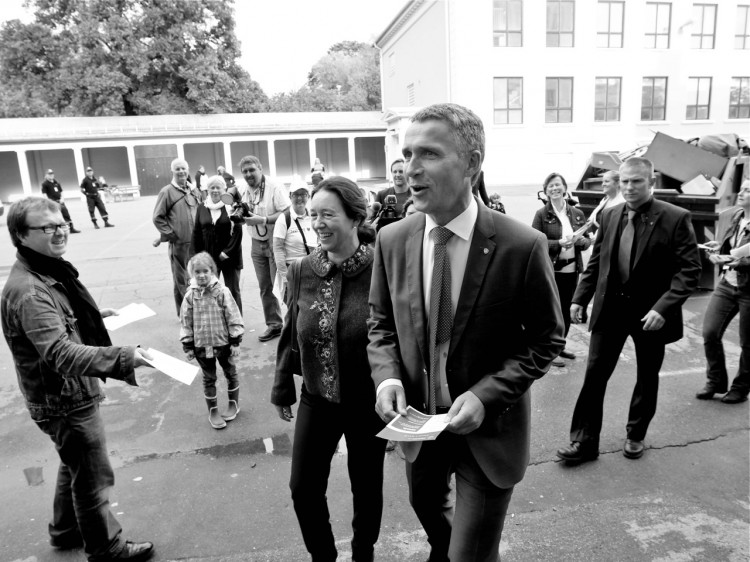
Municipal and regional elections in Norway usually don’t attract much interest outside the country, but after the horrific terrorist attacks of July 22 that directly targeted the ruling party, this local election took on a deeper significance.
On the eve of the election, politicians, voters, and experts reflected on the election that brought Norwegians together in support of their open, democratic society.
Two parties were especially in focus: The ruling Labor Party, whose Youth League was the target for the island massacre, and the right-wing populist Progress Party that shooter Anders Bering Breivik once belonged to.
The big winner in the elections, however, turned out to be the Conservative Party, which improved their support by 9 percent.
In many municipalities they have ruled in coalition with the Progress Party, and analysts believe that many Progress Party voters went over to the Conservatives.
The Labor Party was also successful. In the month following the attacks, they peaked in the polls, although have lost some of that support since. Still, they were the second-most successful at the polls compared to last election, increasing their support by about 2 percent, with 94 percent of votes counted.
One of the Progress Party’s main issues has traditionally been their strong anti-immigration stance. Since Breivik made it clear he was motivated by a strong hatred of the multi-cultural society—particularly Islamophobia—and being strongly anti-immigration, it has been difficult for the Progress Party to highlight these issues this time around.
The Progress Party made its worst election in 20 years, losing almost 7 percent of their support nationally and much more than that in certain regions.
The Epoch Times spoke to some Norwegians outside the election hall in the Sagene district of Oslo.
Robert Bauck Hamar is himself running for a seat in the local parliament in Oslo, representing the Conservative Party. He commented on the way the attacks had influenced the election campaign:
“In the beginning, it was a bit different than usual, but now it seems that things are back to normal. It will be interesting to see if the voter turnout will be bigger this year as a result of the attacks,” he said.
After 55 percent of the votes had been counted, however, statistics indicated that the voter turnout was almost exactly the same as the last election in 2007.
Student Johan Leonhardsen thought the ruling Labor Party would win in Oslo:
“I think the Labor Party has gained some support at the expense of all the other parties [because of the attacks]. I think there have been some that vote for them out of sympathy,” he said.
Generally, the tone of the election campaign has been one of respect, with little negative campaigning or personal attacks.
“There have been fewer personal attacks due to the terrorist attacks. Personal attacks often lead to resentment among the voters toward politicians, and we’ve seen absolutely none of that in this campaign. It’s not so strange, since politicians have suddenly become heroes,” election analyst and scholar Frank Aarebrot told Norwegian newspaper Aftenposten.
Aarebrot referred to the way politicians across the spectrum in Norway have emphasized the need to counter the terrorist attacks by cherishing and strengthening their open, democratic society. In the process, they have come across as both very human and very statesmanlike at the same time.
When New Tang Dynasty TV interviewed Trine Skei Grande, the leader of the Liberal Party last week, she expressed a similar feeling.
“We feel that people are more polite to politicians. I think that people feel that they are more happy that they live in an open democracy like Norway.”
She also noted that more Norwegians joined political parties after the attack, and expressed pride in the reaction of her countrymen.

However, Geir Moen, secretary general of the Progress Party, felt that the focus on the terrorist attacks and the political unity that followed had not been all positive for the election, since it has led to a lack of political debate.
Nonetheless, he did not place all the blame for his party’s disastrous election result solely on the attacks.
“We’ve had a tough year with many issues, both centrally and regionally. All of these things have influenced the result,” he told Norwegian television.
Siv Jensen, leader of the Progress Party took full blame for the poor result but praised her election workers. "Regardless of how the result turns out, the Progress Party fought hard to the end, despite the fact that we’ve had a very difficult year," she said in an election night speech to party faithfuls.