

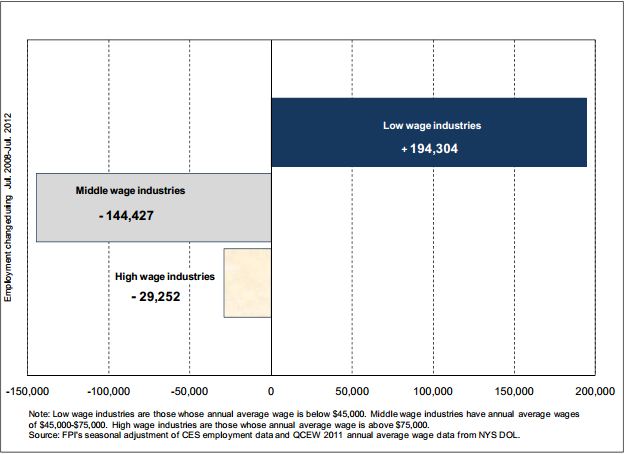
NEW YORK—Job growth in the state over the past four years has been almost entirely in low-wage jobs, according to a report by the nonpartisan Fiscal Policy Institute (FPI).
A net gain of 21,000 jobs since July 2008 is only because a net gain of 194,000 jobs in low-wage industries offset net losses in middle-wage jobs (144,000 lost) and high-wage jobs (29,000 lost).
Low-wage is interpreted as an annual salary of below $45,000, middle-wage as an annual salary of between $45,000 and $75,000, and high-wage as above $75,000.
Most of the low-wage job growth has been in the restaurant sector, in educational service jobs other than colleges, and in home health care services.
Most of the middle-wage job losses were in the manufacturing, construction, and government sectors.
High-wage job losses were mostly in the finance, insurance, and information sectors.
A relatively strong, compared to the national situation, state and city outlook after the 2008 recession has slowed down in the last year.
An average of 25,000 New York workers lost their jobs and applied for unemployment insurance each week during the first half of 2012.
Weakest Recovery Since Great Depression
Unusual circumstances have led to the weakest recovery on record since the Great Depression, according to James Parrott, FPI deputy director and chief economist.
The circumstances include “weak consumer spending due to high unemployment and high consumer debt, and because government spending is so much weaker in this recovery than in the average of the seven prior post-WWII recoveries,” Parrott said via email.