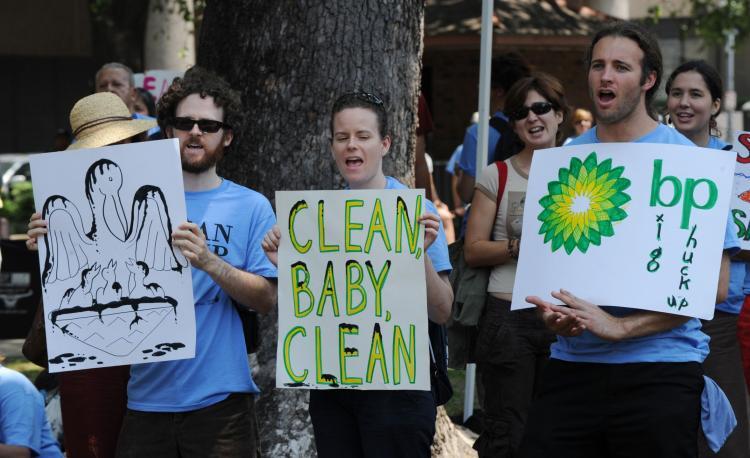
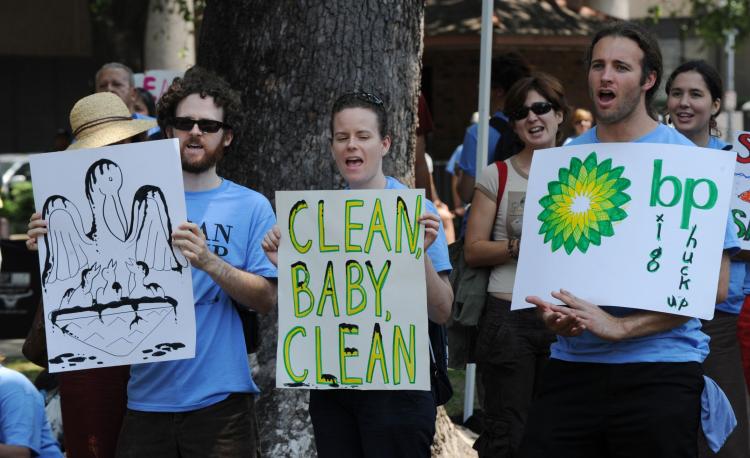
Protesters attend a rally against the BP Deepwater Horizon platform disaster off the coast of Louisiana, in New Orleans on May 8, 2010 (Mark Ralston/AFP/Getty Images)
Protesters attend a rally against the BP Deepwater Horizon platform disaster off the coast of Louisiana, in New Orleans on May 8, 2010 (Mark Ralston/AFP/Getty Images)Health Care Reform Debate
The year 2010 was a dramatic one for President Obama’s signature health care reform legislation. Starting in 2014, every American will be required by law to purchase health care coverage. Those who cannot afford coverage, defined as those for whom coverage would cost more than 8 percent of their income, or those living below the poverty line, will receive government assistance
. To make insurance more affordable, state-based exchanges are being designed to offer better plans at lower costs to individuals and small businesses. Most additional plans will be purchased from these exchanges.
The plan hit a bump on Dec. 13, when one provision of the legislation was ruled unconstitutional by U.S. District Judge Henry E. Hudson in Virginia. Hudson became the first federal judge to rule the individual mandate provision unconstitutional. Republican governors across the nation launched legal challenges as soon as the reform was passed, arguing the government does not have the authority to require individuals to purchase health care plans. At least 20 states representing a total of 14 challenges were filed. In two, federal district judges upheld the act, and cases were dismissed in the other 12.
Historic Upset of Midterm Elections
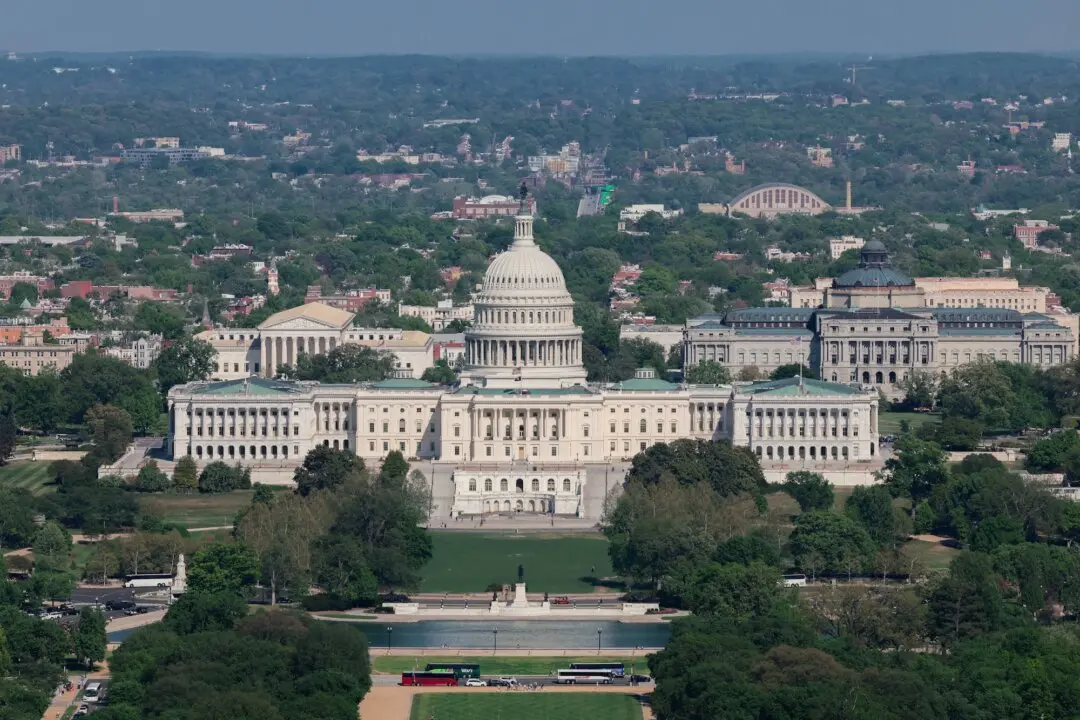
The ambitious Democratic agenda of the Obama administration was dealt a blow by the Republican victory on Nov. 2. Scores of new Republican members, about one-third of the Republican Caucus, joined the House after the midterm election. At least 35 have never held elected office before. In the 112th Congress, Republicans will take over the House, assume chairmanship of all the standing committees, and set the agenda for House legislation. Democrats managed to survive the Republican wave in the Senate, and though losing six seats, they retained a majority of 53 votes.
Political analysts predict that the Obama administration will need to adapt to the new political realities by changing approaches to major issues, including the deficit, taxes, defense, immigration, and education. Most analysts also said that despite the historical significance of the shift in power in the House, the Republican majority would not be able to impose its priorities without consent from the Democrats.
Gulf Oil Spill
The April 20 Deepwater Horizon oil spill cost 11 lives and over $6 billion. After the spill occurred, BP faced mounting costs and 145,000 claims from individuals and businesses impacted by the oil spill. BP has already paid over $319 million in response to 103,900 settled claims. The ballooning expenses includes the cost of “spill response, containment, relief well drilling, grants to Gulf states, and federal cost,” according to BP. In early June, BP, in agreement with the U.S. government, announced the establishment of a $20 billion escrow amount, money held by a third-party, to pay for claims caused by the Deepwater incident. Bringing an end to their third quarter on Aug. 9, BP made a first deposit of $3 billion to this escrow amount. BP will continue to contribute another $2 billion once and $1.25 billion each quarter. The spill had a devastating impact on wildlife, jobs, the seafood industry, and the health of the Gulf ecosystem.
McChrystal Ousted and the War in Afghanistan
Gen. Stanley McChrystal stepped down as commander of U.S. troops and NATO forces in Afghanistan, and his replacement, Gen. David Petraeus, took the reins on June 30 with a unanimous Senate vote. President Barack Obama said on June 23 that he accepted McChrystal’s resignation “with considerable regret, but also with certainty that it is the right thing for our mission in Afghanistan, for our military, and for our country.”
McChrystal resigned in shame after a widely publicized Rolling Stone article titled "The Runaway General" revealed that McChrystal was apparently at odds with members of the Obama administration on the strategy for the war. Obama praised McChrystal’s performance, but pointed out the conduct presented in the Rolling Stone article “undermines the civilian control of the military that is at the core of our democratic system.”