


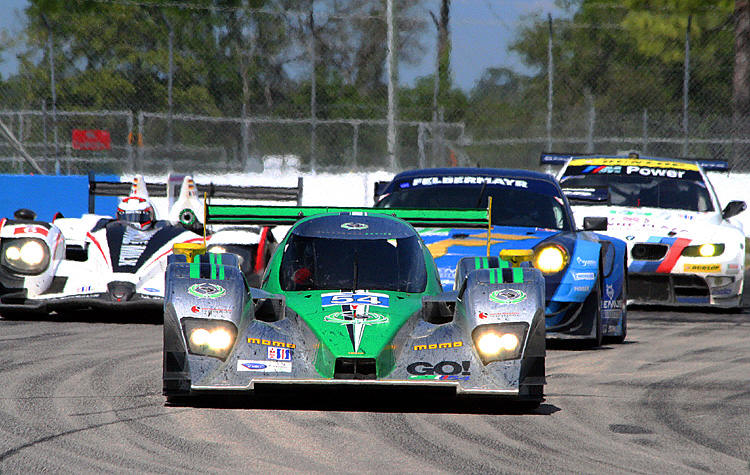
NASCAR, owner of the Grand American sports car series (Rolex Sports Car Series and Continental Tire Sports Car Challenge) has purchased the International Motor Sports Association and its American Le Mans Series, eliminating all competition within the sport.
NASCAR will formally announce the sale Wednesday morning at 10 a.m. The details of new sports car series, which should start racing in 2014, will also be announced.
Both premier series—Grand Am’s Rolex series and the ALMS—have been struggling financially. Grand Am survives because of NASCAR subsidies, and ALMS has been steadily declining in profitability. Rolex had better TV numbers (due to NASCARs’ purchase of time on Speed-TV) while ALMS had more fans but did not have a live TV presence after 2010.
The hope is that the purchase will bring together all sports car fans, teams, and sponsors into a single profitable and popular series.
No firm details have been released, but several sources, including nationalspeedsportnews.com indicate that the new series will feature Grand Am’s Daytona Prototypes as the top class, with drastically slowed ALMS LMP2 prototypes included. ALMS’s GTE class will transfer unchanged, and Grand Am’s much slower GT class will be opened up to ballasted and restricted FIA GT3 cars and ALMS GTC Porsches.
This class structure is designed to keep the DP class, which has about ten participants, plus the four or so P2 teams, along with the ALMS GTE class which provides what is generally considered the best road-racing on the planet right now, while still retaining the two dozen or so Grand Am GT teams and allowing others to join.
The deal reportedly includes the rights to the ALMS and IMSA names, all of ALMS founder Dr. Don Panoz’s hotel properties, and the rights to the lease of Sebring International Raceway and outright ownership of the Road Atlanta track.
One of the prime points of interest is whether or not the new series will conform to international sports car specifications. One of the big draws of ALMS was that its cars met the ACO rules for participation at the Le Mans 24-hour race. This meant ALMS teams could race in the world’s most important sports car race, and that cars from other ACO series could race in ALMS events.
For years the Sebring 12-Hour and Petit le Mans ten-hour races attracted the biggest international teams, and therefore attracted huge hordes of fans, while some teams stayed in ALMS because it gave them the opportunity to race at Le Mans, which is essentially the Super Bowl of sports car racing.
Best information seems to be that the international connection will be abandoned when the current contract ends after 2013.
While all this is based on nothing but leaks from insiders who are unwilling to disclose much before the official announcement, some things are certain: ALMS will be absorbed into the Grand Am Rolex series in 2014, and the fastest ALMS classes will be eliminated or drastically slowed to fit into the new framework, and the new series will operate strictly in North America to its own rules, unrelated to the worldwide sports car community.
Some insiders speculate that an entirely new fastest class will be created in 2015, to replace the DP and P2 cars which will then be at least three years old. This new class might be defined in conjunction with the ACO/FIA international rules, but at this point that is pure—though hopeful—speculation.


