


Known as Operation IceBridge, NASA’s six-year airborne glacier mapping mission is only half completed but stands to break scientific ground in the field of glaciology like no mission before.
Only three years into the largest airborne survey of Earth’s polar ice ever, the scientists have already laid important groundwork in determining glacier movement and sea level changes due to glacier melting.
Every year the survey team makes another trip over the Arctic and Antarctic to survey these ice sheets. In the end, NASA hopes the data can yield a three-dimensional view of Arctic and Antarctic ice sheets, ice shelves, and sea ice. Together with the data provided from NASA’s polar observation satellites the survey should provide scientists with a complete picture of glacier movement and mapping.
“At a time when glaciers and ice sheets are showing rapid changes, we need consistent data that shows how and why that change is happening,” said IceBridge project scientist Michael Studinger in a press release. “With three years of IceBridge data in hand, we have successfully continued the ice sheet elevation record in key areas and broken new ground in understanding the nature of the bedrock under ice sheets and the shape of the seafloor under ice shelves.”
The first Operation IceBridge flights were flown over Greenland in March and May 2009. Later that year in October and November flights over Antarctica continued the project.
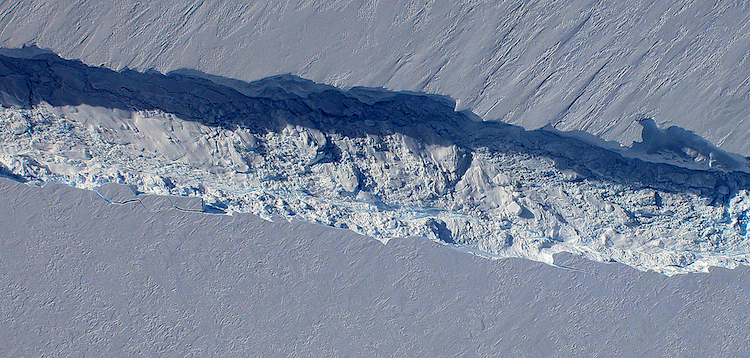
Probably the most interesting observation as yet in the project includes a gigantic crack discovered in West Antarctica, which could eventually split the glacier and produce a monster-sized iceberg.
The gigantic crack starts in Punta Arenas, Chile and extends 18 miles. The grand crack seems to expand slightly more everyday and will eventually split, yielding a new iceberg.
The Pine Island glacier calved its last iceberg in 2001.
Operation IceBridge continues to monitor and chart the Pine Island Glacier’s mass loss and acceleration of its mass loss. This glacier in particular started its rapid deterioration in 2006. The mass-loss acceleration increases approximately sixfold every year.
For example, the glacier lost 7 gigatons of mass in 2005 and about a total 46 gigatons presently. As a means of comparison the Chesapeake Bay holds about 70 gigatons of water. With warmer temperatures the suspected culprit, the overall rapid mass loss of the Pine Island Glacier makes it one of the most significant examples of glacier melting.
City-Sized Iceberg
When the glacier eventually breaks off it will cover about 340 square miles, an area larger than the city of New York. While the thinning of the Pine Island Glacier may be due to climate change, the breakage is normal and happens about once a decade; thus, it cannot be said with certainty whether climate change is responsible for the gigantic crack discovered.
The largest recorded iceberg from the region reached a size of 12,000 square miles (larger than the country of Haiti) and was spotted in the South Pacific Ocean by the USS Glacier in 1956.
The IceBridge project has yielded three years of laser altimetry data over various locations. The work follows up the data collected from NASA’s Ice Climate and Elevation Satellite (ICESat), which stopped operating in 2009. The airborne operations, which can get in closer than a satellite, provide a closer sampling of data and observation.
NASA’s Gravity Recovery and Climate Experiment (GRACE) satellite is still operational and provides a large-scale picture of the subject. However, using the advantage of overflights versus satellite imagery, Operation IceBridge can gather high-resolution data and see the dynamic interactions of ice, bedrock, and ocean currents.
These figures help scientists redesign models and better predict how these glaciers and ice sheets will affect factors like sea level rise.


