


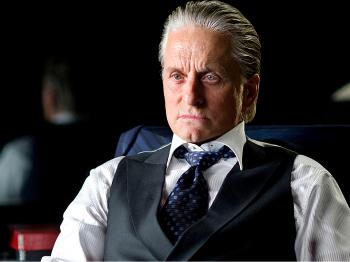
In the highly anticipated sequel to one of the most iconic films of the 1980s, Wall Street: Money Never Sleeps proves that Oliver Stone has still got it when it comes to producing and directing controversial social expositions.
The film begins with the now infamous Gordon Gekko (Michael Douglas) being released from prison and then flashes forward eight years to the days leading up to the financial crisis in 2008. We’re introduced to Jake Moore (Shia LaBeouf), a Keller Zabel investment bank analyst, who appears to lead the charmed life—a beautiful apartment in Manhattan, a beloved girlfriend (played by real-life love Carey Mulligan), and a nice $1.5 million bonus from his boss/mentor. Everything seems perfect, until things start to go horribly wrong.
Amidst rumors that Keller Zabel was holding toxic debt in its balance sheet, the Fed and other large banks refuse to bail it out—ultimately causing the firm to be purchased by another bank for a measly $3/share. (Hmmm, sound strangely familiar? Could this be Bear Stearns, which was acquired by JP Morgan for $2/share?) Following the demise of Keller Zabel, Jake’s beloved boss Louis Zabel commits suicide. Stone gets much of this out of the way within the first few minutes of the film so that he can focus on the relationship between Gekko, Jake, and Jake’s girlfriend Winnie Gekko (Gordon’s daughter.)
Jake seeks Gordon’s advice on getting even with Bretton Woods, CEO of Churchill Schwartz (a la Jamie Dimon, CEO of JP Morgan Chase) and in return, he tries to reconcile Gordon with his estranged and surprisingly principled daughter. Has Gordon changed and redeemed himself? Or is he simply better at hiding his ruthlessness and greed?
You’ll have to see for yourself, however, I will say that I was very pleasantly surprised by the sequel, which was well written, perfectly cast, and brilliantly depicts the events surrounding the financial collapse in 2008. It still has the same electricity and power as the original, but appropriately muted to respect the circumstances we’re currently in.
The film begins with the now infamous Gordon Gekko (Michael Douglas) being released from prison and then flashes forward eight years to the days leading up to the financial crisis in 2008. We’re introduced to Jake Moore (Shia LaBeouf), a Keller Zabel investment bank analyst, who appears to lead the charmed life—a beautiful apartment in Manhattan, a beloved girlfriend (played by real-life love Carey Mulligan), and a nice $1.5 million bonus from his boss/mentor. Everything seems perfect, until things start to go horribly wrong.
Amidst rumors that Keller Zabel was holding toxic debt in its balance sheet, the Fed and other large banks refuse to bail it out—ultimately causing the firm to be purchased by another bank for a measly $3/share. (Hmmm, sound strangely familiar? Could this be Bear Stearns, which was acquired by JP Morgan for $2/share?) Following the demise of Keller Zabel, Jake’s beloved boss Louis Zabel commits suicide. Stone gets much of this out of the way within the first few minutes of the film so that he can focus on the relationship between Gekko, Jake, and Jake’s girlfriend Winnie Gekko (Gordon’s daughter.)
Jake seeks Gordon’s advice on getting even with Bretton Woods, CEO of Churchill Schwartz (a la Jamie Dimon, CEO of JP Morgan Chase) and in return, he tries to reconcile Gordon with his estranged and surprisingly principled daughter. Has Gordon changed and redeemed himself? Or is he simply better at hiding his ruthlessness and greed?
You’ll have to see for yourself, however, I will say that I was very pleasantly surprised by the sequel, which was well written, perfectly cast, and brilliantly depicts the events surrounding the financial collapse in 2008. It still has the same electricity and power as the original, but appropriately muted to respect the circumstances we’re currently in.


