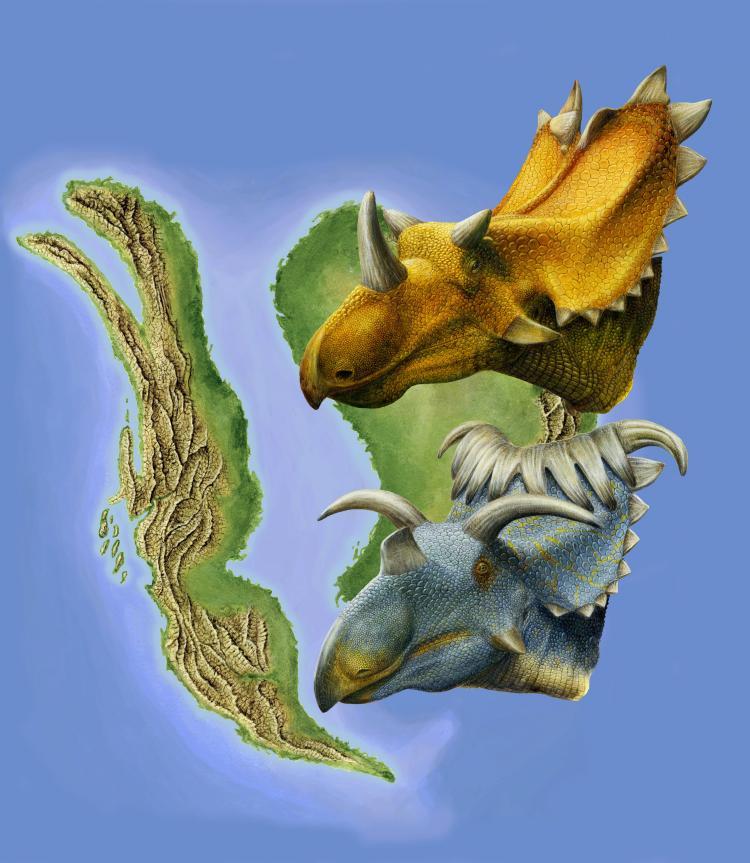
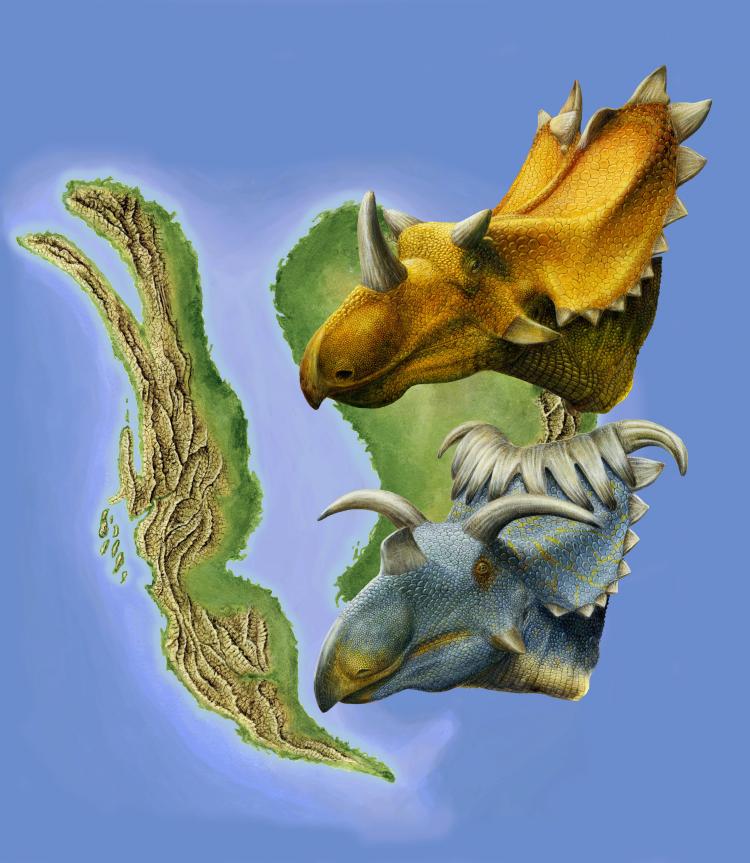
Scientists said the giant plant-eaters, related to the famous Triceratops, inhabited the “lost continent” of Laramidia, the western part of North America, formed when a shallow sea split the continent in two during the Late Cretaceous period.
The 3- to 4-ton Utahceratops gettyi is the bigger of the two new species at 6 feet tall and 18 to 22 feet long. Its skull was about 7 feet long, and along with a large nose horn, it has two sideways-projecting eye horns, similar to a bison. It was named in honor of its discoverer, Mike Getty, paleontology collections manager at the Utah Museum of Natural History (UMNH).
The 15-foot-long Kosmoceratops richardsoni, as well as having a nose horn and two sideways-pointing eye horns, has a remarkable bony frill, making it the most ornate-headed dinosaur known, said the researchers, who described their finds in the online journal PLoS ONE.
“Kosmoceratops is one of the most amazing animals known, with a huge skull decorated with an assortment of bony bells and whistles,” said study lead author Scott Sampson of UMNH in a press release.
“Most of these bizarre features would have made lousy weapons to fend off predators,” Sampson continued. “It’s far more likely that they were used to intimidate or do battle with rivals of the same sex, as well as to attract individuals of the opposite sex.”
The dinosaur remains were discovered in the desert terrain of Grand Staircase-Escalante National Monument (GSENM) in southern Utah, which would have been a subtropical swamp when Kosmoceratops and Utahceratops roamed the area about 76 million years ago, according to the researchers.
GSENM is the largest national monument in the United States and “is now one of the country’s last great, largely unexplored dinosaur boneyards,” said Sampson.
During the Late Cretaceous period, GSENM is thought to have been part of southern Laramidia, an island continent about the size of Australia. Rocks from the northern part of Laramidia have been extensively studied and have yielded a large number of dinosaur fossils. The southern area, though, is less well known, but scientists think there were two distinct northern and southern “provinces” inhabited by different species of dinosaur.
Over the last 10 years, paleontologists have unearthed the bones of more than a dozen other new dinosaurs in GSENM, including duck-billed hadrosaurs, armored ankylosaurs, and meat-eating tyrannosaurs. Fossilized plants, fish, lizards, amphibians, turtles, crocodiles, and mammals have also been discovered, helping scientists to recreate the ancient environment.
“It’s an exciting time to be a paleontologist,” said Sampson. “With many new dinosaurs still discovered each year, we can be quite certain that plenty of surprises still await us out there.”
To read the research paper, please visit article/Fjournal.