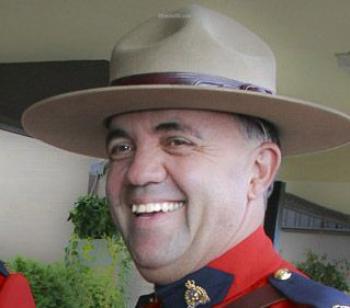
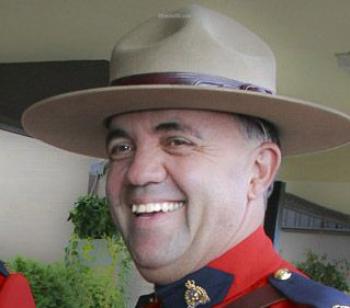
The family was in the process of adopting two children from Haiti, and Gallagher, who was on a nine-month stint in Haiti as part of a UN peacekeeping mission, was happy to be able to help.
But that night the massive earthquake struck, and Gallagher died in the rubble of the apartment he rented in Port-au-Prince.
“As far as I know the shoes never got delivered,” says Richard Blaquiere, a high school teacher in Woodstock.
But Gallagher’s memory will live on in Haiti. Blaquiere and the Woodstock Coalition of Care are co-ordinating efforts to build a vocational school in Haiti to commemorate Gallagher’s life and contribute to the welfare of Haitian children. The school will be called the Sergeant Mark Gallagher Vocational School.
“I got to know Mark after he died,” says Blacquiere. “I had met him a few times, but in the time since the earthquake I’ve gotten to know him a bit, and he was a very kind and generous man.”
The highly respected officer, a recipient of both the Queen’s Golden Jubilee Commemorative Medal and the Police Exemplary Service Medal, was recently recognized in a ceremony in Ottawa for his work with the UN in Haiti.
The school named after Gallagher will be located in Riviére Froide, about 50 km north of Port au Prince, where the Les Petites Soeurs de St. Therese (the Little Sisters of St. Therese) had a primary/secondary school that taught 1,300 children, and a school for children with intellectual and physical disabilities.
Both were flattened in the catastrophic quake, with the loss of 144 children, four nuns, and two lay teachers.
With the main school being rebuilt by a German NGO, it was the nuns who suggested building a vocational school, says Blaquiere, telling him there was a real need for such a school in the area and they had been praying for a way to make it happen.
Serving local rural peasants, the school will house 15 classrooms for up to 550 children and teach cabinet making, masonry, soldering, electrical, agriculture, computers, nurse’s aide, and sewing and embroidery.
“It would give the kids the skills either to stay in the area, or if they did go to the city they would have some skills where they could make some sort of a modicum of a decent life, raise a family, contribute to the economy, and get away from the crime and the misery that’s such a part of the culture of Haiti right now and has been for while,” says Blaquiere.
The coalition wants Haitians themselves involved as much as possible, especially in terms of the construction, he adds, and the purchase of supplies will go through Haitian companies. The architect and the engineer are Haitians based in Port-au-Prince.
“We want everything as much as possible be done by Haitians, so not only can they take ownership of it but they’ll actually make some money,” says Blaquiere, who travelled to Riviére Froide in April and plans to return in December.
One of the first items on the agenda is to build a security wall around the perimeter of the property to keep the materials from being stolen, and as protection for the nuns. The original wall around the schools was almost completely destroyed in the quake. Lootings and kidnappings are common in Haiti.
Fundraising started in earnest this past week, says Blaquiere, with $70,000 coming in from a corporate fundraiser. Discussions are ongoing with the N.B. Department of Education and other groups regarding partnerships, and the coalition expects to get a significant grant from the Canadian International Development Agency. The first of three big gala fundraisers is planned for Nov. 6. 
Estimates place the cost of building the school, which is expected to be completed by 2012 and will be built to withstand earthquakes, at between $1million and $1.5 million.
Groups the coalition has partnered with include the Canadian Teachers Federation and the Association Québécois pour l'Avancement des Nations Unis (AQANU), a Quebec-based NGO that has been working on land management projects and education in Haiti for more than three decades.
Support for the project both in the province and across the country has been strong. But even before the earthquake, New Brunswickers had enduring ties with Haiti, in particular the residents of Woodstock and surrounding communities. Six local churches have missions in Haiti, where they build orphanages, hospitals, clinics, and contribute to community development projects.
“It’s an amazing little community,” says Blaquiere. “For some reason the people in this county have spent an awful lot of time doing relief work and developmental and spiritual stuff in Haiti than I bet just about any other area—if not in the country at least in eastern Canada.”
The outpouring of support has grown in the aftermath of the disaster, he adds, with two medical teams and several church groups going to Haiti to help.
He notes how the community rejoiced when Tim and Michelle Gray—the couple who had given the ill-fated shoes to Sgt. Gallagher to deliver to the orphanage—became the first family in Canada to adopt children from Haiti after the earthquake.
Sgt. Gallagher’s wife, Lisa, who has said her husband “touched the hearts of everyone he met,” has expressed an interest in going to Haiti to volunteer at the school. The mother of a grown son and daughter works as a superintendent in an N.B. school district. 
“We would like to go to Haiti as a family,” she told the local Bugle Observer last month. “I’m absolutely very supportive of the school in Haiti and it is something I want to see be successful. I’d like to do some teaching there.”
Losing the two schools in Riviére Froide was not the only blow for the Little Sisters of St. Therese. Of the nuns’ 42 missions across Haiti, nine now need rebuilding. They lost five schools, three churches, 12 hospital buildings, and eight convents and houses.
Blaquiere describes the nuns and their work as “absolutely amazing,” and says he’s delighted to be involved with the project.
After the school is built, his vision is to “sustain it in more ways than just financially,” such as setting up programs whereby French immersion classes in N.B. would connect with French immersion classes at the school, and perhaps initiate a teacher exchange at some point.
“That’s all down the road,” he says. “Some of that is possible and some may be me dreaming much further ahead than I should be. But this has captured me. I have a new passion.”
For more information, visit www.gallagherschoolhaiti.com. Facebook site: Sgt Mark Gallagher Memorial Vocational School in Haiti Project.