Extremely large temperature changes take place on Mars from winter to summer, affecting the composition of the red planet’s atmosphere and surface ice.
During winter, martian air freezes with more than a quarter of the atmosphere located at the polar caps in the coldest months.
Due to the fact that its atmosphere is 95 percent carbon dioxide, Mars has seasonal polar caps composed of dry ice, which sublimates during summer.
As a result, the planet’s air pressure rises and falls by about 25 percent according to seasonal temperatures.
However, the south polar cap remains sufficiently cold for the ice to persist year-round and accumulate annually.
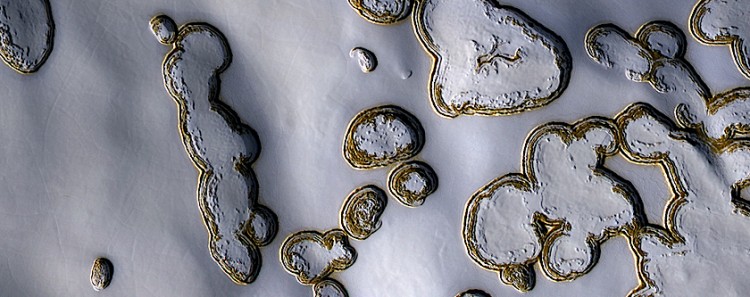
This dry ice slab is around 3 meters (10 feet) deep with flat-floored pits as seen in the above image. These roughly circular formations are about 60 meters (200 feet) wide.
Dust mixed into the ice may explain the unusual color of the pit walls, which are frosted over most of the year, but reveal their true color as summer ends.
Liquid water is scarce on the surface of Mars because the planet’s low atmospheric pressure means ice vaporizes directly to steam on a warm summer’s day.
NASA will launch the Mars Science Laboratory (MSL) mission in late November, bearing the rover Curosity, which will land at Gale Crater and investigate the surface of Mars in search of evidence of the red planet’s wet past and potential habitability.