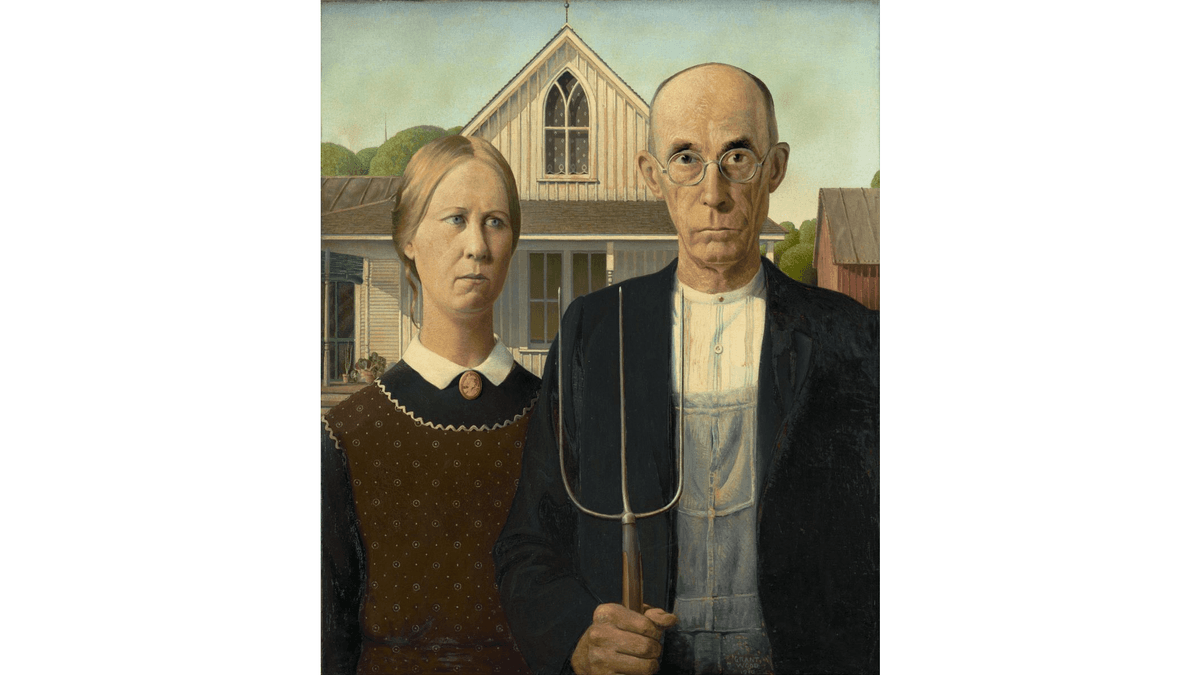
If you’re familiar with American art of the mid-20th century, you surely have seen Grant Wood’s painting “American Gothic.” Now one of the most frequently reproduced and parodied pieces of artwork of all time, this homespun painting reflects the American Regionalist art style which characterized Wood’s work. Painted in 1930, it’s a snapshot from the Midwest of the Great Depression.
Who are the people shown in that painting? When it initially debuted, many interpreted the scene as a depiction of a farmer and his wife. Analysis ranged from fierce criticism to lavish praise, as professional critics and average folks alike debated whether the painting was a biting satire of Midwestern farmers or a loving tribute to rural Americans.
Behind the analysis, debates, and knockoffs was a real woman who later received negative attention from her appearance in the painting, which she only did to help her brother, the artist. That’s right. The woman in “American Gothic” was modeled after Grant Wood’s younger sister, Nan, and the man was their family dentist, Dr. Byron McKeeby, who posed as the farmer intended to be her father, not her husband.
However, this solemn likeness offers but a glimpse into the fascinating and artistic life of Nan Wood Graham, a woman who spent her later years in Riverside, California.
The Farmer’s Daughter
Nancy Rebecca Wood was born on July 26, 1899, on a farm four miles east of Anamosa, Iowa. She was the youngest child of farmer Francis Wood and his wife, Hattie. When she was just 16 months old, her father died, and she, her mother, and three older brothers moved to Cedar Rapids, Iowa. Using the proceeds from the sale of the family farm, as well as some life insurance proceeds, her mother bought a modest house for her family. Mrs. Wood demonstrated fortitude and bravery for her children as she provided for them as a single mother. This determination and positivity impressed itself upon Nan, who accepted her father’s early death as a blessing in disguise.
“I am a firm believer in fate,” Nan wrote. “Had our father lived, he undoubtedly would have become a rich Iowa farmer, and Grant would have most likely followed in his footsteps. His great talent would have been lost to the world.”
As her artistic older brother was beginning to make his way in the world, Nan was still a young girl, and she lived with other brother Frank while attending high school in Waterloo, Iowa. She graduated on May 21, 1918. Around this time, Nan and her mother lived first in a shack and then a nice combined house and studio, both of which Grant built for the three of them after Mrs. Wood lost their childhood house in 1917.
On August 1, 1924, Nan married Emmett Edward Graham, a real estate broker and investor. According to an article in a local newspaper, “The marriage came as a surprise to friends of the couple.” Early in their marriage, Graham contracted tuberculosis, forcing him to spend time in a sanitarium. A few years later, Nan was also diagnosed with tuberculosis, and was almost unhealthily thin for much of her life.
During the early years of her marriage, Nan was still very close to her brother and mother. In 1938, she and her husband drove to California, taking Grant’s estranged wife with them. After Grant’s death in 1942, Nan made several trips back to Iowa to oversee his affairs and maintain his legacy. After her husband Edward died in 1967, the widowed Nan moved into the modest house in Riverside which he’d bought, and she lived there until failing eyesight forced her to move into a nursing home in 1984. On December 14, 1990, she died in a convalescent hospital at the age of 91.
The Artist’s Sister
Grant Wood was a shy, retiring, and painfully naïve man. He wasn’t close to his two brothers, but he had a deep bond with his mother and sister. He provided for them and often lived with them well into his adulthood. Perhaps it was due to his sensitive nature that he was close to his little sister. However, they also shared the bond of art. Nan learned artistic enthusiasm and techniques in drawing and painting from big brother Grant, who patiently taught her by demonstration.
She later recalled how Grant refused to help her color a picture for a contest, saying, “You’ve got to be honest about this.” She eventually completed the project on her own, and her honesty paid off when she won the contest. Despite this early artistic inclination, Nan seems to have paid heed to the discouraging words of an aunt who declared, “One artist in the family is enough.”
However, the young lady never felt like her potential art career was stifled by Grant’s success. She said years later that if she hadn’t been Grant Wood’s sister, she “probably would have been a farmer’s wife, but Grant would still have been Grant.” Nevertheless, she did create one oil painting, “Boarding House Bath,” a fanciful take on the antiquated plumbing she encountered in California boarding houses. She was more skilled in the challenging medium of reverse painting on glass, which she displayed in an exhibit in New York City in 1938 at the encouragement of her sister-in-law, Sara.
She also developed a prize-winning technique of leather tooling, a skill she learned while in a sanitarium for tuberculosis, but caring for her husband after an automobile accident kept her from accepting her brother’s offer to teach it at his Stone City Art Colony in the summer of 1932. When she and Ed were struggling financially in 1939, Nan went back to Iowa to learn the technique of coloring her brother’s lithographs. After he taught her the process of mixing and numbering the watercolors to get the shading exactly right, she returned to California and taught the process to her husband. This gave them much-needed income every month and an enjoyable artistic outlet for Nan.

Painting His Legacy
Nan often acted as a model for her brother’s artwork, providing the figure, face, or both for everything from a stained-glass window to the famous “American Gothic.” To create the desired stern appearance of a farmer’s spinster daughter, Grant lengthened his sister’s face, giving her a drawn look. In fact, he promised that nobody would recognize her. She took rickrack trim off her mother’s old dress and sewed it onto an apron to convey the homespun femininity of a traditional farmwoman. However, people quickly interpreted the woman in the painting as the disagreeable wife of the elderly farmer, which initially bothered Nan (although she later came to pleasantly associate herself with the picture).
Although the painting achieved huge success, the depiction of Iowa womanhood wasn’t so popular among farm wives, who made rude comments about the woman because of their personal offense. To make it up to his sister, Grant painted her portrait in 1933, calling it simply “Portrait of Nan.” In this picture, she wears the waved hair of the era, makeup, and a white blouse with polka dots, whose pattern the painter developed by printing circles on plain fabric with a sliced raw potato. Nan sewed the blouse herself, since she often designed her own clothing. In one hand, she holds a chick, to match her hair color; in the other, she holds a plum, which matches the color of her lips. This was the only painting which Grant displayed in his house.
Grant Wood made his sister’s image famous by using her as the model in what became his best-known work, but she made it her purpose to create an accurate picture of her brother’s life and legacy after his death. Her tools weren’t a paintbrush and acrylics but polite letters of correction to any reporter, biographer, or art critic who misrepresented the facts. In 1993, the State Historical Society of Iowa posthumously published her memoir, “My Brother, Grant Wood.” Between that and Julie Jensen MacDonald’s 2000 book “Grant Wood and Little Sister Nan: Essays and Remembrances,” art historians can gain great insight into the background of these American siblings.