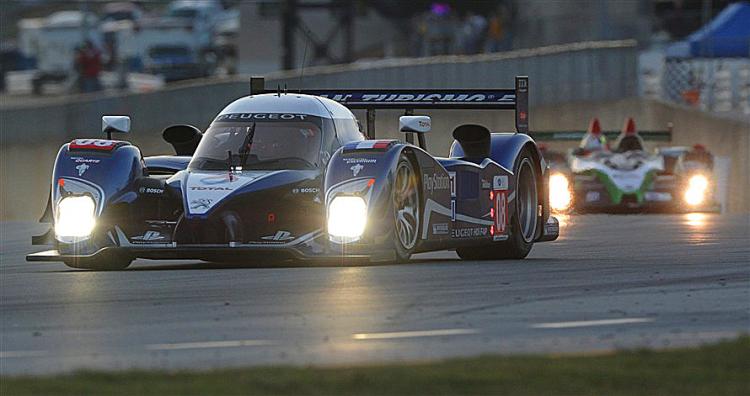
This event, Petit Le Mans (literally “small Le Mans—simple and only slightly pretentious) is a ten-hour or 1000-mile multi-class race, with hugely fast and powerful prototypes and barely modified street cars sharing the track in a test of speed and endurance—just like its French counterpart, but less than half the length.Petit Le Mans ran one year as a stand-alone event, then became the finale for a then-new sports car series, the American Le Mans Series (simple, not too pretentious,) brainchild of wealthy inventor/investor Dr. Don Panoz, who also happened to own the track, Road Atlanta, where the event took place. (Dr. Panoz also holds the lease to Sebring.)
Unlike Le Mans, which is run on a mix of public roads and private sections of track and which shuts down a small portion of France (while attracting perhaps a quarter-million fans) for a few weeks each June, Petit Le Mans (which attracts perhaps half as many fans) has to battle local noise ordinances; it cannot run on Sunday in Bible-Belt Georgia. (In fact, the track’s owner can barely hold off the insistent real-estate developers who want to pay a lot more than the track generates.)
Like its European namesake, Petit Le Mans attracts the best teams from around the world—in fact, most of the teams which contest Le Mans also cross the ocean to do battle in America (an important market for car companies and many other sponsors.) The venerable Sebring 12 Hours and Petit Le Mans are the only truly international sports car races run in North America.
Petit Le Mans, in the few years it has operated, has displaced the once-prestigious Daytona 24 Hours as the second premier North American sports car race, behind Sebring. Daytona has opted to be a purely North American race, featuring slower cars and smaller teams and a lot fewer fans, while Sebring and Petit, both operated by ALMS, have always brought in the best in the sport.
In short, Petit Le Mans almost immediately became as sports-car-racing icon; say “Petit” and aficionados immediately grew reverent. Every fall, fans flocked to Georgia for what was always a fantastic race and a fantastic event—ten hours of excitement, camaraderie, and the sound and fury of the most exotic automobiles on the planet.
And isn’t it always sad to see an icon’s health waning?
International Attack

In order to better please the factories which pump more than a billion dollars into the sport (a successful Le Mans car like the Peugeot 908 or Audi R18 might cost half-a-billion dollars to develop and build; a season budget is as much as a top Formula One team’s) ACO devised the Intercontinental Le Mans Cup—a short series which hit every important car market, in order to give the factories maximum advertising exposure.
As its opening move, ILMC co-opted Sebring and Petit Le Mans. Now these races would be joint ILMC-ALMS affairs, which meant the big-budget European teams would win the top spots, and the U.S. teams would lose their best chances for media exposure.
Then ACO teamed up with another French organization, the Federation Internationale de l'Automobile (FIA)
(how did the French gain a stranglehold on automobile racing anyway?) which controls just about every single auto-related event in the world—except ACO-sanctioned races. The behemoths bred, forming the World Endurance Cup—the ILMC with even more prestige.
WEC, having the clout of basically all the world's auto-racing nobility behind it, began making rules which are crippling ALMS.
WEC went further than ILMC. The new series announced that it would likely drop Petit Le Mans in favor of a race in Bahrain, and would totally take over Sebring. These two races were no longer ALMS races or even joint ALMS-ILMC races. Now they were to be pure WEC races. WEC told Dr. Panoz that starting in 2013, cars from his series (ALMS) would not be allowed to run at his tracks (Sebring and Road Atlanta) in his events (the 12 Hours and Petit Le Mans.)
ALMS, already reeling from mismanagement and media problems, was now reduced to a handful of small races known only to fans of the sport. The ALMS’ best chance to attract new fans, its signature events, were being taken over by a foreign series which wouldn’t even share the track.
Media Difficulties

The only way to keep the teams racing is to provide enough media exposure to satisfy sponsors that their contributions are well rewarded as advertising. And here the fracturing of the network and cable TV audiences has really taken a toll.
With hundreds of channels broadcasting to every conceivable niche, reaching a mass audience has become impossible. Most sports-specific cable networks reach 75-125 million viewers, and not all of those viewers are racing fans. Further, some of the sports-specific networks are on a high cable tier—that is, they aren’t in basic Cable, or Sports Pak I or II; viewers have to pay extra to get channels which might only have a few hours of interesting programming a week.
And just about no channel can afford to devote ten or twelve hours to a single event—except for the Olympics. Doing so would be a huge commercial risk; viewers who didn’t like the event would tune out for an entire day. That’s a lot of potential ad revenue lost.

ALMS moved to an online/cable/network mix, where races are broadcast live online on ESPN3.com, then edited recaps are broadcast a day later either on network TV (ABC) or on cable (ESPN.)
The problem here is that fans want the highest-quality broadcast (streaming video can be shaky) and advertisers want the largest possible market penetration. Taped, edited sporting events offend real fans, and Internet broadcasts only appeal to hardcore fans.
This media deal has many teams complaining (and some leaving,) because the money just isn’t there.
To be fair, the ALMS media package is certainly the way of the future. All minor sports and even the most major are realizing the Internet is the best way to get the product to the most specific audience for the lowest price. Problem is, the future isn’t here yet. Until picture quality and reliability equal broadcast TV, casual fans will be disappointed, and until the sport spends enough on promotion to attract viewers and advertisers to the online broadcast, the ‘Net doesn’t make money.
Next: Mismanagement Issues, Financial Pressure