Labour Sets Out Plan to Nurse Economy Back to Health

September 28, 2011 Updated: October 1, 2015

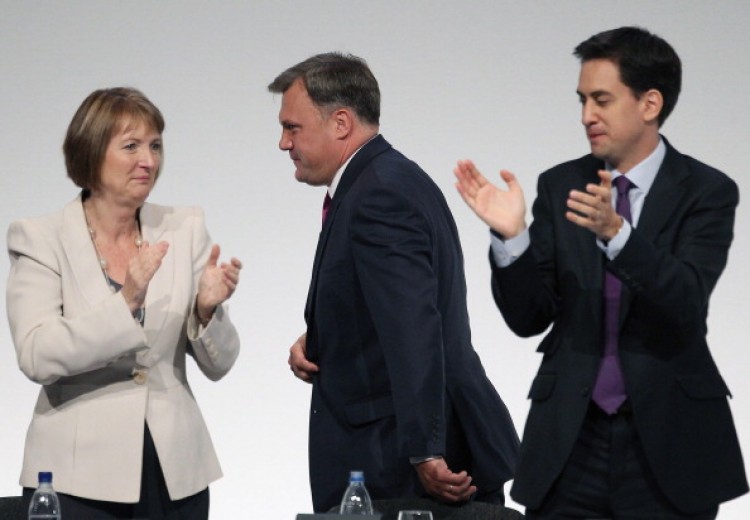
Labour's Shadow Chancellor Ed Balls receives applause from deputy party leader Harriet Harman (L) and leader Ed Miliband after addressing the Labour party conference at the Echo Arena on September 26, 2011 in Liverpool, England.  During his keynote speech to delegates, Shadow chancellor Ed Balls announced a five point plan to boost jobs and economy.  (Jeff J Mitchell/Getty )
Labour's Shadow Chancellor Ed Balls receives applause from deputy party leader Harriet Harman (L) and leader Ed Miliband after addressing the Labour party conference at the Echo Arena on September 26, 2011 in Liverpool, England. During his keynote speech to delegates, Shadow chancellor Ed Balls announced a five point plan to boost jobs and economy. (Jeff J Mitchell/Getty )
With global leaders seeking a cure for the debt crisis threatening to infect the eurozone, the health of the UK’s own economy was naturally a key issue at this year’s Labour Party annual conference.

Shadow Chancellor Ed Balls presented his “five point plan” to greater national economic health on Monday, which he says provides the tonic to strengthen the nation’s economy and at the same time tackles the malaise of the national deficit.

His plan includes: reversing the recent VAT rise, a one-year national insurance tax break for every small firm that takes on extra workers, bringing forwards long-term investment projects, repeating the bank bonus tax, and a one-year cut in VAT to 5 per cent for home improvements.

In his speech to the Labour Party’s conference in Liverpool, Ed Balls rejected the government’s strict diet of austerity measures, saying that they had cut the deficit too fast, stunting economic growth and driving up unemployment.

He said he had warned against the austerity measures a year ago. “We said that going too far, too fast would choke off the recovery and put jobs at risk; we warned that cutting spending and raising taxes too fast would create a vicious circle here in Britain too – and make it harder to get the deficit down.

“And look what’s happened – even before the global instability of the past three months: confidence has slumped; our economy has flat-lined now for nine months; slower growth in Britain than any other G7 country except Japan; unemployment now rising again.”

Mr Balls said that even the IMF had warned that slamming on the brakes too quickly will hurt the recovery and worsen job prospects.

The shadow chancellor did offer an apology for Labour’s stewardship of the country’s finances, admitting that certain shortcomings had weakened the nation’s ability to weather the global financial crisis.

But he did not concede on a key claim made by the government: that the deficit run up by 13 years of Labour spending had left the nation vulnerable to the global economic storm.

“Don’t let anyone tell you that Labour in government was profligate with public money, when we went into the crisis with lower national debt than we inherited in 1997 and lower than America, France, Germany, and Japan,” he said.

“And don’t let anyone say it was public spending on public services here in Britain which caused the global financial crisis. It wasn’t too many police officers or nurses or teachers here in Britain that bankrupted Lehman Brothers in New York.”

He did concede, however, other mistakes. “The 75p pension rise – that was a mistake. So was abolishing the 10p tax rate. We didn’t do enough to get all employers to train. We should have adopted tougher controls on migration from Eastern Europe. We didn’t spend every pound of public money well. And yes – we didn’t regulate the banks toughly enough and stop their gross irresponsibility – here in Britain and all around the world.”

Resisting the instincts of many within the Labour Party, the shadow chancellor also said that the Labour Party could not promise to reverse any of the government’s austerity cuts.

Ed Balls’ speech received praise from the unions, but a mixed reaction from the business community.

John Cridland, director general of the Confederation of British Industry, said in a statement: “Given that public spending cuts are vital to eradicating the deficit and protecting our triple A credit rating, it is right that Ed Balls commits to new fiscal rules. Labour has not got this right in the past.

“If affordable, some of Mr Balls’ proposals for stimulating growth are worth considering, but they must pass the affordability test. In my view, a VAT cut is not affordable.

“Getting young people into work is an important objective we all share.”

But some analysts expressed doubt over the scope of the shadow chancellor’s plans to use the sale of the banks part nationalised in the rescue deal of 2008 to pay off the national debt.

“Balls is cleverly tapping into the widely held myth that the nationalised banks will be sold at a massive profit,” writes Fraser Nelson in the right-wing magazine The Spectator. “The Office for Budget Responsibility looked at this in March, and put an indicative £3.4 billion price tag on the bank disposals: a far cry from the £22 billion which Brown raised from the 3G mobile licence auction.

“If banked, it would accelerate Britain’s deficit reduction by about eight days. But given what’s happened to bank shares since March, Osborne will be lucky to make any profit from the banks at all.”

Many Tory supporters also poured scorn on the shadow chancellor’s plans to cut home improvement VAT to enable greater growth in the housing and small-scale building market.

The plans were endorsed by Richard Diment, director general of the Federation of Master Builders. He said in statement: “This policy makes sense on every level. It supports economic policy by creating jobs and generating growth; it supports environmental objectives by helping to bring derelict homes back into use thus taking pressure off the green belt land to provide new housing; and it tackles rogue traders and tax dodgers by reducing their competitive advantage over legitimate businesses.”

Follow Simon on Twitter: @SPVeazey