MELBOURNE—The story goes that there was a man called Guo Han in the Tang Dynasty who, upon gazing at the bright moon one night, saw a heavenly girl slowly descending towards him. When he had a closer look, he saw that the dress she was wearing was seamless. He asked her why. She answered: “Heavenly clothes are not sewn with needle and thread.” Hence the Chinese idiom, “a heavenly dress without seams” which denotes something flawless.
Although humanity has always strived for perfection in all things, this has often, if not always, escaped us. The seamless garment, however, is firmly within our grasp and there is even an exhibition to prove it.
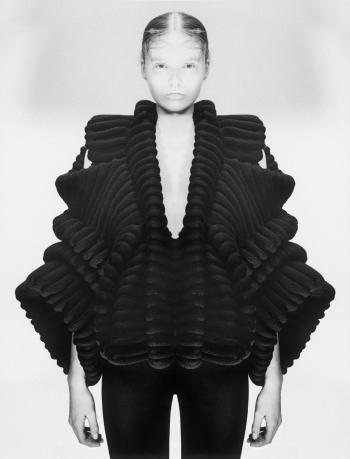
The Endless Garment: The New Craft of Machine Knitting brings to Australia for the first time nine leading international designers.
Exhibition co-curator Ricarda Bigolin explains: “The show is about possibilities, also about knitwear being a medium that has as many creative possibilities as cut and sew.”
Knitwear has traditionally been associated with craft and, even when it is mass produced, it rarely evolves in the leaps and bounds of fashion that uses woven materials. High fashion designers use knit mostly in the way they use fabric—fine jersey knit that is cut and sewn according to a two dimensional pattern—although the odd chunky scarf makes an appearance now and then as a homage to the humble hand knitter. But there is a new trend spearheaded by the likes of Sandra Backlund (Sweden), Yoshiki Hishinuma (Japan) and Saverio Palatella (Italy) who are working and thinking in 3D.
Ms Bigolin explains: “[Ms] Backlund is getting a lot of acclaim in Paris, London [and] New York, but her work also shows an embracing of volume, as opposed to making really form-fitted work. She can build a form around the body, which I find really exciting and interesting, and also that with new technology you don’t have to literally cut and piece together a form, but you can actually integrally build a form.”
This may seem new to some, though not to Melbourne sculptor and designer Julianna Turcu who first held an exhibition in 1988 at the Blackwood Gallery which featured modular, seamless knitted garments.
At the time, Australia was in the grip of a recession, the likes of which saw the fashion industry manufacturers drop like flies. It was not the time to talk revolution, though the machine that could produce seamless, whole garment pieces had just been invented.
Mrs Turcu’s passion for volume came from the fact that she was a sculptor in stone and wood, and senior curator for sculpture and textiles at the Contemporary Art Museum of Romania before she migrated to Australia in 1984.
Although humanity has always strived for perfection in all things, this has often, if not always, escaped us. The seamless garment, however, is firmly within our grasp and there is even an exhibition to prove it.
The Endless Garment: The New Craft of Machine Knitting brings to Australia for the first time nine leading international designers.
Exhibition co-curator Ricarda Bigolin explains: “The show is about possibilities, also about knitwear being a medium that has as many creative possibilities as cut and sew.”
Knitwear has traditionally been associated with craft and, even when it is mass produced, it rarely evolves in the leaps and bounds of fashion that uses woven materials. High fashion designers use knit mostly in the way they use fabric—fine jersey knit that is cut and sewn according to a two dimensional pattern—although the odd chunky scarf makes an appearance now and then as a homage to the humble hand knitter. But there is a new trend spearheaded by the likes of Sandra Backlund (Sweden), Yoshiki Hishinuma (Japan) and Saverio Palatella (Italy) who are working and thinking in 3D.
Ms Bigolin explains: “[Ms] Backlund is getting a lot of acclaim in Paris, London [and] New York, but her work also shows an embracing of volume, as opposed to making really form-fitted work. She can build a form around the body, which I find really exciting and interesting, and also that with new technology you don’t have to literally cut and piece together a form, but you can actually integrally build a form.”
This may seem new to some, though not to Melbourne sculptor and designer Julianna Turcu who first held an exhibition in 1988 at the Blackwood Gallery which featured modular, seamless knitted garments.
At the time, Australia was in the grip of a recession, the likes of which saw the fashion industry manufacturers drop like flies. It was not the time to talk revolution, though the machine that could produce seamless, whole garment pieces had just been invented.
Mrs Turcu’s passion for volume came from the fact that she was a sculptor in stone and wood, and senior curator for sculpture and textiles at the Contemporary Art Museum of Romania before she migrated to Australia in 1984.