NEW YORK—While Jewish people are often thought of as wealthy residents, the reality is that there are more than 244,000 individuals in Jewish households in New York City living in poverty, including 52,000 children.
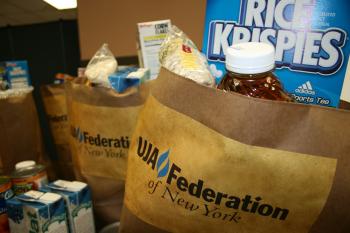
Recognizing the growing impact of the economic crisis on the Jewish poor of New York City and their ability to afford basic nutritious food, the UJA-Federation (United Jewish Appeal) of New York provided a $400,000 check to the Metropolitan Council on Jewish Poverty. This grant will ensure Met Council’s food distribution sites remain stocked to provide kosher food to all who are hungry.
As Jewish families living in or near poverty are faced with choosing between rent, heat, food and medicine, this grant will help to stave off the public health crisis which inevitably results from poor nutrition.
In addition, based on the evidence of the growing number of poor and near poor in NYC, UJA-Federation also allocated $600,000 in additional funding to strengthen the capacity of Met Council, one of the hundreds of agencies under the UJA-Federation umbrella network that responds to emerging community crises and priorities.
“Rising hunger in New York City as a direct result of this economic crisis is a significant emergency, one that could no more be ignored than the aftermath of a hurricane or natural disaster,” said Dr. John Ruskay, Executive Vice President and CEO of UJA-Federation. “The response of the UJA-Federation leadership was swift and sure, providing both the emergency grant of $400,000 for food to feed the hungry, and an additional $600,000 to cover the increased operating expenses Met Council will incur to help hundreds of thousands of New York City’s poor and near-poor through this economic tsunami.”
Beth Israel Medical Center has partnered with the UJA and Met Council to see that the nutritional needs of the community, a fundamental element of good health, are met.
“Proper nutrition is the first line of defense for good public health,” explained Dr. David J. Shulkin, MD, President and CEO of Beth Israel Medical Center. “The best hospitals and doctors in the world cannot improve the health of their community in isolation from meeting the basic human needs of people… Sound nutrition is the cornerstone of good health and is critical to providing care in the community.”
“As a large hospital center with tight ties to our community, we look to partner with groups such as UJA and Met Council that address issues such as hunger and poverty, and then provide access to care for those in need. Clearly optimal healthcare is a job for more than just a hospital, it requires true community involvement,” Dr. Shulkin concluded.
According to Met Council, even before this economic crisis pushed more people over the edge into poverty or near-poverty, there were 244,000 individuals in Jewish households in New York City living on poverty. Another 348,000 fall into the poor and near-poor Jewish households struggling to get by in NYC.
Recognizing the growing impact of the economic crisis on the Jewish poor of New York City and their ability to afford basic nutritious food, the UJA-Federation (United Jewish Appeal) of New York provided a $400,000 check to the Metropolitan Council on Jewish Poverty. This grant will ensure Met Council’s food distribution sites remain stocked to provide kosher food to all who are hungry.
As Jewish families living in or near poverty are faced with choosing between rent, heat, food and medicine, this grant will help to stave off the public health crisis which inevitably results from poor nutrition.
In addition, based on the evidence of the growing number of poor and near poor in NYC, UJA-Federation also allocated $600,000 in additional funding to strengthen the capacity of Met Council, one of the hundreds of agencies under the UJA-Federation umbrella network that responds to emerging community crises and priorities.
“Rising hunger in New York City as a direct result of this economic crisis is a significant emergency, one that could no more be ignored than the aftermath of a hurricane or natural disaster,” said Dr. John Ruskay, Executive Vice President and CEO of UJA-Federation. “The response of the UJA-Federation leadership was swift and sure, providing both the emergency grant of $400,000 for food to feed the hungry, and an additional $600,000 to cover the increased operating expenses Met Council will incur to help hundreds of thousands of New York City’s poor and near-poor through this economic tsunami.”
Beth Israel Medical Center has partnered with the UJA and Met Council to see that the nutritional needs of the community, a fundamental element of good health, are met.
“Proper nutrition is the first line of defense for good public health,” explained Dr. David J. Shulkin, MD, President and CEO of Beth Israel Medical Center. “The best hospitals and doctors in the world cannot improve the health of their community in isolation from meeting the basic human needs of people… Sound nutrition is the cornerstone of good health and is critical to providing care in the community.”
“As a large hospital center with tight ties to our community, we look to partner with groups such as UJA and Met Council that address issues such as hunger and poverty, and then provide access to care for those in need. Clearly optimal healthcare is a job for more than just a hospital, it requires true community involvement,” Dr. Shulkin concluded.
According to Met Council, even before this economic crisis pushed more people over the edge into poverty or near-poverty, there were 244,000 individuals in Jewish households in New York City living on poverty. Another 348,000 fall into the poor and near-poor Jewish households struggling to get by in NYC.