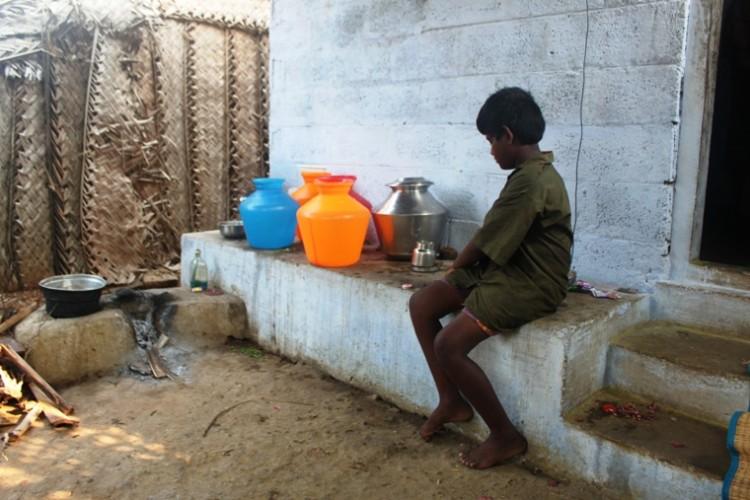
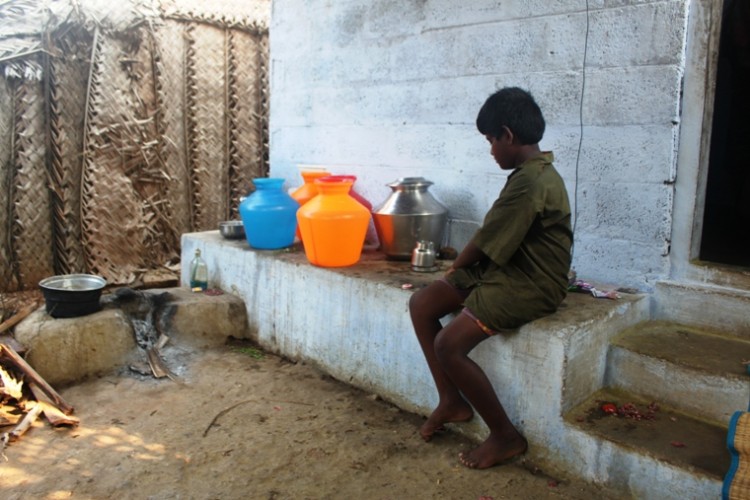
KOLINJANOOR, India—His small hands moved fast as he picked the bright white jasmine flowers from the bushes. But the sweet smell of the jasmine flowers is something 8-year-old Shaktivel had long forgotten—each day of the week he picked the flowers for nearly 14 hours, receiving only three to four dollars in pay for the whole week.
Shaktivel’s case is no exception, as the Arundhatiyar community that he and his family belong to is one of the most marginalized social classes in Southern India. To cope with the poverty, child labor is seen as a necessity and socially accepted—having been passed down from generation to generation.
Shaktivel’s parents, who have never been to school and know neither how to read nor write, have been pleased with him and his two elder brothers working in the jasmine field. His mother also works in the jasmine field, and his father is an agricultural laborer.
Now however, Shaktivel only picks jasmine flowers on his holidays, as he has become the first generation in his family to attend school. Pulled from the jasmine fields by organizations dedicated to providing education to child laborers, Shakitvel is now among the 20 youngsters from his village Kolinjanoor and neighboring villages whom are attending school.
An organization named READ puts the children in a rehabilitation program, named the National Child Labor School, aimed at giving them a one-year nonformal education, to prepare them for a regular educational system. Having already spent one year in the “bridge school,” the children are then able to enroll in the normal school in their villages.
The rehabilitation program for the child laborers is part of a program by the Indian authorities started in 1987 aimed at putting the child laborers back in the education system. The schools are funded by authorities, and free bus passes are provided to the child laborers to go to school.
Over the past seven years, 293 children, including Shaktivel, have been provided education by the organization.
But staying in school and off the 10,000 acres of jasmine fields in the region for work proves arduous for many of the former child laborers.
Poovizhi and Duraisami, teachers at the National Child Labor School in the town of Sathyamangalam in Tamil Nadu Province, say that children from the Arundhatiyar community often drop out of school because of illness, or because of work in the jasmine field, or as fodder collectors for cattle in the forests.
“Poverty, migration of parents for work to other towns, and lack of interest in going to school leads to children dropping out from schools and working,” says Duraisami.
Ajith Kumar was enrolled in the bridge school. He had worked in a textile factory to pay back a loan his family had taken to build a house. He worked 12 hours a day folding and packing banyans, earning between 200 and 300 Indian rupees ($4–$6) a week.
Ajith doesn’t want to go to the school; he likes playing around the village with his friends and, according to his neighbor, has started to smoke cigarettes and beedis (country cigarettes). His sister Tulsimani has also not been going to school for the past three months because Ajith is not doing so and she wants to be with her brother.
For teachers, the future of the school seems uncertain. “We have heard that because of lack of funds, the project is closing next year,” says schoolteacher Duraisami.
The project officer for the district at Erode, Mr. Shanmugam, however refutes the possibility of the scheme closing next year; he however doesn’t know how long it will continue.