Irish Housing in Disarray as Waiting Lists Lengthen and Homelessness Rises

September 21, 2011 Updated: September 29, 2015

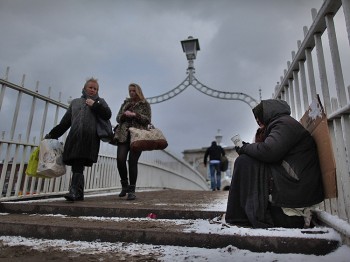
Rising Homelessness in Ireland. (Getty Images)
A campaign was launched last Friday to stop the repossession and eviction of people who can’t pay their mortgages by the Defend Our Homes League, which includes the ULA group of TD’s, the legal group New Beginning, the campaign group Irish Homeowners Unite and a range of people in difficulty with mortgages.

According to Joan Collins, TD for Dublin South Central: “With record numbers in arrears and negative equity, the prospect of being evicted has become more immediate for many people who are burdened with mortgages they simply cannot pay. We are calling for repayments to be reduced in accordance with ability to pay – which should be determined by an agency that is independent of the government and the banks.”

Clare Daly, TD for Dublin North, said that people with huge mortgages and negative equity should be able to surrender their mortgage and have any negative equity written off. They should also have the option of remaining in their home as tenants with the rent set at ability to pay, she said, or, alternatively, they should be entitled to seek social housing elsewhere if they want to.

The Defend our Homes League arose out of an initial meeting at the Red Cow Hotel in Dublin this July. The meeting was organised by United Left Alliance TDs and was supported by independents, legal group New Beginning, and Irish Home Owners Unite.

The aim Of the Defend our Homes League is to organise home owners on a national basis to keep people in their homes, to stop repossessions and to prevent evictions.

The League stresses that there are essentially four groups who need urgent action on their behalf by the government. Those who are in arrears and need short to medium term assistance until their financial circumstances improve; those who wish to surrender their mortgages and become tenants; those in negative equity; and those who have had their homes repossessed but still have substantial and un-payable debts.

David Hall from New Beginning said: "New Beginning believes there’s a need for coherent solutions and will be bringing forward a ground breaking solution to assist the borrower put in place a financial plan to best position them to stay in their homes. We will continue to fight the banks legally to force a political solution to this debt crisis."

Caroline Lennon of Irish Homeowners Unite said that the Irish Homeowners Unite group have no agenda other than to challenge the authoritarian attitude of banks and what she called “the tacit support given to them by the state and those with vested interests.” She said the IHU believe that homeowners should put their needs first, and not those of the banks.

Housing Waiting Lists Surge

Unsold houses lie empty at the Castlemoyne housing estate. (Getty Images)
Meanwhile, government figures released this week show that there were over 98,000 households in need of housing as of March of this year. Aideen Hayden, Chairperson of the Threshold support group, said: “This is a significant increase since the last Housing Needs Assessment in 2008, but we believe the real level may be much higher again – potentially double the official rate.

“The Housing Needs Assessment focuses only on those who have come to the attention of, and are interacting directly with, the authorities. But Threshold knows there is a whole raft of people experiencing housing problems who do not fall into these categories. Single people, for example, are strongly discouraged by many local authorities from placing their names on housing waiting lists.”

The Respond! Housing Association claims the dramatic increase in housing need is a result of ad hoc housing policies adopted by previous governments over the past number of decades. According to the housing charity, the number of households on waiting lists increased at an alarming rate since 1991, despite a booming economy and property market during the Celtic Tiger years.

Respond! spokesperson Aoife Walsh says it is now critical that a coherent, national housing plan is put in place that will tackle the housing crisis in Ireland.

“In 1991, just over 20,000 households were on Local Authority housing waiting lists, and this figure now stands at almost 100,000 households. Despite many years of prosperity in the nineties and noughties, the lack of a consistent housing policy led to an over inflated property and an under developed social housing sector,” said Ms Walsh.

Ms Hayden said thousands of people were struggling to pay their rent or their mortgages every month, but they do not appear on official lists or receive housing payments. For example, over 95,000 home-owners are struggling with mortgage repayments, she said, though this is not reflected in the Housing Needs Assessment.

The results of the Housing Needs Assessment also highlights the very low income of those on waiting lists, with almost 80 per cent of households earning less than 15,000 euro per annum. According to Respond!, further cuts in social welfare, rent supplement and child benefit will drastically impact upon this already vulnerable group.

“Obviously, the situation has been exacerbated by the recession: families that are down an income due to unemployment, or people who are on reduced pay or working hours, are all struggling to keep up with rent and mortgage payments. All of these people potentially have a housing need, but their situation is not considered in the figures,” said Ms Hayden.

According to Threshold, the private rented sector is increasingly replacing the traditional local authority housing model.

“People who would, in the past, have gotten local authority housing are now living in the private rented sector,” said Ms Hayden. “There are many Irish people who face a permanent future in private rented accommodation because of a lack of any other options. Having a significant proportion of our population living in the private rented sector is set to become a long-term feature of Irish life, and policies and regulation must become more robust in response.”

“It’s appropriate and prudent to act now to ensure there is good regulation and management of the rented housing market in future years,” said Ms Hayden.

Calls for Reforms to Help Vulnerable Tenants

Threshold has called on the Government to put in place a system whereby all accommodation for which rent supplement is paid meets the standards set out in the Rental Accommodation Scheme. The organisation said it continues to be alarmed at the levels of sub-standard accommodation in which many of its clients are forced to live.

Ultimately, Threshold would like to see a certification scheme introduced whereby all rented accommodation would have to be certified as fit for purpose. This would mirror the current BER scheme and it could be integrated into this scheme and cover an expanded remit relevant to the range of standards that would be associated with property, including energy rating, rent standards, fire standards and revenue compliance.

Despite pressures on the exchequer, particularly in the area of social supports and provisions, Threshold warned against any reduction in rent supplement and particularly for single person households, since accommodation for this market remains expensive and many of the recipients in this category are particularly vulnerable.

Local authorities distributing sleeping bags to the homeless
Following reports that Dublin City Council workers are handing out sleeping bags to homeless people at night, one of Ireland’s leading housing charities has revealed that they were forced to close a transitional housing unit for homeless men in Dublin in recent months.

Respond! Housing Association confirmed that following the withdrawal of funding from the Dublin Regional Homeless Executive (formerly the Homeless Agency), the charity was no longer able to provide transitional housing for homeless men in Drumcondra, Dublin. The withdrawal of funding to Respond! followed the decision of the Dublin Regional Homeless Executive to reconfigure the provision of homeless support services in Dublin.

According to Respond! spokesperson Aoife Walsh, recent reports highlighting the crisis in emergency services in Dublin are particularly upsetting given the closure of the charity’s transitional housing unit in Drumcondra, Dublin.

When open, Conrath House employed 16 full and part time staff and accommodated up to 43 men. The centre provided a stepping stone from emergency accommodation to independent living for men following a difficult period in their lives.

“It is disappointing that Respond! was forced to close Conrath House for good when it is now clear there was not adequate alternative services in place. As we approach the winter, it is worrying that Dublin City Council appear to be offering sleeping bags to homeless people as a short term solution to homelessness” added Walsh. “The target to end homelessness by 2010 was never achieved and unfortunately we seem further away from achieving it now than we ever did before,” she said.