Internet Censorship and Cyberdissidence

December 24, 2010 Updated: October 1, 2015

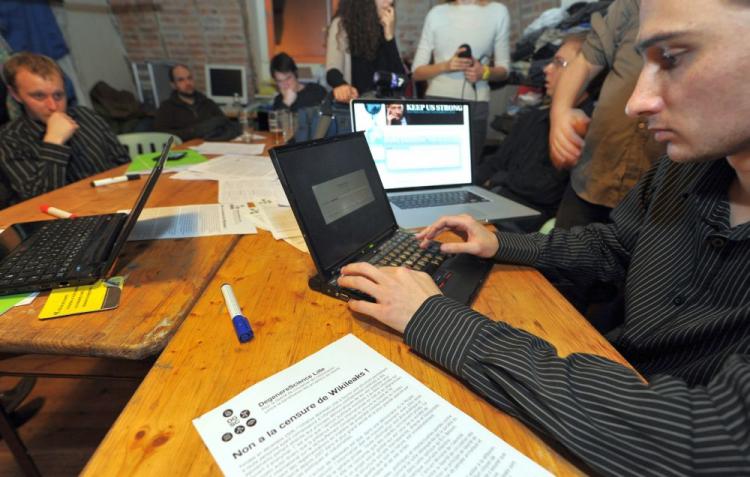
Hackers from the French Degenerescience association visit the anti-secrecy website WikiLeaks on Dec 9. The hackers from this group decided to counter censorship of the WikiLeaks site by creating a network of mirrored servers.  (Philippe Huguen/AFP/Getty Images)
Hackers from the French Degenerescience association visit the anti-secrecy website WikiLeaks on Dec 9. The hackers from this group decided to counter censorship of the WikiLeaks site by creating a network of mirrored servers. (Philippe Huguen/AFP/Getty Images)
While some forms of oppression can be hidden from the outside world, information blockades and Web-based oppression provide an open window into a society's level of freedom.

Everything from social inequalities to government oppression in the physical world “are reinscribed in cyberspace,” said professor Barney Warf of the University of Kansas Department of Geography.

Warf has recently published a report that found a clear link between a given society's overall freedom and the level of its Internet freedom. The utopian view of the Internet “tends to be a little bit too rosy and it ignores the extent to which many governments go to try and eliminate access to the Internet,” he said.

The Internet is used by more than a quarter of the world’s population, yet “one-quarter of the world’s netizens live under the harshest forms of censorship, and in most countries self-censorship accomplishes what governments have not,” Warf stated in his latest report.

The issue of Internet censorship—and even the roles some U.S. companies have played in establishing and continuing it—was raised by Secretary of State Hillary Clinton after Google had announced that it would no longer censor its Chinese domain, Google.cn.

Following Clinton’s speech, U.S. senior adviser for innovation Alec Ross said during a Jan. 22 Department of State press briefing, “One of the key takeaways that I hope you all took from the speech was her point that this doesn’t just go to the issue of information freedom, but it also goes to the issue of what kind of world we want to live in.”

“Do we want to live in a world with one Internet, one common knowledge base from which we can all draw? Or, do we want to live in a world in which access to information and knowledge is based on what country you live in and the whims of the censors in that country?” he added.

As technology becomes more advanced, so do the uses for the Internet. With the dawn of the Web 2.0 movement—essentially transforming the Web from static websites to a forum for collaboration and social networking—the ability of individuals to share and access information is now stunning. This has also raised concern over the openness of the Internet.

The WikiLeaks organization has proven that it is nearly impossible to stop information from spreading online once it is released. Cyberterrorism raises similar issues. Terrorist groups use websites like YouTube to post propaganda videos. If these clips are removed from one site, they can be back up at another location within minutes.

Internet piracy has also pushed the boundaries further. The ability to download illegal content has placed the Internet at a crossroads, and governments continuously search for ways to successfully block such content.

Official regulations pertaining to the Internet in the United States were set on Dec. 21 with the Federal Communication Commission’s (FCC) passing of the Net Neutrality laws. The new rules state that Internet service providers cannot “block lawful content, applications, services, or non-harmful devices, subject to reasonable network management.” The point of mentioning “lawful content” leaves the door open to block content such as that being released by WikiLeaks or video-download services.

Internet Blockades

Despite actions to block illegal file sharing, the United States remains toward the top of the list when it comes to Internet freedom.

Some countries allow little to no Internet access. North Korea, in particular, blocks Internet access almost completely, except for select government officials who are permitted access. Other countries, such as China, allow a degree of access, yet rule the digital world with an iron fist.

“The Chinese are the worst in many respects, and not only have they pioneered this, but they have exported their censorship—programs and such—to countries like Iran, and Cuba, and Uzbekistan, and elsewhere. So, a lot of the blame for this goes on the Chinese government,” Warf said.

China’s Internet censorship program, loosely called “The Great Firewall,” was started in 2006 in part by software developed by U.S. companies, including Nortel and Cisco Systems, according to Warf.

“It takes a wide variety of forms, from blocking access to websites, to monitoring chat rooms, to making people at cybercafes register their names. They even have women in Chinese cybercafes who police Internet usage. They’re called ‘Big Mammas,’” he said.

If a user tries to access a blocked website in China, they are greeted by two cartoon police officers pointing to their eyes and smiling. The characters pop up on the screen and “tell you that you tried to access a forbidden website and warn you that continued attempts will lead to investigation,” Warf said.

Follow Joshua on Twitter: @JoshJPhilipp