Hurricane force winds from Hurricane Earl are expected to reach North Carolina’s Outer Banks Thursday night even if the center of Earl remains offshore, the National Hurricane Center announced at 2 p.m. EDT Thursday.
On its forecast track, the center of the hurricane will pass near the Outer Banks of North Carolina Thursday night and approach southeast New England Friday night before it travels farther north to Canada.
“Millions of people will be affected by this massive storm,” the Weather Channel warns on its website.
So far, U.S. officials have issued a mandatory evacuation for 30,000 residents and visitors on Hatteras Island and 5,000 people on Ocracoke Island, which is only accessible by ferry and airplane.
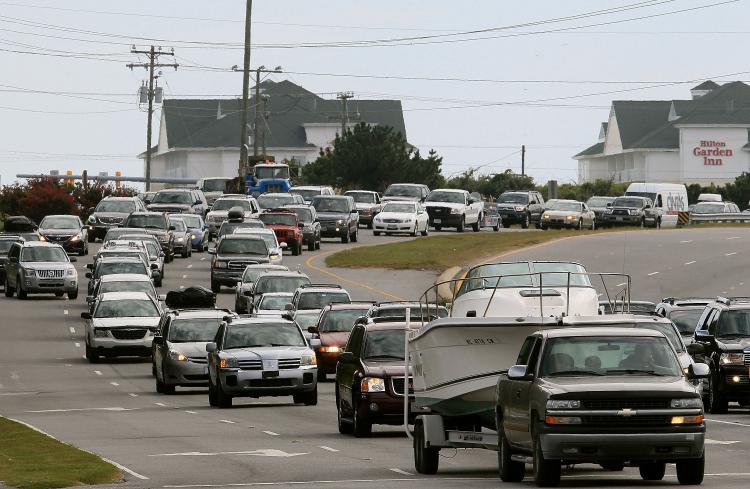
“This is a crucial time for people living in storm-surge zones and in flood plains,” says a release from the North Carolina Department of Crime Control and Public Safety. “Those ordered to evacuate must do so immediately. Evacuation routes will become congested, causing traffic to move slowly. Law enforcement officials will be assigned to evacuation zones to secure private property and the safety of evacuees.”
On Thursday morning, President Barack Obama declared an emergency in North Carolina and the North Carolina National Guard is deploying 80 troops to alleviate the situation. Obama authorized the Department of Homeland Security and Federal Emergency Management Agency (FEMA) to coordinate all disaster relief efforts.
The Category 3 Hurricane Earl, situated about 245 miles (365 km) south of Cape Hatteras, N.C., is spinning toward North Carolina at 18 mph with maximum sustained winds of 125 mph.
Data collected by a reconnaissance plane indicate that Earl has started to weaken, a trend that will continue throughout Thursday and Friday.
Earl has weakened from a Category 4 storm to a Category 3 storm on Thursday afternoon, but Earl is forecast to remain a powerful hurricane as it passes near the Outer Banks.
The hurricane is expected to bring raised water levels, heavy rainfall, gusty winds, dangerous surf, and large swells to the East Coast.
A Category 3 storm on the Saffir-Simpson Hurricane Scale can lead to “devastating damage,” according to the center.
On its forecast track, the center of the hurricane will pass near the Outer Banks of North Carolina Thursday night and approach southeast New England Friday night before it travels farther north to Canada.
“Millions of people will be affected by this massive storm,” the Weather Channel warns on its website.
So far, U.S. officials have issued a mandatory evacuation for 30,000 residents and visitors on Hatteras Island and 5,000 people on Ocracoke Island, which is only accessible by ferry and airplane.
“This is a crucial time for people living in storm-surge zones and in flood plains,” says a release from the North Carolina Department of Crime Control and Public Safety. “Those ordered to evacuate must do so immediately. Evacuation routes will become congested, causing traffic to move slowly. Law enforcement officials will be assigned to evacuation zones to secure private property and the safety of evacuees.”
On Thursday morning, President Barack Obama declared an emergency in North Carolina and the North Carolina National Guard is deploying 80 troops to alleviate the situation. Obama authorized the Department of Homeland Security and Federal Emergency Management Agency (FEMA) to coordinate all disaster relief efforts.
The Category 3 Hurricane Earl, situated about 245 miles (365 km) south of Cape Hatteras, N.C., is spinning toward North Carolina at 18 mph with maximum sustained winds of 125 mph.
Data collected by a reconnaissance plane indicate that Earl has started to weaken, a trend that will continue throughout Thursday and Friday.
Earl has weakened from a Category 4 storm to a Category 3 storm on Thursday afternoon, but Earl is forecast to remain a powerful hurricane as it passes near the Outer Banks.
The hurricane is expected to bring raised water levels, heavy rainfall, gusty winds, dangerous surf, and large swells to the East Coast.
A Category 3 storm on the Saffir-Simpson Hurricane Scale can lead to “devastating damage,” according to the center.