


Using happiness and well-being as a measure of economic and social progress rather than relying solely on GDP appears to be gathering momentum on the international political scene.
According to British Prime Minister David Cameron, measuring the happiness of the population and using that information to form public policy is an important step in recovering from the recession and building a better life for the people of the U.K.
“It will help bring about a re-appraisal of what matters, and in time, it will lead to government policy that is more focused not just on the bottom line, but on all those things that make life worthwhile,” he said in a speech on Nov. 25.
Cameron’s announcement to implement a “happiness index” follows a similar move by France last September, when President Nicolas Sarkozy said his government would include happiness and well-being when measuring the country’s economic progress after the fallout from the global economic crisis.
Sarkozy invited other countries to follow his lead, saying, “A great revolution is waiting for us.”
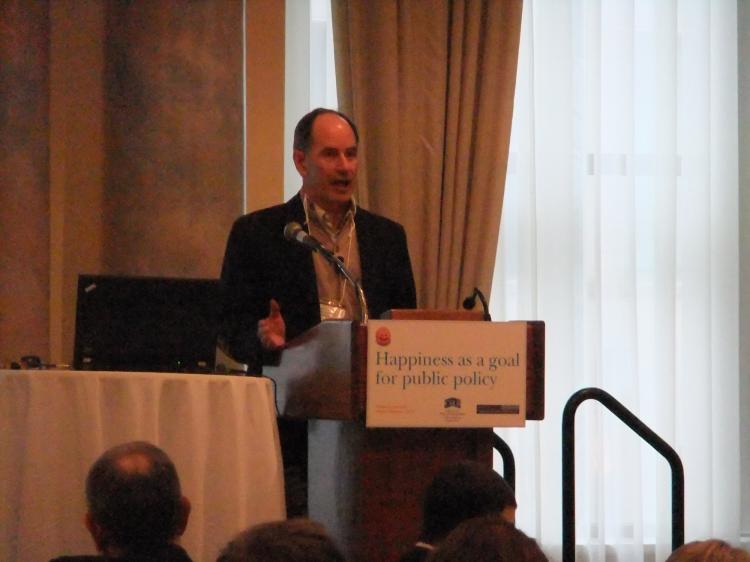
Happiness economics was also the topic of a conference in Ottawa last week, where a group of speakers including public policy experts and economists mulled over whether Canada should have happiness as an objective for public policy and, if so, what those policies should be.
“There was a large number of government officials at the conference,” says Andrew Sharpe, Executive Director of the non-profit Centre for the Study of Living Standards (CSLS), which hosted the conference along with the Ontario government’s Institute for Competitiveness and Prosperity (ICAP).
“I had a meeting with the deputy ministers before the conference to brief them and fill them in on what’s happening. So there is interest at the senior levels in this issue.”
France is taking into consideration the recommendations of Nobel Prize economists Joseph Stiglitz and Amartya Sen, who President Sarkozy has asked to look into alternative ways of measuring social well-being and economic progress.
The Stiglitz Commission report released last September recommended governments give greater attention to the issue of subjective well-being.
The term gross national happiness (GNH) was coined in 1972 by the then-king of Bhutan, who sought to build an economy that would serve Bhutan’s unique culture based on Buddhist spiritual values.
Over the years Bhutan, with the support of the UN Development Program, has put the concept into practice, measuring quality of life or social progress in more holistic and psychological terms than GDP.
According to the CSLS, the origins of the study of happiness can be traced back to Aristotle, who opposed the notion that happiness came from pleasure derived from a person’s body or material possessions. He believed happiness resulted from a good birth accompanied by a lifetime of good friends, children, health, wealth, and a contented old age.
He emphasized the importance of a lifetime of virtuous activity, which in turn required a sufficient supply of material goods to sustain it.
Economists in the late 19th century theorized that extra income brought less extra happiness as a person got richer. In a 1974 study, American economist Richard Easterlin identified a “saturation point” beyond which more money would not equal more happiness.
His findings showed that although income per person rose steadily in the U.S. between 1946 and 1970, average reported happiness showed no long-term trend and declined between 1960 and 1970.
A 2008 study, however, found that increases in income are clearly linked to increased self-reported happiness, both for individual people and countries.
Key findings from a recent CSLS/ICAP study show that mental and physical health, a sense of belonging to one’s community, marital and immigration status, unemployment, and stress are major influences on happiness.
Called “Does Money Matter? Determining the Happiness of Canadians,” the study found that overall, Canadians are a happy lot, with 91 percent being either satisfied or very satisfied with their lives.
“We’re number fifth in the world, so we’re already doing OK,” says Sharpe. “But we could do even better.”
According to British Prime Minister David Cameron, measuring the happiness of the population and using that information to form public policy is an important step in recovering from the recession and building a better life for the people of the U.K.
“It will help bring about a re-appraisal of what matters, and in time, it will lead to government policy that is more focused not just on the bottom line, but on all those things that make life worthwhile,” he said in a speech on Nov. 25.
Cameron’s announcement to implement a “happiness index” follows a similar move by France last September, when President Nicolas Sarkozy said his government would include happiness and well-being when measuring the country’s economic progress after the fallout from the global economic crisis.
Sarkozy invited other countries to follow his lead, saying, “A great revolution is waiting for us.”
Happiness economics was also the topic of a conference in Ottawa last week, where a group of speakers including public policy experts and economists mulled over whether Canada should have happiness as an objective for public policy and, if so, what those policies should be.
“There was a large number of government officials at the conference,” says Andrew Sharpe, Executive Director of the non-profit Centre for the Study of Living Standards (CSLS), which hosted the conference along with the Ontario government’s Institute for Competitiveness and Prosperity (ICAP).
“I had a meeting with the deputy ministers before the conference to brief them and fill them in on what’s happening. So there is interest at the senior levels in this issue.”
France is taking into consideration the recommendations of Nobel Prize economists Joseph Stiglitz and Amartya Sen, who President Sarkozy has asked to look into alternative ways of measuring social well-being and economic progress.
The Stiglitz Commission report released last September recommended governments give greater attention to the issue of subjective well-being.
The term gross national happiness (GNH) was coined in 1972 by the then-king of Bhutan, who sought to build an economy that would serve Bhutan’s unique culture based on Buddhist spiritual values.
Over the years Bhutan, with the support of the UN Development Program, has put the concept into practice, measuring quality of life or social progress in more holistic and psychological terms than GDP.
According to the CSLS, the origins of the study of happiness can be traced back to Aristotle, who opposed the notion that happiness came from pleasure derived from a person’s body or material possessions. He believed happiness resulted from a good birth accompanied by a lifetime of good friends, children, health, wealth, and a contented old age.
He emphasized the importance of a lifetime of virtuous activity, which in turn required a sufficient supply of material goods to sustain it.
Economists in the late 19th century theorized that extra income brought less extra happiness as a person got richer. In a 1974 study, American economist Richard Easterlin identified a “saturation point” beyond which more money would not equal more happiness.
His findings showed that although income per person rose steadily in the U.S. between 1946 and 1970, average reported happiness showed no long-term trend and declined between 1960 and 1970.
A 2008 study, however, found that increases in income are clearly linked to increased self-reported happiness, both for individual people and countries.
Key findings from a recent CSLS/ICAP study show that mental and physical health, a sense of belonging to one’s community, marital and immigration status, unemployment, and stress are major influences on happiness.
Called “Does Money Matter? Determining the Happiness of Canadians,” the study found that overall, Canadians are a happy lot, with 91 percent being either satisfied or very satisfied with their lives.
“We’re number fifth in the world, so we’re already doing OK,” says Sharpe. “But we could do even better.”


