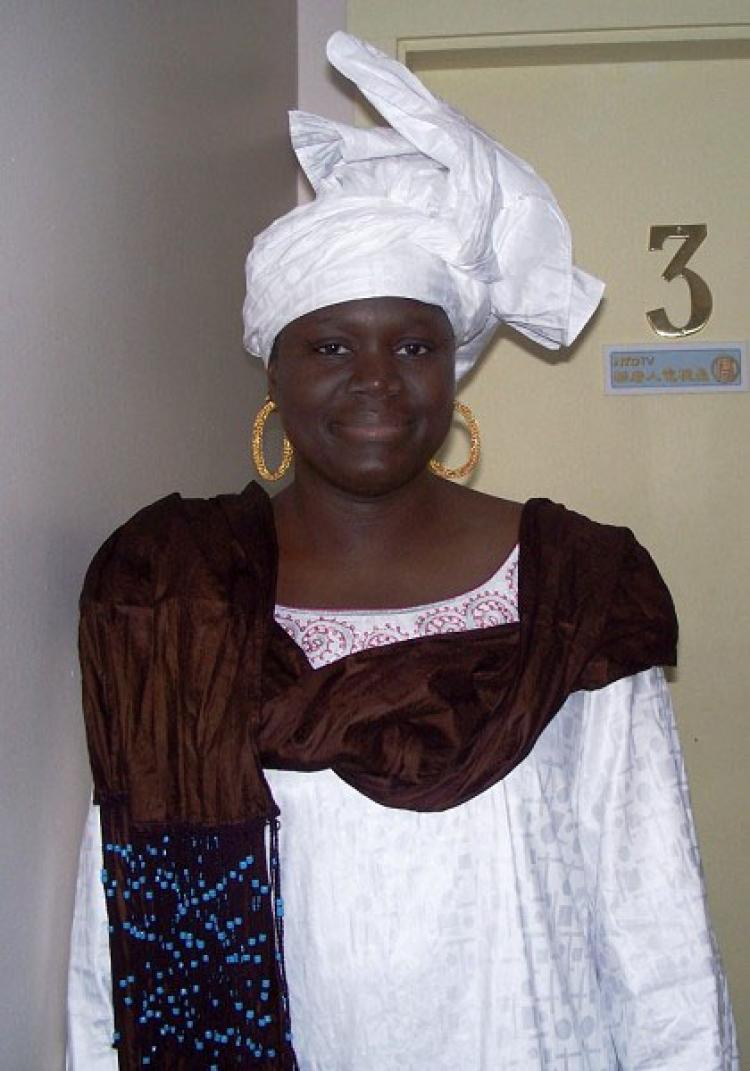
NEW YORK—Maimouna Ngom (Manny) was born is Senegal, raised in Paris, and now a professional fashion designer in Canada. It was an unusual and fated twist in direction for her to start designing traditional Chinese couture garments. Her ensembles look fit for Chinese court ladies or empresses, or for the set of “House of Flying Daggers.”
Ngom entered the Han Couture Global Design Competition that took place in the fashion capital of New York on Oct.19. The competition aims at reviving the rich and spiritual fashions of ancient China—a challenge that changed Manny’s views on fashion for good.
As a non-Chinese, Ngom’s attention to detail and craftsmanship won her an Honorable Mention award in the Casual Wear category and her formal wear was a tough act to follow, standing out with a distinct presence.
“They used to dress elegant, they dressed with thought, they used to dress rich, in silk, which we don’t see nowadays,” said Manny, dressed elegantly in her own evening wear, a combination of African dress with more Asian-patterned fabric.
“Because I’m a fashion designer, the design that I do, I copy a lot, for the mass market—which is not rewarding for a fashion designer, or challenging. So when I heard about the competition, I thought, OK, I’m not Chinese but I’m going to challenge myself on the creativity side, and in all aspects of fashion.”
“I hope that I will make the ancient Chinese couture culture proud,” she continued.
Asked if she prefers Western-style fashion or ancient Han fashion, Ngom was a complete convert. “
“You know, usually I go see Web sites with all the fashion designers, but when I was doing the competition, designing, I had no interest going to see those designers. I find ancient Chinese clothing was so rich, and so profound and so intricate. Honestly, today I prefer Han couture—100 percent.”
Crash Course in Ancient Attire
Once she had decided to enter, Ngom had to give herself a crash course in ancient Chinese attire. “First I had to learn a bit about Chinese culture. I didn’t have much time to submit my sketches, so 5,000 years of culture I had to get through quickly. I went to the library, and I only studied the ancient, anything with ancient, like from the paintings … and everything was there, there I found my designs.”
What she discovered, however, was not only a look, a style, but also that the culture of dressing in ancient China involved far more than aesthetics. “I read that the Chinese culture was given to the Chinese by the gods—that’s what they believe. So I said to myself, when I design it has to be divine.”
“They were very righteous, very elegant … And I learned that the clothing reflected what the people believed … it was all thoughtful; it was a combination of innocence and beauty, which you don’t see today. You don’t see that in fashion.”
As the models floated gracefully down the runway, poised and noble, you could see wearing the gowns made them feel incredibly beautiful and feminine. But there is an aura of strength coming from within that may be tied to the garments’ spiritual bearings. The Buddhist and Daoist belief in maintaining harmony between heaven and humans was reflected in every aspect of society, including clothing and style.
Each part of the garment seems to symbolize humans’ connection with heaven, from the seam that runs down the back, symbolizing that the Dao of humans takes the middle road between heaven and earth, to the sash that connects the top to the skirt, creating one garment. The sash represents the need for humans to be balanced, up-right, and unbiased.
The Shen Yi—the traditional robe—is made of four pieces of fabric representing the four seasons, and the skirt is made of 12 pieces, representing the 12 months of the year. When a person puts on the garment, it should have the effect of motivating the wearer to follow the laws of heaven and earth in everything that person does, and to follow the natural patterns of life, being in harmony with nature.
Loving the Challenge
As well as being inspired by the depth of meaning, Ngom clearly has an eye for design. Balancing refined elegance with breathtaking drama, her creations stood out among many exquisite designs.
“My base fabrics were all silks, because back in ancient China it was just silk. I used all kinds of silk—printed silk, embroidered silks, and silk with beading, and from there I designed each garment. They’re all very difficult, and intricate. They have a lot of stitching and sewing, very intricate. I heard that the judges will see that. I hope they will see that in mine,” Ngom said at the show while waiting for results.
“The most difficult thing I encountered in the competition was to choose the right fabric. We had to send in our fabric samples and design sketches in July this year. I didn’t know if I would pass; you have no idea the first time, right. So as a non-Chinese I had no idea if I did a nice job.”
Loving a good challenge, Ngom said next year she’ll try her hand at Han couture for men.