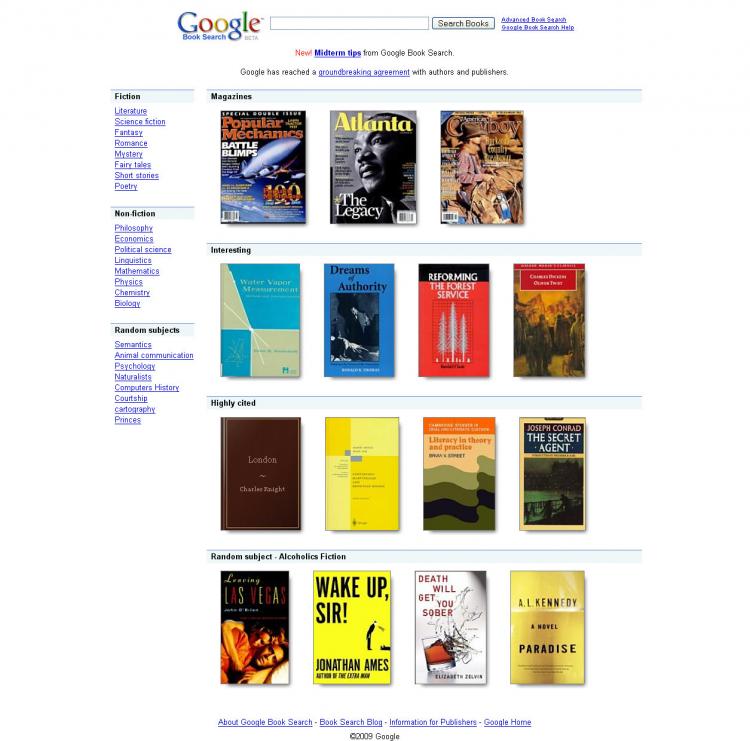
Google Inc. announced on Tuesday that it would exclude books still being sold in Europe from its massive campaign to scan out-of-print books for sale online.
Backing off under increasing pressure from European regulators as well as bookstores and sellers, Google said that its “Books Registry” program would not include books listed as commercially available in Europe without the express permission of the book authors to do so.
The search giant had reached a settlement with authors and publishers in October 2008, agreeing to pay them $125 million to resolve a lawsuit that had been brought against it by the Authors Guild in 2005.
However, that settlement only applied to users in the United States, and still faces some criticism. In addition, the settlement has to be approved by a federal judge in October 2009.
Google said that it would add two non-U.S. representatives to the Books Rights Registry board, which was set up to govern the agreed-upon books settlement.
In 2004, Google started scanning out-of-print books from public libraries, such as New York Public Library, and university libraries, including those at Stanford and Harvard. It made them available online through Google Books, and allowed Internet users to browse through books online.
Before the settlement, Google Books only allowed users to read snippets from books, but the settlement allowed Google to offer the entire copyrighted work to online searchers.
Google Books currently allows online users to browse through the book, and purchase it online for a fee. It also allows unlimited printing access with a per-page fee through public libraries and through individual subscriptions for institutions and universities.
While civil rights activists support Google’s digitization of books and offering them online, critics complain about a for-profit company—especially one with a poor privacy history such as Google—operating such a giant online library.
Backing off under increasing pressure from European regulators as well as bookstores and sellers, Google said that its “Books Registry” program would not include books listed as commercially available in Europe without the express permission of the book authors to do so.
The search giant had reached a settlement with authors and publishers in October 2008, agreeing to pay them $125 million to resolve a lawsuit that had been brought against it by the Authors Guild in 2005.
However, that settlement only applied to users in the United States, and still faces some criticism. In addition, the settlement has to be approved by a federal judge in October 2009.
Google said that it would add two non-U.S. representatives to the Books Rights Registry board, which was set up to govern the agreed-upon books settlement.
In 2004, Google started scanning out-of-print books from public libraries, such as New York Public Library, and university libraries, including those at Stanford and Harvard. It made them available online through Google Books, and allowed Internet users to browse through books online.
Before the settlement, Google Books only allowed users to read snippets from books, but the settlement allowed Google to offer the entire copyrighted work to online searchers.
Google Books currently allows online users to browse through the book, and purchase it online for a fee. It also allows unlimited printing access with a per-page fee through public libraries and through individual subscriptions for institutions and universities.
While civil rights activists support Google’s digitization of books and offering them online, critics complain about a for-profit company—especially one with a poor privacy history such as Google—operating such a giant online library.