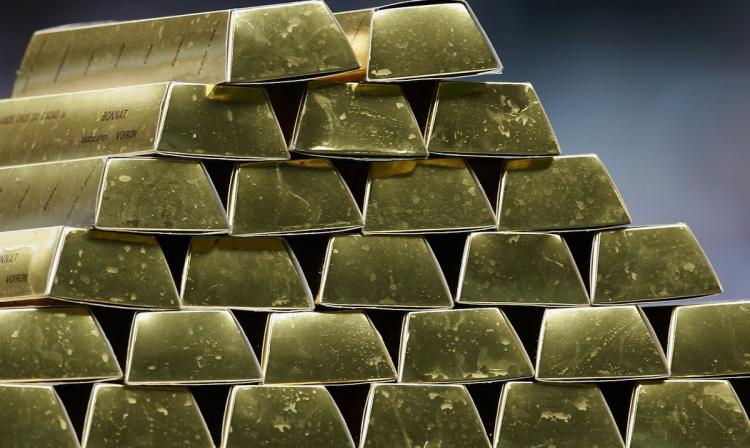
The economic downturn brought with it an upturn in the demand for gold, as investors had been burned in the stock market and believed that possessing gold bars, jewelry, or investments would hedge them against further losses.
“European demand for gold bars and coins in 2008 was close to 243 tons and in 2009 rose to 293 tons,” according to the World Gold Council (WGC) publication Gold Demand Trends, published late last month.
The United States Mint sold gold worth $480 million in the second quarter of 2010.
Investors, looking for a safe haven, bought gold-backed securities during Q2, with Exchange Traded Funds (ETFs) leading the way. Overall, gold purchases increased by 36 percent (1,050 tons of gold) over the same period in 2008, with major purchases from Asia. Gold jewelry accounted for more than one-third of all sales, and gold bars accounted for about 10 percent of gold sales.
“In Q2 2010, the diversity of gold’s demand base, less driven by industrial uses as many other commodities, meant that gold was one of the best performing commodities,” according to the WGC.
Demand for gold in industrial markets by companies that use gold in their production because of its good electrical and thermal conductivity increased by 14 percent when compared with the same period in 2009, indicating that production is increasing. The increase is attributed to improved electronic equipment sales.
“During the second quarter, many financial assets, especially in Europe, suffered losses as risk aversion, credit concerns, and disappointing economic news around the world prompted investors to seek assets with little or no default risk, greater liquidity and lower volatility,” WGC said. “As a result, gold was, once again, one of very few assets that exhibited a positive price performance during the period.”
Gold as Investment
Investors are increasingly using gold has a hedge against economic inflation as well as stock market downturns.
“To protect yourself against inflation, deflation, stock market weakness and potential currency problems—in other words, if you want to hedge financial uncertainties, there is only one portfolio item that will serve you in all seasons and under most circumstances—gold coins and bullion,” state the experts at USA Gold.
However, the experts caution from converting all assets into gold bullions or coins and suggest that one limits the holdings to between 10 percent and 30 percent of one’s assets.
“You cannot approach gold the way you approach stock or real estate investments. Timing is not the real issue. The first question you need to ask yourself is whether or not you believe you need to own gold,” cautioned gold specialists.
Global Gold Coffers
Surprisingly, when discussing gold reserves or deposits, investors and analysts have little sense of the production of gold or the amount of reserves still underground. The majority of analysts view gold from the perspective of what has already been mined or is in the hands of central banks.
The International Monetary Fund (IMF) held close to 97 million ounces of gold at the beginning of 2010 with an early September market price of around $118.3 billion.
The IMF has sold gold five times since 1957, with the last sale of around 13 million ounces announced at the end of 2009. IMF sells gold when it is in need of liquid assets, which it lends to member nations at lower interest rates and longer repayment terms than standard loans.
The Reserve Bank of India bought almost half of the IMF gold at a market price of $6.7 billion. The Bank of Mauritius bought 2 metric tons of gold for $71.7 million and Sri Lanka spent $375 million for approximately 4 metric tons of the gold.
“This transaction is an important step toward achieving the objectives of the IMF’s limited gold sales program, which are to help put the Fund’s finances on a sound long-term footing and enable us to step up much-needed concessional lending to the poorest countries,” said Dominique Strauss-Kahn, managing director at the IMF, in a statement about gold sales to India.
As of June, the United States held 8,133.5 tons of gold, by far the country with the largest holdings of gold.
With today’s gold prices having hedged up from the $1,122 spot price/ounce on Jan. 4, to the $1,252/ounce on Sept. 3, the U.S. holdings would have a value of around $293 billion.
Considering that the average spot price in 1970 was $38.90, gold has appreciated at a rate of 338 percent over a period of 40 years.
Nongovernmental holders that hold significant amounts of gold are ETFs, amounting to approximately 1,856 tons of gold bullions.
Gold Harvesting in the 21st Century
The world’s total mined gold reserves amounts to about $5 trillion, while annual production is around $73 billion at end-of-June market prices, according to Kitco, a retailer of precious metals.
Africa holds the largest underground gold ore reserves, an estimated 40 percent of the world’s total reserves.
With increasing demand and record high prices for gold, gold mining should have taken on new heights. Just the reverse happened: “Since 2001 mined gold production has fallen by 8.6%,” according to an article on the Zeal Speculation and Investment blog.
Worldwide gold mining production has been on a downward slide since it peaked in 2003, with the lowest level in 2008, falling to a 10-year low.
“Formerly the world’s No.1 gold mining nation, South Africa saw gold output drop by 15% last year [2008] thanks to a combination of energy shortages, labor disputes (mostly over the industry’s horrific safety record) and the cold, hard fact that South Africa’s gold reserves are being mined out,” according to a report from the Gold 2009 website.
By the end of 2009, South Africa’s gold production took a nose dive, falling by 5.8 percent over the prior year. During the first quarter of 2010, gold mining had decreased by 2 percent from the same period in 2008. In 1970, South Africa’s mines produced 67.7 percent of the world’s gold production. By 1985, it decreased to 43.8 percent and by 2009 to 9.8 percent.
“A similar slowdown in gold mining output has also hit the mature fields of the United States, Canada and Australia,” according to the Gold 2009 report. Rather than dwindling reserves, as in South Africa, lack of skilled labor has contributed to the slowdown of gold mining output in these countries. “We’ve had a real shortage of skilled labor,” said Judith Mosley, head of mining finance at Society Generale.
China has become the world’s No. 1 producer, producing 12.2 percent of the world’s gold in 2009. China didn’t show up as a significant producer of gold in the major statistical publications until 1995, when it produced 6.2 percent of the world’s production output. The United States has taken second place, with a 9.9 percent output in 2009.
“European demand for gold bars and coins in 2008 was close to 243 tons and in 2009 rose to 293 tons,” according to the World Gold Council (WGC) publication Gold Demand Trends, published late last month.
The United States Mint sold gold worth $480 million in the second quarter of 2010.
Investors, looking for a safe haven, bought gold-backed securities during Q2, with Exchange Traded Funds (ETFs) leading the way. Overall, gold purchases increased by 36 percent (1,050 tons of gold) over the same period in 2008, with major purchases from Asia. Gold jewelry accounted for more than one-third of all sales, and gold bars accounted for about 10 percent of gold sales.
“In Q2 2010, the diversity of gold’s demand base, less driven by industrial uses as many other commodities, meant that gold was one of the best performing commodities,” according to the WGC.
Demand for gold in industrial markets by companies that use gold in their production because of its good electrical and thermal conductivity increased by 14 percent when compared with the same period in 2009, indicating that production is increasing. The increase is attributed to improved electronic equipment sales.
“During the second quarter, many financial assets, especially in Europe, suffered losses as risk aversion, credit concerns, and disappointing economic news around the world prompted investors to seek assets with little or no default risk, greater liquidity and lower volatility,” WGC said. “As a result, gold was, once again, one of very few assets that exhibited a positive price performance during the period.”
Gold as Investment
Investors are increasingly using gold has a hedge against economic inflation as well as stock market downturns.
“To protect yourself against inflation, deflation, stock market weakness and potential currency problems—in other words, if you want to hedge financial uncertainties, there is only one portfolio item that will serve you in all seasons and under most circumstances—gold coins and bullion,” state the experts at USA Gold.
However, the experts caution from converting all assets into gold bullions or coins and suggest that one limits the holdings to between 10 percent and 30 percent of one’s assets.
“You cannot approach gold the way you approach stock or real estate investments. Timing is not the real issue. The first question you need to ask yourself is whether or not you believe you need to own gold,” cautioned gold specialists.
Global Gold Coffers
Surprisingly, when discussing gold reserves or deposits, investors and analysts have little sense of the production of gold or the amount of reserves still underground. The majority of analysts view gold from the perspective of what has already been mined or is in the hands of central banks.
The International Monetary Fund (IMF) held close to 97 million ounces of gold at the beginning of 2010 with an early September market price of around $118.3 billion.
The IMF has sold gold five times since 1957, with the last sale of around 13 million ounces announced at the end of 2009. IMF sells gold when it is in need of liquid assets, which it lends to member nations at lower interest rates and longer repayment terms than standard loans.
The Reserve Bank of India bought almost half of the IMF gold at a market price of $6.7 billion. The Bank of Mauritius bought 2 metric tons of gold for $71.7 million and Sri Lanka spent $375 million for approximately 4 metric tons of the gold.
“This transaction is an important step toward achieving the objectives of the IMF’s limited gold sales program, which are to help put the Fund’s finances on a sound long-term footing and enable us to step up much-needed concessional lending to the poorest countries,” said Dominique Strauss-Kahn, managing director at the IMF, in a statement about gold sales to India.
As of June, the United States held 8,133.5 tons of gold, by far the country with the largest holdings of gold.
With today’s gold prices having hedged up from the $1,122 spot price/ounce on Jan. 4, to the $1,252/ounce on Sept. 3, the U.S. holdings would have a value of around $293 billion.
Considering that the average spot price in 1970 was $38.90, gold has appreciated at a rate of 338 percent over a period of 40 years.
Nongovernmental holders that hold significant amounts of gold are ETFs, amounting to approximately 1,856 tons of gold bullions.
Gold Harvesting in the 21st Century
The world’s total mined gold reserves amounts to about $5 trillion, while annual production is around $73 billion at end-of-June market prices, according to Kitco, a retailer of precious metals.
Africa holds the largest underground gold ore reserves, an estimated 40 percent of the world’s total reserves.
With increasing demand and record high prices for gold, gold mining should have taken on new heights. Just the reverse happened: “Since 2001 mined gold production has fallen by 8.6%,” according to an article on the Zeal Speculation and Investment blog.
Worldwide gold mining production has been on a downward slide since it peaked in 2003, with the lowest level in 2008, falling to a 10-year low.
“Formerly the world’s No.1 gold mining nation, South Africa saw gold output drop by 15% last year [2008] thanks to a combination of energy shortages, labor disputes (mostly over the industry’s horrific safety record) and the cold, hard fact that South Africa’s gold reserves are being mined out,” according to a report from the Gold 2009 website.
By the end of 2009, South Africa’s gold production took a nose dive, falling by 5.8 percent over the prior year. During the first quarter of 2010, gold mining had decreased by 2 percent from the same period in 2008. In 1970, South Africa’s mines produced 67.7 percent of the world’s gold production. By 1985, it decreased to 43.8 percent and by 2009 to 9.8 percent.
“A similar slowdown in gold mining output has also hit the mature fields of the United States, Canada and Australia,” according to the Gold 2009 report. Rather than dwindling reserves, as in South Africa, lack of skilled labor has contributed to the slowdown of gold mining output in these countries. “We’ve had a real shortage of skilled labor,” said Judith Mosley, head of mining finance at Society Generale.
China has become the world’s No. 1 producer, producing 12.2 percent of the world’s gold in 2009. China didn’t show up as a significant producer of gold in the major statistical publications until 1995, when it produced 6.2 percent of the world’s production output. The United States has taken second place, with a 9.9 percent output in 2009.