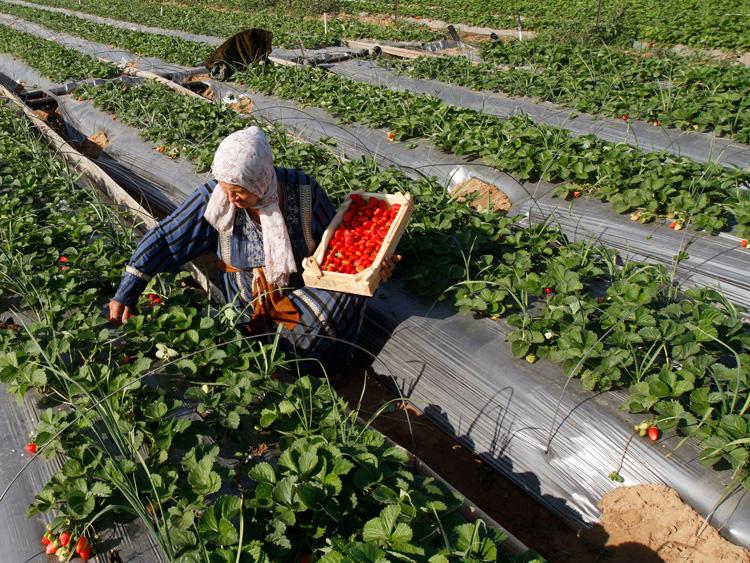
About two weeks prior, on Nov. 28, a similar measure, launched with Dutch funding, enabled exports of flowers and strawberries from the Hamas-controlled Gaza Strip to the European market. Thus far, 23 tons of strawberries and approximately 33,000 flowers have been exported, according to data published last week by the Israeli government.
International pressure played a key role in convincing the Israeli government to ease its blockade. International aid and internationally funded projects are currently the pillar of the Gazan economy.
The June 20 decision to expand the variety and amount of goods allowed into the Gaza Strip was made largely due to pressure following the flotilla incident last May, when nine activists were killed while attempting to break through the blockade.
Slow Economic Recovery
The Palestinian Economy was booming after the Oslo accords in 1994, but took a skydive following violence of the second Palestinian uprising, known as the “Intifada,” in 2000. Palestine’s economy has been on a slow course of recovery since. For Gaza, the takeover of Hamas led to international isolation and a restriction of imports and exports for the territory.
An International Monetary Fund report on the Palestinian Economy in September showed an increase in Gaza's economic indicators in 2010. GDP growth in Gaza is estimated at 16 percent, according to the report.
It adds that even with the improved economy, however, Gaza’s current output per capita is only 60 percent of its 1994 level, and its unemployment levels are among the highest in the world at 35 percent.
The International Influence
Following the June 20 decision, 64 internationally funded projects focusing on health, infrastructure, housing, and education were approved by the government of Israel in the Gaza Strip.
Although they were approved, the projects have drawn concern from the Israeli government due to the nature of materials they require. Since the beginning of 2010, 78 internationally funded projects were approved for the Gaza Strip by the Israeli government.
Approval was recently granted to complete U.N. construction projects in Gaza, totaling $110 million, confirmed Robert Serry, U.N.'s special coordinator for the Middle East Peace Process in a statement, following the Israeli decision to increase exports from Gaza.
The Palestinian Economy—and the Gazan economy in particular—are heavily dependent on aid from foreign governments and NGOs.
A 2011 strategy, with a nearly $6 billion budget, was presented for Palestinian territories by the United Nation’s humanitarian Consolidated Appeal Process. It is supported by 213 projects, including 147 from local and international NGOs, and 66 from United Nations agencies.
The projects are focused on areas where the Palestinian Authority has limited reach, including the Gaza Strip and areas of the West Bank that are under full control by Israel. This sum does not include international aid and funds to the Palestinian Authority itself.
According to the 2011 appeal, published last week, while Israel's new policy toward Gaza has resulted in increased goods and materials, it has not changed the most fundamental parameters of the blockade. According to the appeal, the number of truckloads entering Gaza between July and September this year constituted less than a fourth of what was moved into the strip in the first five months of 2007, before Hamas took over the Gaza Strip.
“Unless the crossings are completely reopened in a secure environment, allowing, inter alia, full resumption of export flows and legitimate business activity, the socio-economic stranglehold on Gaza will continue to stifle its recovery and development potential and maintain most of its population dependent on humanitarian aid,” reads the appeal.