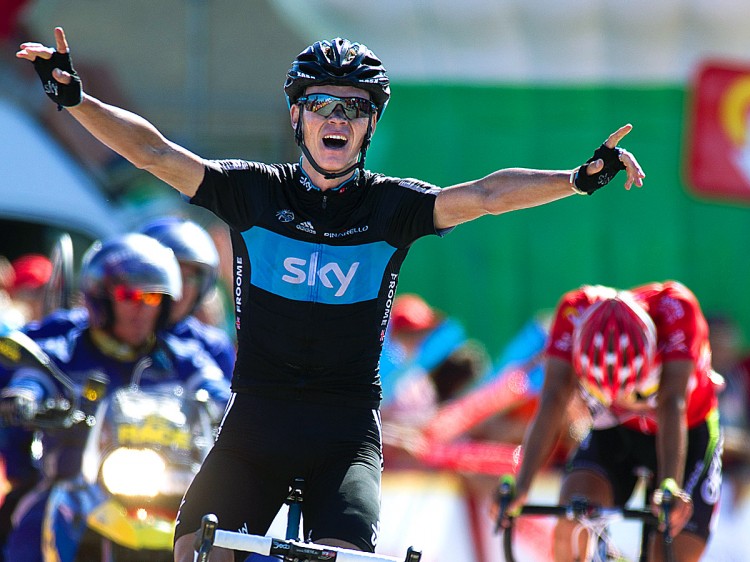
After repeated attacks on a leg-breaking 18% grade in the final two kilometers, Sky’s Chris Froome managed to pass race leader Juan Jose Cobo in the final 100 meters of Stage 17 of the 2011 Vuelta a España, but couldn’t get far enough ahead to win the red jersey.
Froome came into the stage 22 seconds behind the race-leading Geox rider; with 20-, 12-, and 8-second time bonuses for the top three finishers, Froome needed to beat his opponent to the line by 30 seconds.
Cobo crossed the line only a second behind the Sky rider, keeping his race leader’s red jersey by 13 seconds.
Froome’s teammate Bradley Wiggins, Sky’s original pick as GC contender, couldn’t keep up on the climb and finished twelfth, 39 seconds back, 1:41 behind in GC.
"That was indescribable," Froome told cyclingnews.com after the finish. "It was one of the hardest days on the bicycle of my life.
"It was the last mountain top finish and both Bradley and myself came into the stage trying to do as much as we could. But as you could see, Cobo was so strong and he holds the jersey by 13 seconds."
Froome explained that even though Wiggins is the team leader, whichever was in better shape would get support because Sky is all about the team.
"Bradley is stronger than me some days, and some days I'm stronger,” he told Eurosport. “The team has been fantastic—the last two-and-a-half weeks the team have helped us out every day. We are just doing the most we can.
"The worst is now over—we still have to go out and look to make the most of it, but the hardest is over," he concluded.
Stage 17, 211 km from Faustino V to Peña Cabarga, was the race’s longest stage, and the last with a mountaintop finish. The final six-kilometer climb started out with an eight percent grade for the first 3500 meters, followed by a flatter section, before ramping up to 18 percent for the final two kilometers.
This stage offered the last chance for Sky’s Brad Wiggins and Chris Froome, placed second and third on GC, to take time back from Juan Jose Cobo.
The first part of the climb seemed to suit Wiggins; if he could set a high enough pace for the first four km, possibly he could exhaust Cobo enough to hold him off on the steepest sections.
Chris Froome, based on his riding in earlier stages, would fare well on both parts of the climb, but wouldn’t be able to match Cobo.
High Pace
The stage started with numerous attacks which the peloton chased down, hitting speeds of up to 70 kph. Finally, 50 km into the stage, a group of 20 riders were allowed to escape. The pace up the first Cat 2 climb whittled that bunch down to 16; these riders stayed away until the 100-km mark before they were swept up by the speeding peloton.
Five km later a group of six attacked: Sylvain Chavanel (QuickStep,) Johannes Frohlinger (Skil Shimano,) Greg Van Avermaet (BMC,) Olivier Kaisen (Omega Pharma-Lotto,) Guillaume Bonnafond (Ag2R,)and Evgeny Petrov (Astana) opened a gap of almost three minutes. Sylvain Chavanel dropped out of the break after 30 km, and shortly after three riders— Marzio Bruseghin (Movistar,) Matthias Frank (BMC) and polka dot jersey David Moncoutie (Cofidis)—bridged across from the peloton.
This group stayed away until the end of the descent from the day’s second climb, the Cat 2 Portillo de Luneda. Geox, drove the peloton hard, hoping to deliver their man, Juan Jose Cobo, to the base of the final climb in better shape than the competition.
Katusha and Omega Pharma-Lotto moved up to set the pace with Geox through the final intermediate sprint—which no one contested; the pace was too high—and on to the lower slopes of the final climb.
The Decisive Climb
The attacks started almost immediately. Rabobank’s Stevne Kruijswijk was the first to try, followed by Euskatel’s Amets Txurruka. Kruijswijk fell back; Garmin-Cervelo’s Dan martin then launched a powerful assault up the eight-percent grade.
Martin passed Txurruka to take the lead, while Saxo Bank’s Chris Anker Sorenson and Movistar’s Marzio Bruseghin set off in pursuit.
The Garmin rider looked strong; he had a gap of nine seconds over his pursuers at the four-km mark, where the slope started to level out.
Bruseghin accelerated up the six-percent portion, catching Martin at the three-km banner, with the slope now increasing to nine percent. Chris Anker Sorenson finally caught the slowing lead pair as the slope steepened to ten percent.
Meanwhile, Denis Menchov, who had been driving the peloton for Geox, was displaces by Jürgen Van Den Broeck of Omega Pharma-Lotto. Van Den Broeck had been a favorite coming in to the Vuelta, but had never performed to expectation. Apparently he decided Stage 17 was his last chance to get a win for himself and the team; he attacked when the slope dropped to six percent. This left Menchov leading the peloton with Cobo second wheel, and the pair from Sky just behind.
Van Den Broeck caught the leading trio but the grade was kicking up sharply; all three slowed, and the peloton, now led by Juan Jose Cobo with Eusaktel’s Mikel Nieve, passed the attackers 1500 meters from the finish, where the slope increased to 16 percent.
Van Den Broeck attacked again, covered immediately by Nieve with Cobo and Froome following—Wiggins was losing ground at this point, unable to handle the grade.
Cobo Goes for the Stage, Froome for the Lead

The Sky rider did not just open a small gap; he seemed intent on accelerating all the way up the rest of the ascent. He knew he needed 30 seconds to take the race lead, and he seemed able and determined to do just that.
Cobo tried hard to hang on, but he couldn’t match Froome’s acceleration. For the first time all week, the Geox rider seemed to be beaten. It turned out, he was just gathering his strength.
300 meters from the crest, the Geox rider took off again, pedaling strongly after his opponent. Froome, having pushed hard for 700 meters, was starting to tire, and with 200 meters to go, Cobo caught him.
This brought about the amazing spectacle of two climbers, dead tired after a lung-searing 19 percent ascent, trying to outsprint one another up the final meters of the mountain. Cobo took the lead int5o the final 100 meters, but Froome was not done. He found the strength for one more kick, crossing the finish line perhaps five bike-lengths ahead of Cobo.
Rabobank’s Bauke Mollema was next across the line, followed by Dan Martin.
Stage 17 was Froome’s best chance to take the lead; the final climb was tough enough to crack a rider, and with a mountaintop finish, a gap gained on the climb could last until the finish line. The rest of the stages have enough road after the final climbs for a rider to make up lost time.
It is not impossible that Froome could gain 13 seconds, with time bonuses. It seems unlikely; Geox has been riding a smart race and protecting Cobo perfectly. Cobo himself is having a great Vuelta; he has only shown stress once, on this final climb, and he recovered quickly enough to nearly win the stage.
Stage 18
Stage 18 is a breakaway stage; with five categorized climbs before the final flat 25 kilometers, it offers a fine canvas for the right group to create a long break. The GC contenders are unlikely to spend themselves chasing riders who have no chance of winning overall.
At 175 kilometers with three Cat 3s, a Cat 2 and a Cat 1 climb, this could be a very difficult stage; the last two Cat 3 climbs will probably seem a lot steeper and longer than Cat 3s. Still the final 30 kilometers are either descending or flat, there is plenty of room to gain time lost on the climbs.
If Sky really wants to win the 2011 Vuelta, they will need to pick a stage and push the pace, hoping to exhaust Juan Jose Cobo on the final climb. Stage 18, with 25 flat kilometers after the final Cat 3 climb, might not be the best stage for that.
Stage 19, with a closing Cat 2 climb and about eight kilometers after the final descent, might be Sky’s last chance to finally bet a British rider a Grand Tour win. Problem is, Stage 19 is shorter (only 159 km) and the climbs are easier—two Cat 3s and two Cat 2s.
It looks as if Spanish cycling fans will have the best possible finish to this year’s Vuelta: a Spanish rider from a Spanish team should win the Spanish Grand Tour.
|
Vuelta a España Stage 17 |
|
General Classification after Stage 17 |
||||||
|
1 |
Christopher Froome |
Sky |
4:52:38 |
1 |
Juan Jose Cobo |
Geox |
69:31:41 |
|
|
2 |
Juan Jose Cobo |
Geox |
0:00:01 |
2 |
Christopher Froome |
Sky |
0:00:13 |
|
|
3 |
Bauke Mollema |
Rabobank |
0:00:21 |
3 |
Bradley Wiggins |
Sky |
0:01:41 |
|
|
4 |
Daniel Martin |
Garmin-Cervelo |
0:00:24 |
4 |
Bauke Mollema |
Rabobank |
0:02:05 |
|
|
5 |
Igor Anton |
Euskaltel-Euskadi |
0:00:27 |
5 |
Denis Menchov |
Geox |
0:03:48 |
|
|
6 |
Mikel Nieve |
Euskaltel-Euskadi |
0:00:27 |
6 |
Maxime Monfort |
Leopard Trek |
0:04:13' |
|
|
7 |
Marzio Bruseghin |
Movistar |
0:00:29 |
7 |
Vincenzo Nibali |
Liquigas |
0:04:31 |
|
|
8 |
Jurgen Van Den Broeck |
Omega Pharma-Lotto |
0:00:31 |
8 |
Jurgen Van Den Broeck |
Omega Pharma-Lotto |
0:04:45 |
|
|
9 |
Denis Menchov |
Geox |
0:00:31 |
9 |
Daniel Moreno Fernandez |
Katusha |
0:05:20 |
|
|
10 |
Beñat Intxausti |
Movistar |
0:00:35 |
10 |
Mikel Nieve Ituralde |
Euskaltel-Euskadi |
0:05:33 |
|