

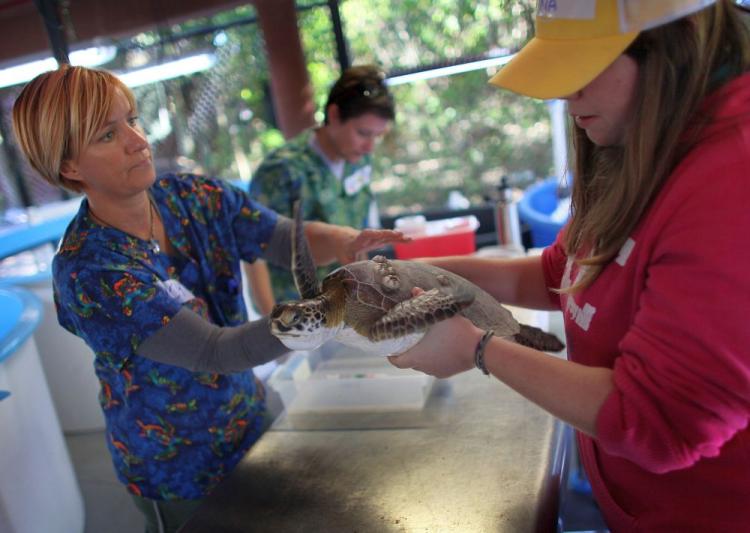
A recent streak of freezing temperatures in Florida have been detrimental to tropical fish farms. Temperatures in Florida have hit record lows of 25 degrees Fahrenheit—enough to destroy orange and immobilize sea turtles from shock.
Local iguanas have even been dropping from the trees, as the cold-blooded reptiles go into a sleep state in temperatures below 40 degrees.
“Anything below 58 degrees is deadly to tropical fish,” said Michael Prater, owner of a fish hatchery called Dade City Tropicals in Dade City, Florida.
Prater is among the lucky ones. He keeps his fish in an indoor greenhouse and heats his ponds with propane. Even so, “it’s killing us in the price of propane,” he added.
The colorful fish are typically sold at pet stores, and Florida produces an estimated 95 percent of the nation’s aquarium fish, according to the Tropical Aquaculture Laboratory.
In 2003, the Florida tropical fish industry was estimated at a value of $47.2 million, making it the most lucrative aquaculture industry in the state, according to the Florida Agricultural Statistics Service.
“I’m afraid a lot of my friends have lost a lot of fish,” said Prater. “It’s gonna put a lot of people out of business.”
It is not easy to recover from a lost crop of tropical fish. For the farmers lucky enough to have their breeding fish indoors, it takes six months for the fish to reach a sellable size.
Prater said that when the fish die, they sink to the bottom of the ponds and rot. Farmers know they lost their crop when they go to feed the fish and none come up.
Some farmers cover their ponds, which can help keep them warm with sunlight, but according to Prater, with “as many days as we’ve had consecutive cold and cloud its not likely [the fish] survived.”
For the fish still left, temperatures in the 50s often cause sickness, which typically starts to show within two weeks when the ponds begin to warm back up. “To survive that will be a pure miracle,” Prater said. “There’s pure stress on them; enormous stress.”
“It’s one of those things you don’t know is gonna happen until it hits you,” he said. “We love the work. We love the fish. It’s disheartening when you’re looking and there’s dead fish everywhere and all your money’s gone.”
Local iguanas have even been dropping from the trees, as the cold-blooded reptiles go into a sleep state in temperatures below 40 degrees.
“Anything below 58 degrees is deadly to tropical fish,” said Michael Prater, owner of a fish hatchery called Dade City Tropicals in Dade City, Florida.
Prater is among the lucky ones. He keeps his fish in an indoor greenhouse and heats his ponds with propane. Even so, “it’s killing us in the price of propane,” he added.
The colorful fish are typically sold at pet stores, and Florida produces an estimated 95 percent of the nation’s aquarium fish, according to the Tropical Aquaculture Laboratory.
In 2003, the Florida tropical fish industry was estimated at a value of $47.2 million, making it the most lucrative aquaculture industry in the state, according to the Florida Agricultural Statistics Service.
“I’m afraid a lot of my friends have lost a lot of fish,” said Prater. “It’s gonna put a lot of people out of business.”
It is not easy to recover from a lost crop of tropical fish. For the farmers lucky enough to have their breeding fish indoors, it takes six months for the fish to reach a sellable size.
Prater said that when the fish die, they sink to the bottom of the ponds and rot. Farmers know they lost their crop when they go to feed the fish and none come up.
Some farmers cover their ponds, which can help keep them warm with sunlight, but according to Prater, with “as many days as we’ve had consecutive cold and cloud its not likely [the fish] survived.”
For the fish still left, temperatures in the 50s often cause sickness, which typically starts to show within two weeks when the ponds begin to warm back up. “To survive that will be a pure miracle,” Prater said. “There’s pure stress on them; enormous stress.”
“It’s one of those things you don’t know is gonna happen until it hits you,” he said. “We love the work. We love the fish. It’s disheartening when you’re looking and there’s dead fish everywhere and all your money’s gone.”