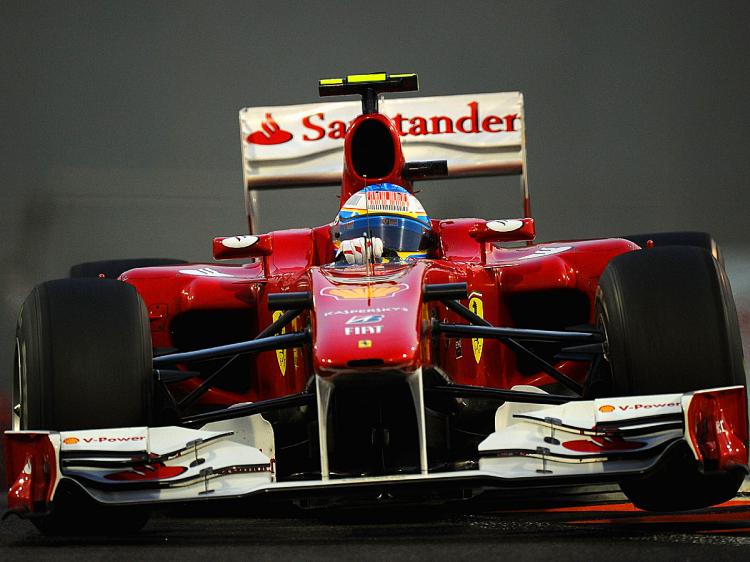
Ferrari has been calling for the FIA (Federation Internationale de l'Automobile, F1’s governing body) to expand Formula One teams from two to three cars—a move which would improve Ferrari’s chance in the World Constructors’ Championship and would also squeeze out several of the smaller teams.
"It would be nice to see a third Ferrari fielded perhaps by a private American team,” di Montezemolo told Italy’s Autosprint magazine. “I'm thinking of a team like Ganassi or Penske. On the question of a third car, we are determined.”
Ferrari, probably the best-funded team on the F1 grid now that BMW, Toyota, and Honda have all withdrawn, would benefit more than its competition if teams were expanded.
"If a team does not have the money to be in Formula 1, they can go to GP2," di Montezemolo continued. "It is disheartening to see someone like [Lotus driver Jarno] Trulli many seconds behind. Think what Jarno could do with a Ferrari given to his team."
The FIA allowed three new teams: Lotus, Virgin, and HST—for 2010. None of the new teams were close to competitive, usually lapping several seconds slower than the next slowest teams.
F1 has a very steep learning curve, and these three teams did not have much time to both prepare funding and design and build cars for 2010, but some in the F1 community felt that smaller grids would be preferable to slower cars, citing possible safety concerns and also saying the image of Formula One as the most elite auto racing series on the planet, would be sullied by poorly-performing teams.
Most of the other teams in the Formula One Team Association rejected Ferrari’s proposal.
Ganassi, Penske, Best of the Americans
It is easy to see why di Montezemolo would choose Americans teams to run Ferrari’s third car; the United States is Ferrari’s biggest market. It is equally easy to see why di Montezemolo would name Penske Racing and Ganassi Racing. Formula One does not attract a lot of fans in America, but the involvement of a big American team might change that, particularly with a U.S. F1 event joining the calendar in 2012.
Roger Penske and Chip Ganassi run some the of the most diverse and most successful racing teams in North America, competing in NASCAR Sprint Cup, NASCAR Nationwide, IndyCar, and at different times in Grand Am and the American Le Mans Series.
Roger Penske has been part of American and international racing for five decades. In the past Penske ran his own F1 team, and also competed in Trans Am and Can Am racing.
This year, Chip Ganassi received the International Motorsports Industry Show (IMIS) Achievement Award and the National Speed Sport News Champion award, the first non-driver winner, and a John Bolster Award from Autosport magazine for team achievement.
In 2010, Ganassi Racing became the first team to win the Daytona 500, the Indy 500, and the Brickyard 400 in one season; Ganassi teams also won the IndyCar and Grand Am championships.
Chip Ganassi racing has won the past three IndyCar championships, and two of the last three Grand Am championships.
Penske Racing and Ganassi Racing teams are invariably well funded, well supported, and operate at the highest levels of proficiency and professionalism. Both teams have the budgets to hire the best personnel, and the records to attract the biggest sponsors.
American Fan Reaction
American fans are feuding over whether di Montezemolo’s comments are an attempt to steal away two of the top IndyCar teams to F1 at a time when IndyCar is struggling to emerge from decades of division; a gesture of respect (implying that these teams are on par with Ferrari’s F1 efforts); or a display of condescension (implying that Ferrari considers these teams suitable only as a backup team.)
Others argue that neither American team would consider a move to F1, which is many times more expensive than any American series, while they are having so much success in the United States. With U.S. racing budgets tight and the economic recovery slow, why would either team risk getting into F1, where the learning curve is very steep, the major players well-established, and the costs phenomenal?
More likely, di Montezemolo’s comments were intended to prod the FIA into considering Ferrari’s desire for three-car teams, sweetening the pot with the allure of American interest; Formula One Management head Bernie Ecclestone is very interested in tapping into the U.S. market.
Likely di Montezemolo is just jockeying for political position, trying to pressure the FIA into giving Ferrari what it always wants: an advantage in F1.
As for Penske and Ganassi, both are businessmen (which is the main reason both have been so successful.) Either would probably be willing to expand into F1—so long as the plan made good business sense.
If sponsors could be lined up, willing to provide half-a-billion dollars in funding; if Ferrari was willing to share all technical details and engineering support; if Penske or Ganassi racing were offered a chance to compete on equal terms with the best in F1, and pay the bills and salaries while doing so, probably either teams would take the step.
Would this be good for F1? Probably not. Most of the existing teams probably couldn’t find the money to fully fund a third car with a top-rank driver, which would leave the grid filled with second-rate efforts, just as it is now.
And allowing Ferrari to dominate F1, as it did in the Schumacher years, would probably scare off any new teams considering an F1 assay, and also might drive off teams like Mercedes Benz, that need to justify every penny to the corporate board.
Ferrari always has a plan for world domination; sometimes the FIA caves in, and sometimes the FIA stands up. Hopefully new FIA boss Jean Todt (who presided over Ferrari during the Schumacher years) will let the new teams learn for a few seasons, and will tell Mr. di Montezemolo that Ferrari is already doing quite well in F1; the team doesn’t need any more advantages.
But as an American racing fan, I lament the fact that there is no U.S. team on the F1 grid, and isn’t likely to be any time soon. One thing is certain, if Penske or Ganassi went to F1, they wouldn’t end up the last season’s USF-1 debacle.
Economically, F1 doesn’t make sense for Penske or Ganassi, but if it did, they’d be there and they’d do it right.