


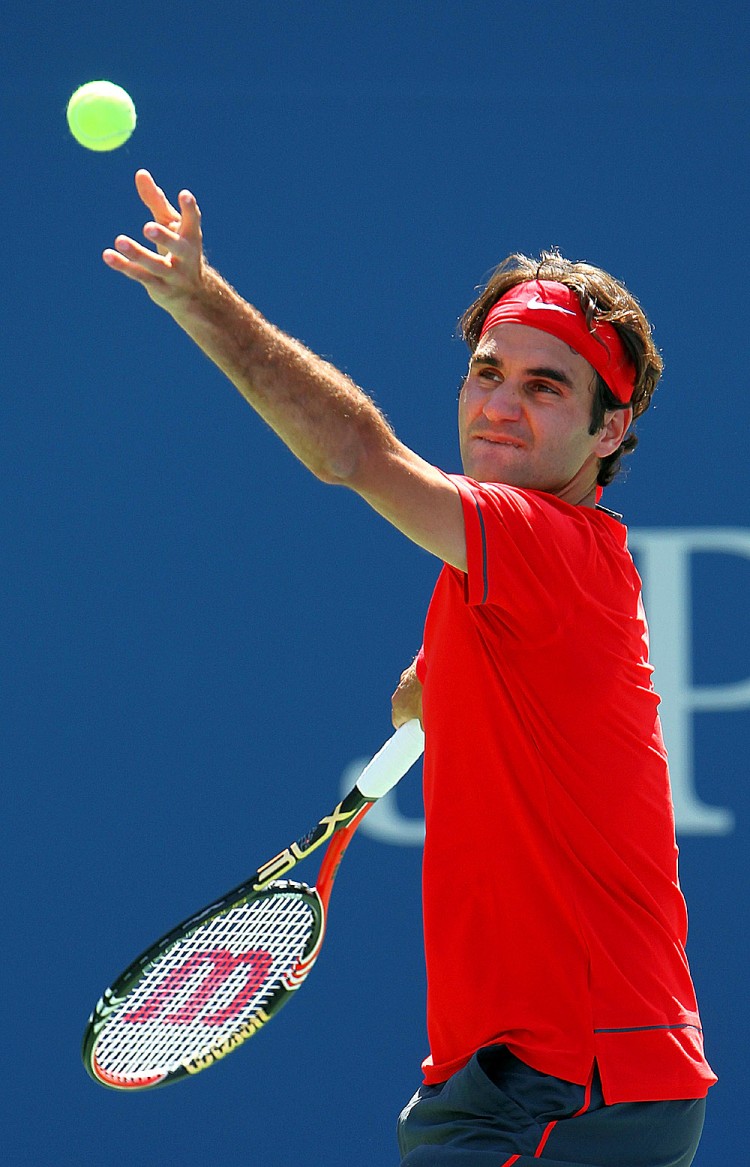
Five-time US Open champion Roger Federer continued his steady advance through the draw, eliminating Israel’s Dudi Sela in straight sets, 6–3, 6–2, 6–2.
Federer was never challenged; his opponent seemed almost to have surrendered as soon as the match started.
After the match, Federer acknowledged that the match was not particularly challenging.
“Yeah, not much trouble on my serve, and from the baseline I also thought I had the upper hand. When it’s like that, obviously it’s tough for the opponent, but I just think I was superior today.
“It was a good match for me in breezy conditions. It was a bit tricky early on to find the rhythm. That’s why I was happy to get the first break in the first set.”
Sela, ranked 94th in the world, ht twice as many errors as winners (22 to 10,) compared to 26 errors to 31 winners for Federer.
Most of Federer’s errors came when he was firing slams into an almost open court, having pulled Sela wide with tough angles.
The Swiss champion’s serve was accurate, if not overwhelmingly fast, Federer made 72 percent of his first serves at an average speed of 109 mph. Placement was Roger’s weapon, as he picked the lines and corners of the service box with precision.
When Federer lost a point or missed a shot, it seemed to be laziness or lapses of concentration, as if he wasn’t taking the match entirely seriously.
The players Federer will face later in the tournament will take full advantage of every Federer error; he will not be able to get away missing scoring chances.
It seems likely that Federer’s focus will improve when it is needed. He did not win five US open titles by being distracted.
Federer also admitted that despite his long career, he still gets nervous before a match.
“I mean, it is a big stadium, after all. You’re supposed to have a few nerves. If you don’t, you don’t care. So I do care a lot.”
The court is slower this year, than last year, Federer pointed out. “Obviously the points were kept short today, but it’s really the rough surface that if you have a lot of rallies kind of fluffs it up and slows it down. That never really happened today, so when it’s like this it’s fine.
“Once you get the rallies going, you know, time and time again, balls considerably slow down.” The slow surface could aid players who don’t move particularly well, but Federer’s accuracy and angles negated the effect.
During the on-court TV interview after the match, Federer took the time to explain proper serving technique to the crowd. Not having much to say about the match, Federer went over the fundamentals: elbow position, ball toss, and grip. The crowed very much appreciated the impromptu tennis clinic.
Federer was never challenged; his opponent seemed almost to have surrendered as soon as the match started.
After the match, Federer acknowledged that the match was not particularly challenging.
“Yeah, not much trouble on my serve, and from the baseline I also thought I had the upper hand. When it’s like that, obviously it’s tough for the opponent, but I just think I was superior today.
“It was a good match for me in breezy conditions. It was a bit tricky early on to find the rhythm. That’s why I was happy to get the first break in the first set.”
Sela, ranked 94th in the world, ht twice as many errors as winners (22 to 10,) compared to 26 errors to 31 winners for Federer.
Most of Federer’s errors came when he was firing slams into an almost open court, having pulled Sela wide with tough angles.
The Swiss champion’s serve was accurate, if not overwhelmingly fast, Federer made 72 percent of his first serves at an average speed of 109 mph. Placement was Roger’s weapon, as he picked the lines and corners of the service box with precision.
When Federer lost a point or missed a shot, it seemed to be laziness or lapses of concentration, as if he wasn’t taking the match entirely seriously.
The players Federer will face later in the tournament will take full advantage of every Federer error; he will not be able to get away missing scoring chances.
It seems likely that Federer’s focus will improve when it is needed. He did not win five US open titles by being distracted.
Federer also admitted that despite his long career, he still gets nervous before a match.
“I mean, it is a big stadium, after all. You’re supposed to have a few nerves. If you don’t, you don’t care. So I do care a lot.”
The court is slower this year, than last year, Federer pointed out. “Obviously the points were kept short today, but it’s really the rough surface that if you have a lot of rallies kind of fluffs it up and slows it down. That never really happened today, so when it’s like this it’s fine.
“Once you get the rallies going, you know, time and time again, balls considerably slow down.” The slow surface could aid players who don’t move particularly well, but Federer’s accuracy and angles negated the effect.
During the on-court TV interview after the match, Federer took the time to explain proper serving technique to the crowd. Not having much to say about the match, Federer went over the fundamentals: elbow position, ball toss, and grip. The crowed very much appreciated the impromptu tennis clinic.


