Drew Hutton, an academician, has been a campaigner for the environment in Queensland, a state in northeastern Australia, for over 29 years. He is now a spokesperson for the 6 degrees Coal and Climate Campaign for Friends of the Earth in Queensland.
He has been a candidate for political office several times, running as a member of the Greens, Australia’s environmental political party.
Hutton made the following comments to farmers, who are in a battle with the coal industry, during a Rural Press Club meeting in Toowoomba, the gateway to the Queenland’s rich farmlands.
According to Hutton, farmers have changed their attitudes to what environmentalists are saying, and there have been a lot of “breakthroughs” in agriculture. “Just in the last 10 years really, with the emphasis on far less pesticide use; far lower levels of tillage of the soil; [and] the importance of maintaining biodiversity; not only soil health, but the health of the whole environment,” he told The Epoch Times.
He also said that he has learned much from the farmers and now has a better understanding of the challenges they face. “I think the environment movement needs to be a bit more understanding of the pressures that farmers work under,” he said.
Hutton said he is now well received in the farming community and believes that a Green-Farmer Alliance is on the horizon that will combine rural activist groups who are opposing of the coal industry with urban environmentalists.
Rural Resources Clash
Hutton said that while many may find it hard to believe that farmers could align with the Greens, particularly because of derogatory comments about greenies from members of National Party, which popular in rural areas, connections have been forming because of the concern over coal.
The best quality coal in Australia coincides in many places with the best farmland, and while the coal industry argues that the two industries can work side by side, agriculture proponents see it differently.
Conservative farmers have already been picketing on the boundaries of their land in the state of New South Wales where prime farmland is being threatened by the supremacy of coal.
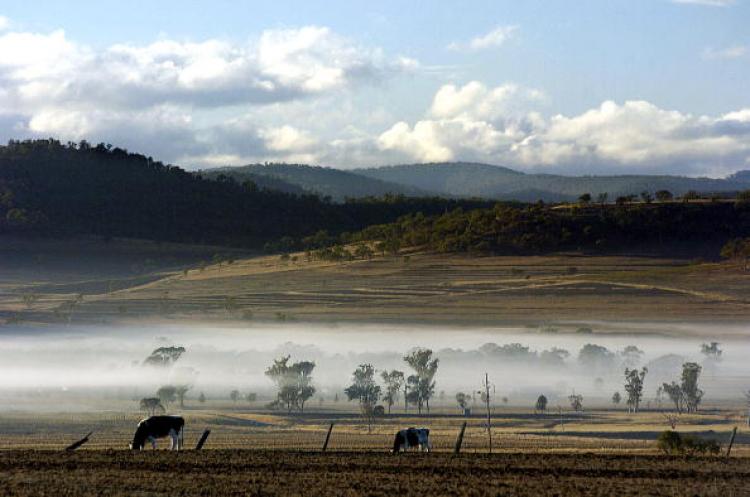
Now, on the Darling Downs, considered to be one of the richest tracts of farmland in the world, there are approximately 40 new coalmines or expansions of existing mines being planned. Up to 50,000 new coal seam gas wells are also in the works.
“Its hideous,” said Hutton. “What we are looking at is the most radical transformation of the Darling Downs, in fact of inland Queensland west of the Great Divide, since the expansion of the pastoral front in the early days of settlement. That is how radical it is.”
Hutton said it is a complex issue, and farmers and the Greens are demanding a moratorium on coal seam gas development in the region until state and federal governments can look more closely at what is involved.
In the meantime, the dialogue between the Greens and farmers is growing, and he believes an alliance is the only way to protect Australia’s food security and agrarian industry.
“From the start, I argued that only an alliance between rural action groups and predominantly urban-based environmental campaigners would achieve this objective. … I think subsequent events have borne this out.”