

Six new exoplanets, or planets outside our solar system, have been discovered by Kepler, NASA’s space telescope. Several hundred more planet candidates have been identified in data released by the Kepler mission on Tuesday, Feb. 1.
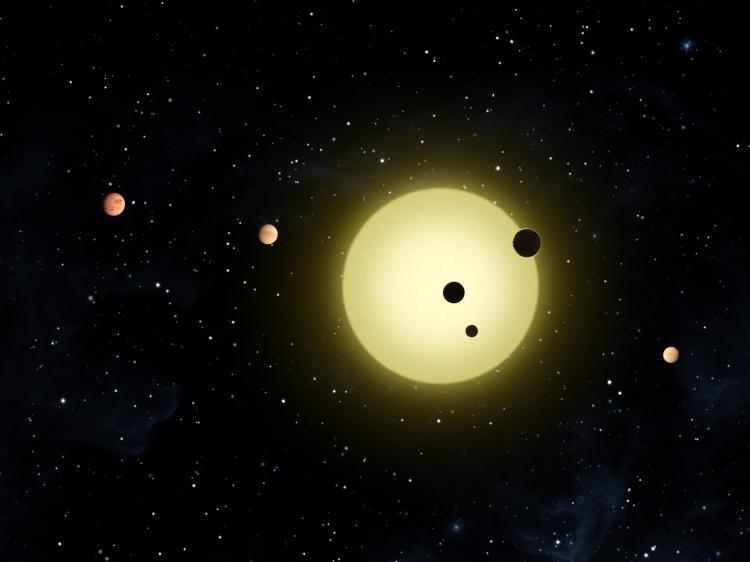
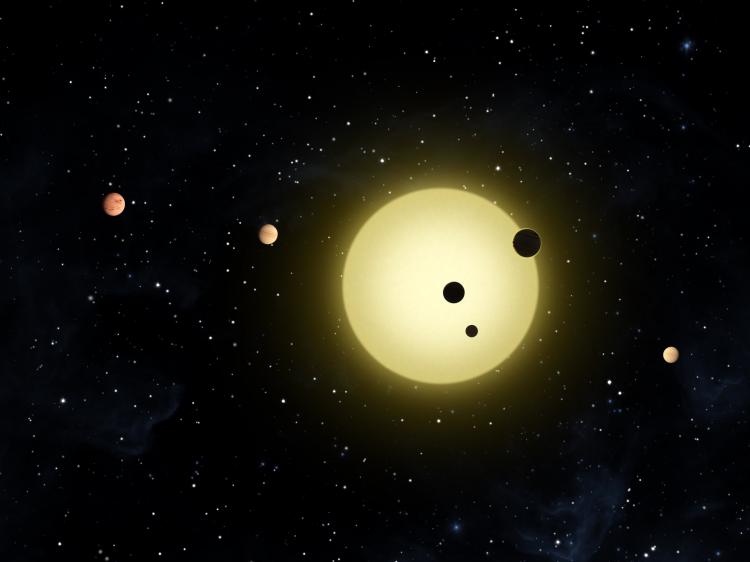
The six exoplanets have been confirmed with follow-up observations and are orbiting a sun-like star named Kepler-11, which is 2,000 light-years from Earth. This is the largest known group of planets orbiting a star outside our solar system, according to NASA.
All six worlds are larger than Earth, with the largest ones similar in size to Neptune and Uranus. They are mixtures of gases and rock, and water may be present. Planetary scientist Jack Lissauer, who is on the Kepler team, said in a press release that their mass is among the lowest of known exoplanets.
Of the remaining planet candidates, 54 are in the habitable zone of their stars, which means liquid water may be present on their surface, and the environment is likely to be suitable for Earth-like life. Five of these bodies are close to the size of Earth.
“In one generation we have gone from extraterrestrial planets being a mainstay of science fiction, to the present, where Kepler has helped turn science fiction into today’s reality,” said NASA Administrator Charles Bolden in the press release.
“These discoveries underscore the importance of NASA’s science missions, which consistently increase understanding of our place in the cosmos.”
Since its mission began in March 2009, Kepler has identified 1,235 planet candidates so far, including 68 that are approximately the same size as Earth.
“The fact that we’ve found so many planet candidates in such a tiny fraction of the sky suggests there are countless planets orbiting sun-like stars in our galaxy,” said William Borucki, science principal investigator for the Kepler mission, according to the release.
“We went from zero to 68 Earth-sized planet candidates and zero to 54 candidates in the habitable zone, some of which could have moons with liquid water.”
Details of the Kepler-11 system were published in Nature on Feb. 3.
The six exoplanets have been confirmed with follow-up observations and are orbiting a sun-like star named Kepler-11, which is 2,000 light-years from Earth. This is the largest known group of planets orbiting a star outside our solar system, according to NASA.
All six worlds are larger than Earth, with the largest ones similar in size to Neptune and Uranus. They are mixtures of gases and rock, and water may be present. Planetary scientist Jack Lissauer, who is on the Kepler team, said in a press release that their mass is among the lowest of known exoplanets.
Of the remaining planet candidates, 54 are in the habitable zone of their stars, which means liquid water may be present on their surface, and the environment is likely to be suitable for Earth-like life. Five of these bodies are close to the size of Earth.
“In one generation we have gone from extraterrestrial planets being a mainstay of science fiction, to the present, where Kepler has helped turn science fiction into today’s reality,” said NASA Administrator Charles Bolden in the press release.
“These discoveries underscore the importance of NASA’s science missions, which consistently increase understanding of our place in the cosmos.”
Since its mission began in March 2009, Kepler has identified 1,235 planet candidates so far, including 68 that are approximately the same size as Earth.
“The fact that we’ve found so many planet candidates in such a tiny fraction of the sky suggests there are countless planets orbiting sun-like stars in our galaxy,” said William Borucki, science principal investigator for the Kepler mission, according to the release.
“We went from zero to 68 Earth-sized planet candidates and zero to 54 candidates in the habitable zone, some of which could have moons with liquid water.”
Details of the Kepler-11 system were published in Nature on Feb. 3.


