EU Commission President Calls for Economic Union

September 29, 2011 Updated: October 1, 2015

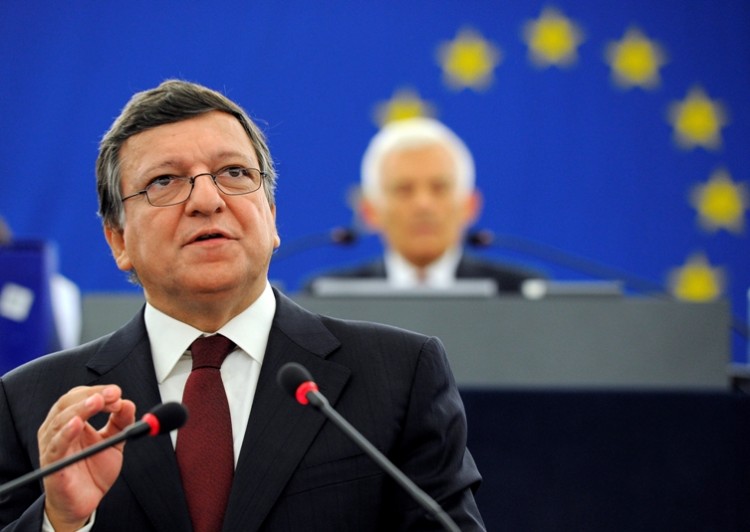
European Commission President Jose Manuel Barroso adresses the assembly of the European Parliament in Strasbourg, France. (Patrick Hertzog/AFP/Getty Images)
As could be expected given the euro crisis, EU commission President Jose Manuel Barroso, spent much time talking about the troubled economy Wednesday in his annual address to the European Parliament about the state of the union. He indicated that greater integration and an economic union is needed in Europe to complement the monetary union of the euro.

Barroso said that the EU is currently facing its greatest challenge ever in the form of a financial, economic, and social crisis. He said that the EU must believe in and work hard for its future, and regain what it has lost to competitors in the global market in recent years.

“Significant growth in Europe is not an impossible dream. It will not come magically tomorrow. But we can create the conditions for growth to resume. We have done it before. We must and we can do it again,” he said.

Barroso spoke at length about Greece, which may default on its debt, and described proposed measures to deal with the country’s debt crisis. To those that have speculated that Greece will be kicked out of the monetary union, Barroso said, “Greece is, and will remain, a member of the euro area,” but also that it “must implement its commitments in full and on time” and must “break with counterproductive practices and resist vested interests.”

Some of the support for Greece outlined by Barroso was 15 billion euros (US$20 billion) from the EU structural funds to be spent on 100 different projects. But Barroso also said, with reference not only to Greece but the entire union, that the situation is “not a sprint, but a marathon.”

For Europe to regain its strength and competitiveness in the long run, more integration is necessary. An economic union with regulatory bodies in addition to the current monetary union, will be necessary for the euro area to be credible in the eyes of the market, was his message.

Barroso said that for now, the commission will deliver proposals on three much-debated and controversial issues: A bigger bailout fund for euro countries in need, eurobonds to promote stability, and a tax on financial transactions.

“In the last three years, member states—I should say taxpayers—have granted aid and provided guarantees of 4.6 trillion euros (US$6.2 trillion) to the financial sector. It is time for the financial sector to make a contribution back to society,” Barroso said about the financial transaction tax.

This idea did not meet with unanimous approval. European Member of Parliament Jan Zahradil, of the conservative ECR party, said that this will cause businesses to leave the EU.

In general, Barroso hinted at more power transfers and greater unification on the horizon, something that will be highly controversial to large groups in many of the member states. Among other things, he indicated that the slowest moving member states cannot always be allowed to block proceedings.

Both Zahradil and Nigel Farage of the euroskeptic EFD group opposed the idea of more power moving from the democratically elected governments of the member states to the union. Farage said, "When you take away any democratic accountability nobody is in charge."