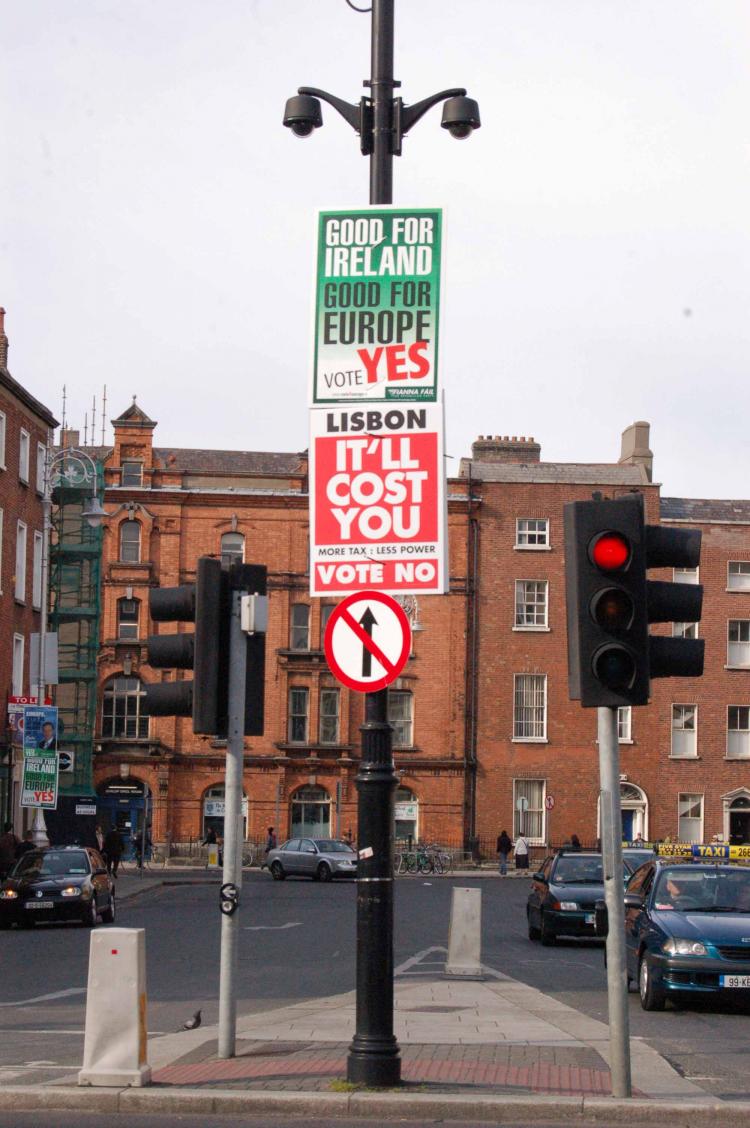
Since the Lisbon treaty No vote, an Oireachtas Joint Committee on the Constitution has been assigned the task of reviewing our current framework for governing the referendum process. The committee is to decide whether both sides of any referendum should be entitled to equal coverage on television and radio.
The Supreme Court decision in the Coughlan case, in which the court ruled that both the Yes and No campaigns in any referendum must be allowed the same airtime, is what the committee will be focusing on.
Committee chairman Senator Ardagh said in a statement, “the review was not a reaction to the rejection of the Lisbon Treaty, though the result would be one of the catalysts.”
With respect to the Oireachtas Joint Committee and its remit, Sinn Fein's Caoimhghn O'Caolin TD has criticised the government saying that they are trying to manipulate how public debates take place
in the future on the Lisbon Treaty.
Mr O'Caolin TD said in a statement, “This is yet another underhand tactic by the government who are clearly intent on manipulating any future public referendum debate. Rather than simply get on with the job of addressing the issues raised during the Lisbon debate on workers rights, public services, democracy, tax sovereignty and defence policy.” He accused Fianna Fail of “exhausting every avenue to sideline the electorate.”
The government are under a lot of pressure in the EU to resolve the Lisbon issue. In mid-October this year Minister Micheál Martin addressed a meeting of EU Leaders and Foreign Ministers in Brussels he said, “Finding an acceptable resolution to our Lisbon dilemma is a task which the Government is clearly focused on. By December, it is our aim to have identified a way forward and the steps that have to be taken." He said the Government is committed to work to ensure that the uncertainty that currently exists can be overcome.
Recent visits from EU leaders have also added pressure to the already over heated government.
The anti-Lisbon Treaty group Libertas is adding to this pressure, they have added a new aspect to the No vote campaign by registering as a European political party.
Speaking on Irish national radio RTE, Libertas leader Mr. Ganley said that in forming a Libertas political party all EU states could have the opportunity to vote on the Lisbon Treaty. "It will give people across Europe an option that they were not given, to have a proxy European referendum on the Lisbon Treaty."
Another critic of the Government is , Sinn Fein MEP Mary Lou McDonald who criticised Taoiseach Brian Cowen for not bringing to the attention of the Dail his plans to have another bite at the Lisbon treaty.
Ms McDonald did however offer to work with the Taoiseach to address the key issues with respect to workers' rights, public services, tax sovereignty and democracy. She was concerned that the Taoiseach might be overly influenced by president Sarkozy and his wishes for Ireland.
In a recent press release the Taoiseach outlined his thoughts on the Lisbon Treaty and how the government needs to address the No vote.
Mr Cowen said, “Many people voted No or abstained because of a lack of knowledge or
understanding of the Treaty, a lack of knowledge which applies not only to the Lisbon Treaty but more generally to the EU and how it functions.”
The Taoiseach stressed that he did not want to influence the Oireachtas sub committee and its findings but he felt that it was appropriate for him to to give his own view on the issues that most concerned the electorate during the referendum campaign.
He listed the future composition of the Commission, issues related to defence and our tradition of neutrality, social/ethical matters and taxation.
The Taoiseach concluded “I stressed that the concerns that surfaced during our referendum campaign would need to be adequately addressed if we are to find an acceptable way forward.
“I believe that this point is recognised by our partners within the Union that is to say: they too see that the concerns of the Irish voters need to be addressed. But while I believe they will work with us to seek a satisfactory way forward, the other Member States are clear that they want
the package of reforms in the Lisbon Treaty to come into effect.”
“Our task in the period ahead will be to work out how to address our concerns in a way which can be endorsed by all 27 Member States.”
Pressure is mounting in Europe
Irish civil servants are on the front line when it comes to criticism from European counterparts.
Ms Catherine Day, Secretary General of the EU Commission told an Oireachtas Sub-Committee on Ireland’s Future in the EU of the effect which she feels the outcome of Lisbon has had on Ireland’s influence at EU level: "I believe that Ireland’s image in the EU has been tarnished by the No Vote. It has reduced our ability to shape and influence policy events in the EU. Other member states tend to view us only through the prism of the Lisbon Treaty."
The Sub-Committee on Ireland’s Future in the EU was established following the result of the Lisbon Treaty Referendum. The Sub-Committee will consider Ireland’s future role within the EU, examine the re-percussions for Ireland of the outcome of the Lisbon Treaty and produce proposals suggesting how Ireland might address the rejection of the treaty.
The Sub-Committee meets up to three times a week and is scheduled to produce its report at the end of November.