Dwarf Galaxy Blows Glowing Gas Bubbles

September 29, 2011 Updated: October 1, 2015

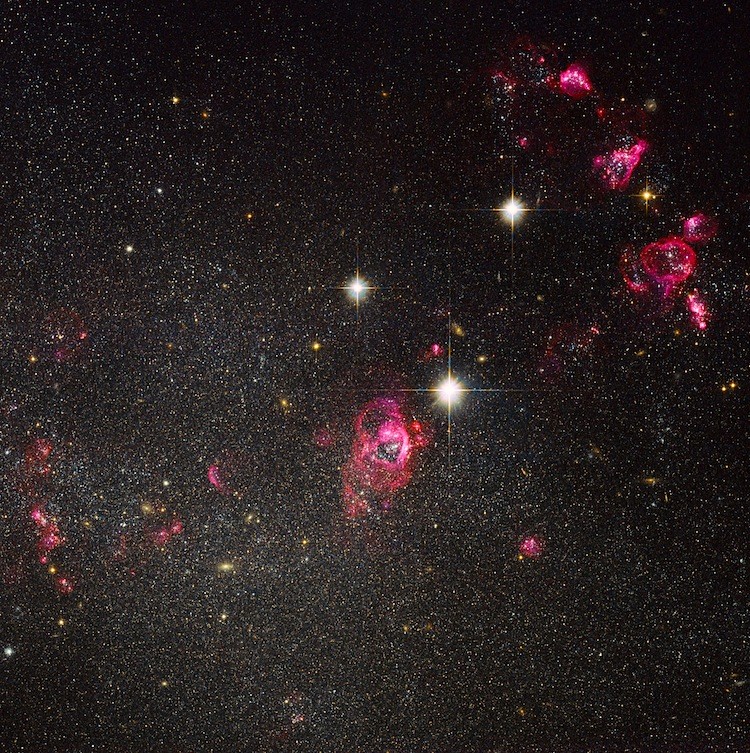
The NASA/ESA Hubble Space Telescope has captured this image of dwarf irregular galaxy Holmberg II. It is a composite of visible and near-infrared exposures taken using the Wide Field Channel of Hubble's Advanced Camera for Surveys. (NASA & ESA)
This colorful composite image from the Hubble Space Telescope shows the dwarf irregular galaxy Holmberg II, around 9.8 million light-years away in the Messier 81 group of galaxies.

The gigantic shells of gas are densely star-forming, and are able to keep their delicate shape due to the galaxy’s gentle gravity.

The bubbles were created during the dynamic life histories of numerous stellar generations. After high-mass stars formed in dense gas regions, they generated powerful winds that strip off surrounding matter. Finally, they exploded as supernovae, sending shock waves through the denser gas regions that heated and expanded the gas to create these fragile shells.

Three of the bubbles towards the top right of the photo are lit up by an ultraluminous X-ray source.

One possible explanation for this is an intermediate-mass black hole that could be emitting intense irradiation as it sucks in nearby material.