Full of humor, heart, and a holiness rarely seen on screen, ‘Departures’ reverently challenges our modern societal taboos on death and tradition within a beautiful and original story.
Written and directed by Japanese talent Yojiro Takita, the lauded film won the prestigious Best Foreign Language Film at this past year’s Academy Awards and 10 Japan Academy Prizes. It tells the story of Daigo (Masahiro Motoki) a young, married cello player whose orchestra disbands, forcing him to find a new mode of income.
He moves out of the city with his wife Mika (Ryoko Hirosue) to his late mother’s house in Yamagata, in the Northeast, out of the city, to begin again.
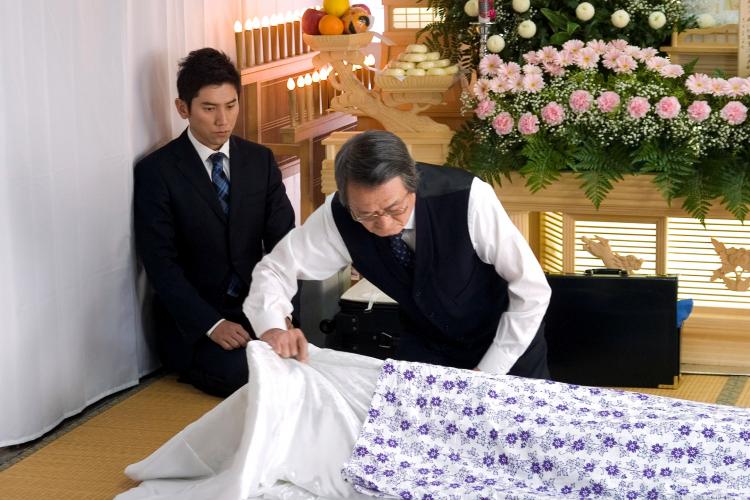
It is there that Daigo, misunderstanding a newspaper employment ad, stumbles into a job that offers him opportunities for healing and a depth of experience he had never imagined as an “encoffiner.”
Encoffination is the ceremony of preparing and placing a body in a coffin with ritualized washing and dressing in the presence of the bereaved and carried out with utmost care and modesty.
Where once these sacred rituals were done at home by the family of the deceased, now strangers have taken on this sacred task to prepare loved ones for their transition or “departure.”
In the press notes, Takita explains his inspiration for the film. “I received the idea for this project from the producer [Toshiaki Nakazawa and Tasuhiro Mase]. It was the film star, Motoki, who conceived a film about a ‘nokanshi’ [encoffeneer]. He had heard about this ritual from books, but had never seen it performed directly. When I read the script I felt the content was very familiar and close and thought the film will be dealing with death. … I think finding the charm in themes that other people do not want to touch is probably a habit to all directors.
“I believe I came to face ‘death’ more naturally, I am afraid to die, but not afraid of death itself anymore. When I attend funerals for my close ones, often I would have just prayed for the deceased, but I found myself touching their faces and trying to confront their deaths,” explains Takita.
“By touching their skin, I would feel the warmth of the deceased, the warm-hearted life of the person who had cared for me. I came to think that I must tell kids that death exists in everyday [life].”
Perhaps the universal appeal of ‘Departures’ is that through loving those who have died, all involved learn to live and love more robustly, compassionately, and authentically.
Written and directed by Japanese talent Yojiro Takita, the lauded film won the prestigious Best Foreign Language Film at this past year’s Academy Awards and 10 Japan Academy Prizes. It tells the story of Daigo (Masahiro Motoki) a young, married cello player whose orchestra disbands, forcing him to find a new mode of income.
He moves out of the city with his wife Mika (Ryoko Hirosue) to his late mother’s house in Yamagata, in the Northeast, out of the city, to begin again.
It is there that Daigo, misunderstanding a newspaper employment ad, stumbles into a job that offers him opportunities for healing and a depth of experience he had never imagined as an “encoffiner.”
Encoffination is the ceremony of preparing and placing a body in a coffin with ritualized washing and dressing in the presence of the bereaved and carried out with utmost care and modesty.
Where once these sacred rituals were done at home by the family of the deceased, now strangers have taken on this sacred task to prepare loved ones for their transition or “departure.”
In the press notes, Takita explains his inspiration for the film. “I received the idea for this project from the producer [Toshiaki Nakazawa and Tasuhiro Mase]. It was the film star, Motoki, who conceived a film about a ‘nokanshi’ [encoffeneer]. He had heard about this ritual from books, but had never seen it performed directly. When I read the script I felt the content was very familiar and close and thought the film will be dealing with death. … I think finding the charm in themes that other people do not want to touch is probably a habit to all directors.
“I believe I came to face ‘death’ more naturally, I am afraid to die, but not afraid of death itself anymore. When I attend funerals for my close ones, often I would have just prayed for the deceased, but I found myself touching their faces and trying to confront their deaths,” explains Takita.
“By touching their skin, I would feel the warmth of the deceased, the warm-hearted life of the person who had cared for me. I came to think that I must tell kids that death exists in everyday [life].”
Perhaps the universal appeal of ‘Departures’ is that through loving those who have died, all involved learn to live and love more robustly, compassionately, and authentically.