Defence Spending Under the Spotlight

September 28, 2011 Updated: October 1, 2015

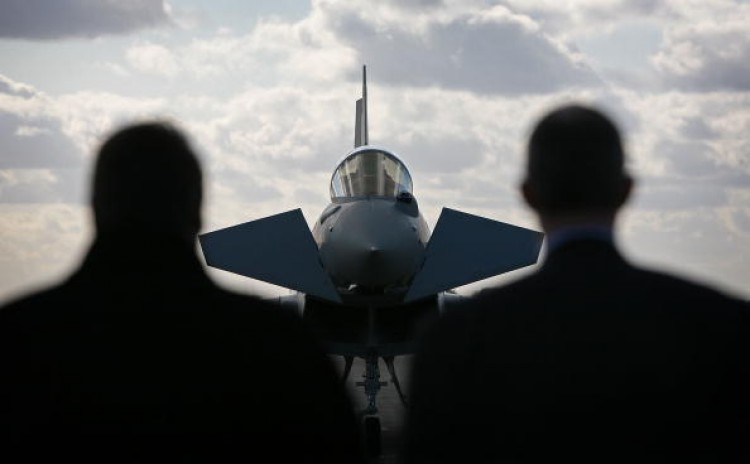
Two men from the ministry of defence watch one of the new Typhoon Tranche type 2 aircraft arrive at RAF Coningsby, on October 21, 2008 in Lincolnshire, England. BAE systems say dropping Typhoon jet orders are partly responsible for the loss of 3,000 jobs. (Christopher Furlong/Getty Images)
The UK is no longer the military super-power it was for decades, but the strength of its armed forces still places it among the top six in the world.

That is one of the conclusions of a report into the £74 billion 10-year funding gap in the armed forces, which it says has now been closed by the Ministry of Defence (MoD).

The report, published on Tuesday by the Royal United Services Institute (RUSI), however, also warns that the MoD’s plans could be “blown off course” if the cost of major programmes increases more sharply than planned.

“Three key projects, any one of which could pose substantial financial risks to the MoD, will be particularly important in this regard,” writes professor Malcolm Chalmers, the report’s author.

“These are the successor nuclear deterrent, the Joint Strike Fighter, and the Type-26 frigate. Of those projects still in the pre-Main Gate stage (i.e. without production contracts having been signed), these are the three with the largest projected budgets over the next decade.”

Two thirds of the projected £74 billion MoD “funding gap” was the result of cuts to the defence budget made by the current government between 2011 and 2015. The other third was inherited from unaffordable commitments made by the previous government.

“The decision to reduce the size of the regular army, made more palatable by increased investment in reserve forces, has restored some credibility to the commitment to a balanced posture. While the MoD’s books may be balanced on paper, the work needed to turn assumptions into detailed plans has only just begun,” writes Chalmers.

The report, entitled "Looking into the Black Hole: Is the UK Defence Budget Crisis Really Over", states: “The UK will never again be a member of the select club of global superpowers. Indeed it has not been one for decades.

“But currently planned levels of defence spending should be enough for it to maintain its position as one of the world’s five second-rank military powers (with only the US in the first rank).”

This will allow the UK to carry out operations such as those in Afghanistan or Libya.

The report comes amid claims that members of the armed forces returning from Libya face redundancy and as defence manufacturer BAE Systems also announced 3,000 job cuts in the UK.

Unions and opposition politicians blamed the job losses on the deficit reduction programme. However, BAE Systems cited broader global reasons, blamed both reductions in orders of European Typhoon fighters (which includes from the UK) and US F-35 orders.

Ian King, chief executive of BAE Systems, said in a statement: “Pressure on the US defence budget and top level programme changes mean the anticipated increase in F-35 production rates will be slower than originally planned, again impacting on our expected workload.”

The majority of the 3,000 jobs at sites around the UK, according to BAE, “are associated with the changes in Typhoon and F-35 production and the need to remain competitive”.

Follow Simon on Twitter: @SPVeazey