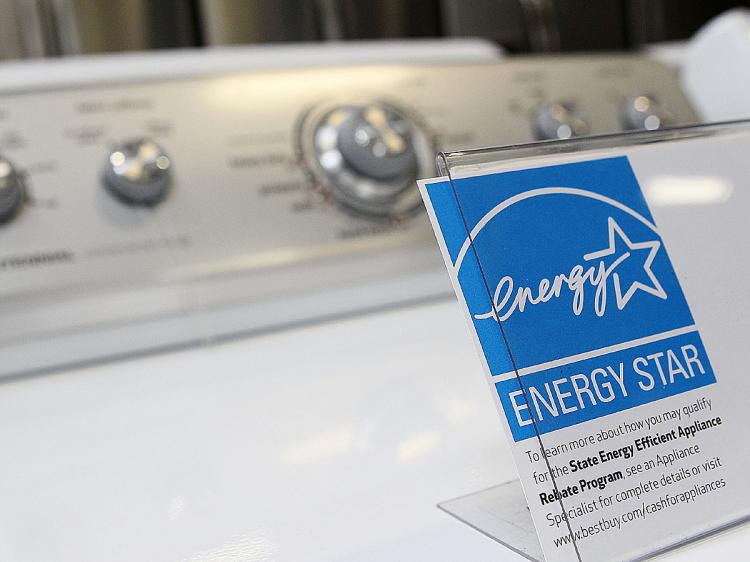
WASHINGTON—Energy Star ratings should tell people exactly how much energy a specific product or building uses, says Congresswoman Carolyn B. Maloney (D-N.Y.). Maloney says current ratings that tell energy savings relative to other appliances or buildings don’t provide consumers with enough information. She shared her concerns Monday in a letter sent to Department of Energy (DOE) Secretary Steven Chu, and Environmental Protection Agency (EPA) administrator Lisa Jackson.
In late July, Anthony Malkin, owner of the Empire State Building, testified before Congress’s Joint Economic Committee that energy retrofits of that building currently in process would achieve 40-percent energy savings. He said that in one day, before retrofit, the building uses the energy of 40,000 homes. The retrofit is calculated to pay for itself with energy savings in three years, Malkin said, adding that 64 percent of all energy consumed in New York City is consumed by 20 percent of the buildings.
Malkin said some estimate that in “major American cities, 85-95 percent of all buildings which will be here in 2035 are here today.” Building new energy-efficient buildings will not reduce energy consumption significantly, he says. Only “addressing the existing built environment will make a difference.”
Rep. Maloney writes that if the DOE and EPA want to encourage owners to retrofit their buildings and become more energy efficient the Energy Star program should evaluate buildings’ energy efficiency before and after a retrofit, and provide building owners with energy-efficiency ratings they can take to the public and to tenants. Such ratings would help owners calculate the money saved by retrofitting a building.
The Energy Star program was developed by the EPA in 1992 to inform and encourage consumers to purchase energy-efficient products. The program also measures the energy efficiency of a building relative to other buildings. Now Maloney is arguing the program needs to become a more useful tool for businesses and consumers.
In her letter Maloney uses the example of a consumer purchasing a washing machine. She says the Energy Star washing machine tells the consumer it will use 30 percent less energy than a washing machine that didn’t receive Energy Star classification. But what a consumer needs to know is how much energy this washer will use and how much money it will save.
Maloney says the program also lacks credibility. A recent study by the government accountability office (GAO) found the Energy Star program vulnerable to fraud and abuse, and said the program is for the most part a “self-certification” program as the Energy Star program does not verify the energy savings companies report. According to GAO it secured Energy Star certification for 15 bogus products, including a gas-powered alarm clock. The Energy Star program rejected two bogus products and three of the submitted products never received a response.
In late July, Anthony Malkin, owner of the Empire State Building, testified before Congress’s Joint Economic Committee that energy retrofits of that building currently in process would achieve 40-percent energy savings. He said that in one day, before retrofit, the building uses the energy of 40,000 homes. The retrofit is calculated to pay for itself with energy savings in three years, Malkin said, adding that 64 percent of all energy consumed in New York City is consumed by 20 percent of the buildings.
Malkin said some estimate that in “major American cities, 85-95 percent of all buildings which will be here in 2035 are here today.” Building new energy-efficient buildings will not reduce energy consumption significantly, he says. Only “addressing the existing built environment will make a difference.”
Rep. Maloney writes that if the DOE and EPA want to encourage owners to retrofit their buildings and become more energy efficient the Energy Star program should evaluate buildings’ energy efficiency before and after a retrofit, and provide building owners with energy-efficiency ratings they can take to the public and to tenants. Such ratings would help owners calculate the money saved by retrofitting a building.
The Energy Star program was developed by the EPA in 1992 to inform and encourage consumers to purchase energy-efficient products. The program also measures the energy efficiency of a building relative to other buildings. Now Maloney is arguing the program needs to become a more useful tool for businesses and consumers.
In her letter Maloney uses the example of a consumer purchasing a washing machine. She says the Energy Star washing machine tells the consumer it will use 30 percent less energy than a washing machine that didn’t receive Energy Star classification. But what a consumer needs to know is how much energy this washer will use and how much money it will save.
Maloney says the program also lacks credibility. A recent study by the government accountability office (GAO) found the Energy Star program vulnerable to fraud and abuse, and said the program is for the most part a “self-certification” program as the Energy Star program does not verify the energy savings companies report. According to GAO it secured Energy Star certification for 15 bogus products, including a gas-powered alarm clock. The Energy Star program rejected two bogus products and three of the submitted products never received a response.