


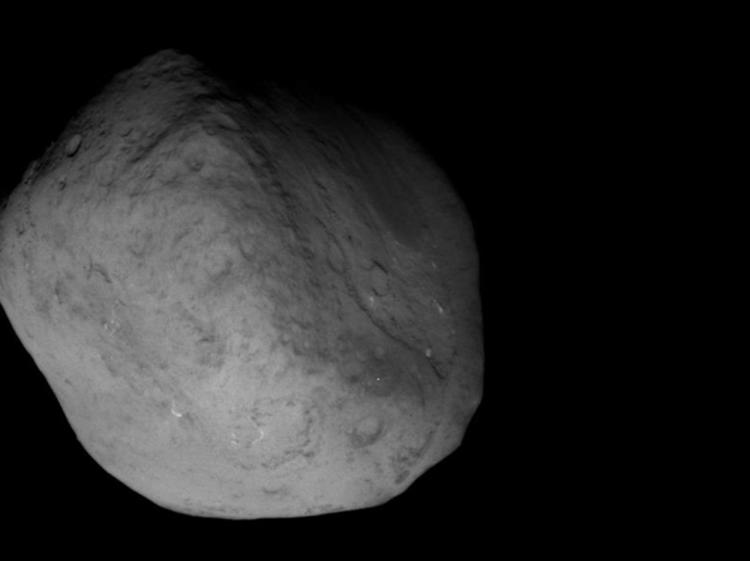
Stardust, the veteran comet hunter, finally set its sights on Comet Tempel-1 last night, Feb. 14, in the fateful Valentine’s Day encounter of the spacecraft’s final mission, Stardust-NExT.
All 72 approach-images are being transmitted from the spacecraft to NASA’s Jet Propulsion Lab (JPL) in Pasadena, Calif. Each takes around 15 minutes to arrive. The first six most distant ones can be viewed HERE.
Further images, including those from the closest approach within 124 miles of Tempel-1’s surface, are being downlinked in chronological order and will be available online later today.
The image transmission started at about 3:45 a.m. EST, making the estimated time for all images to arrive at the lab around 10 p.m. EST tonight.
A NASA news conference, originally planned for 1 p.m. EST, will happen later today at a time to be confirmed shortly, giving scientists more time to analyze the comet data and images.
The Stardust-NExT mission concludes Stardust’s 12-year journey, which began in 1999 to collect interstellar dust, included the hunt and sampling of comet Wild 2 in 2004.
Tempel-1 has a unique history, being the first comet to receive visits from two different spacecraft. In 2005, Deep Impact landed on the icy body and launched an impactor probe into the comet’s nucleus.
Through this second encounter, scientists hope to learn about changes in the comet and the Deep Impact crater over the last six years, during which it has completed one full orbit of the sun.
A team of scientists has made painstaking calculations to give Stardust the best chance of seeing the impact crater, but comets are unpredictable.
“The comet doesn’t just rotate at a specific rate—it speeds up and slows down its rotation depending on what part of its surface is heated by the sun,” said Steve Chesley, Stardust-NExT co-investigator from JPL, according to a press release from the lab. “Overall, the comet’s spin is speeding up over time. We expect its average rotation rate to go up progressively as it continues its orbits around the sun, but it is hard to define just how much.”
Stardust-NExT’s principal investigator, Joe Veverka of Cornell University in Ithaca, N.Y., and the rest of the team are sitting on the edge of their seats as the data arrive.
“If we see the other face of the comet, we will provide science with the most complete picture of any comet surface to date,” Veverka said. “Either way, we win.”
All 72 approach-images are being transmitted from the spacecraft to NASA’s Jet Propulsion Lab (JPL) in Pasadena, Calif. Each takes around 15 minutes to arrive. The first six most distant ones can be viewed HERE.
Further images, including those from the closest approach within 124 miles of Tempel-1’s surface, are being downlinked in chronological order and will be available online later today.
The image transmission started at about 3:45 a.m. EST, making the estimated time for all images to arrive at the lab around 10 p.m. EST tonight.
A NASA news conference, originally planned for 1 p.m. EST, will happen later today at a time to be confirmed shortly, giving scientists more time to analyze the comet data and images.
The Stardust-NExT mission concludes Stardust’s 12-year journey, which began in 1999 to collect interstellar dust, included the hunt and sampling of comet Wild 2 in 2004.
Tempel-1 has a unique history, being the first comet to receive visits from two different spacecraft. In 2005, Deep Impact landed on the icy body and launched an impactor probe into the comet’s nucleus.
Through this second encounter, scientists hope to learn about changes in the comet and the Deep Impact crater over the last six years, during which it has completed one full orbit of the sun.
A team of scientists has made painstaking calculations to give Stardust the best chance of seeing the impact crater, but comets are unpredictable.
“The comet doesn’t just rotate at a specific rate—it speeds up and slows down its rotation depending on what part of its surface is heated by the sun,” said Steve Chesley, Stardust-NExT co-investigator from JPL, according to a press release from the lab. “Overall, the comet’s spin is speeding up over time. We expect its average rotation rate to go up progressively as it continues its orbits around the sun, but it is hard to define just how much.”
Stardust-NExT’s principal investigator, Joe Veverka of Cornell University in Ithaca, N.Y., and the rest of the team are sitting on the edge of their seats as the data arrive.
“If we see the other face of the comet, we will provide science with the most complete picture of any comet surface to date,” Veverka said. “Either way, we win.”


