The smell of apples along with sweet music filled the air on a sunny Sunday afternoon at the corner of Spadina Road and Austin Terrace.
At City Cider at Spadina, a fall harvest event on Sept. 18 organized by the Spadina Museum in partnership with Not Far From The Tree, participants had the opportunity to learn heritage apple-picking methods and taste cider made right there.
“We have animated the whole orchard in different ways today—the fold pressing, chopping, grinding, and cleaning of the apple cider,” said Laura Reinsborough, founder and director of Not Far From The Tree.
The local non-profit organization was launched in 2008 to help homeowners who can’t keep up with the abundant harvest produced by their apple and other fruit trees.
The harvest is split three ways: one-third is offered to the tree owner, one-third is shared among the volunteers, and one-third is delivered by bicycle to be donated to food banks, shelters, and community kitchens.
Sunday’s event was held right at the heart of the museum’s heritage urban apple orchard where the local group began.
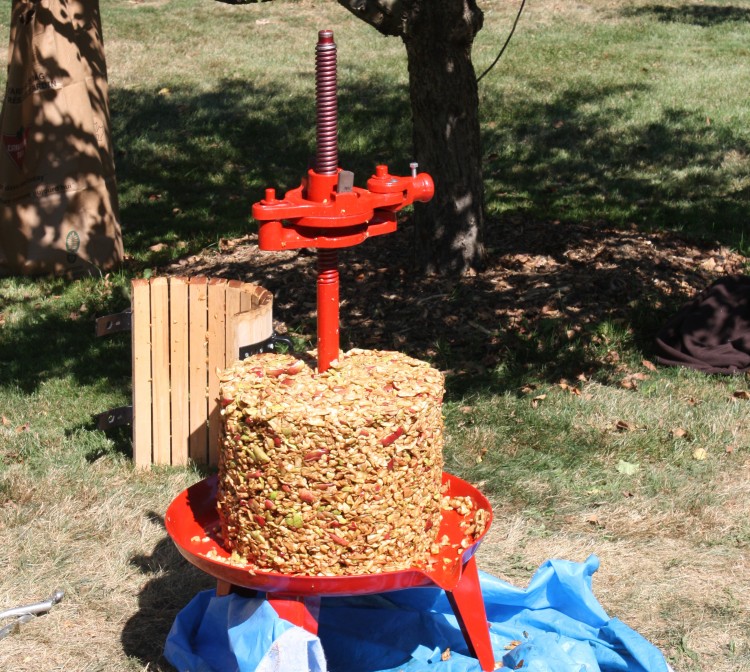
Leah, a volunteer with Not Far From The Tree, demonstrated proper apple-picking techniques and how to make apple cider the old-fashioned way, with a manual press and some elbow grease.
“We are not using anything that falls on the ground, so no windfall,” she explained.
After the apples are washed they are cut into four pieces and put in a bin to be further diced until the pieces are small enough to be placed in the barrel.
Once in the barrel, a clamp is placed on top and screwed down by two volunteers. The apple juice is caught in a pan at the bottom which is then warmed up to become hot cider.
What remains of the apples is “this sort of dried up—almost fruit leather sort of bits—which are going to get composted,” said Leah.
With presentations of live music and other entertainment, the event was more than just about apples.
“There is a corn roast, storytelling, and yoga at the back, there is live music right in the orchard, entrance into the museum, as well as a printing press and tours of the recently renovated 1930s museum,” said Reinsborough.
Organizers hope to make the event an annual one to celebrate local food sustainability and diversity, and also grow the event to feature more fruit trees.
At City Cider at Spadina, a fall harvest event on Sept. 18 organized by the Spadina Museum in partnership with Not Far From The Tree, participants had the opportunity to learn heritage apple-picking methods and taste cider made right there.
“We have animated the whole orchard in different ways today—the fold pressing, chopping, grinding, and cleaning of the apple cider,” said Laura Reinsborough, founder and director of Not Far From The Tree.
The local non-profit organization was launched in 2008 to help homeowners who can’t keep up with the abundant harvest produced by their apple and other fruit trees.
The harvest is split three ways: one-third is offered to the tree owner, one-third is shared among the volunteers, and one-third is delivered by bicycle to be donated to food banks, shelters, and community kitchens.
Sunday’s event was held right at the heart of the museum’s heritage urban apple orchard where the local group began.
Leah, a volunteer with Not Far From The Tree, demonstrated proper apple-picking techniques and how to make apple cider the old-fashioned way, with a manual press and some elbow grease.
“We are not using anything that falls on the ground, so no windfall,” she explained.
After the apples are washed they are cut into four pieces and put in a bin to be further diced until the pieces are small enough to be placed in the barrel.
Once in the barrel, a clamp is placed on top and screwed down by two volunteers. The apple juice is caught in a pan at the bottom which is then warmed up to become hot cider.
What remains of the apples is “this sort of dried up—almost fruit leather sort of bits—which are going to get composted,” said Leah.
With presentations of live music and other entertainment, the event was more than just about apples.
“There is a corn roast, storytelling, and yoga at the back, there is live music right in the orchard, entrance into the museum, as well as a printing press and tours of the recently renovated 1930s museum,” said Reinsborough.
Organizers hope to make the event an annual one to celebrate local food sustainability and diversity, and also grow the event to feature more fruit trees.