The two platforms will cooperate on the joint promotion of short and long videos and the creation of short video content. Tencent will license Douyin, owned by ByteDance, its long videos with network broadcasting rights and sublicensing rights. In addition, Tencent and Douyin explicitly stipulated publication rules for short video content.
The announcement, signaling a settlement between the rival video hosting services, sparked widespread concern in the market. Before this, the two parties had a long-standing dispute over copyright issues.
The last legal dispute between Douyin and Tencent was in November 2022, when Douyin was awarded more than 32 million yuan (about $4.65 million) by a court in China for Tencent’s copyright infringement of an online drama, a record-breaking amount for such cases in China. In the second half of 2021, Tencent sued Douyin for copyright infringement 168 times, with claims exceeding 2.943 billion yuan (about $428 million). Douyin fought back, demanding that Tencent remove the infringing videos and pay 10 million yuan (about $1.45 million) in restitution.
Reasons for Unexpected Partnership
Several Chinese industry experts told China Financial Daily that it was only a matter of time before Douyin and Tencent settled, given the weak growth of videos on Tencent and the risk of infringements faced by Douyin.According to Lu Yuanxing, a U.S.-based Chinese political analyst, the partnership between Douyin and Tencent was obviously promoted by the CCP behind the scenes.
In an interview with The Epoch Times on April 9, Lu said that the feud between Tencent and Douyin is long-standing, and long-form videos were originally Tencent’s specialty. The so-called cooperation was a concession by Tencent as it authorized Douyin to use Tencent’s content. This is a unilateral transfer of interests, and it is not normal market behavior. Lu believes this deal must have resulted from a CCP behind-the-scenes push.
Lu further explained: “Since Douyin has been cooperating with the CCP, it has been sparing no effort in monitoring its users. It is not only the Chinese version of Douyin, but also its counterpart TiKToK that has been cooperating with the CCP in stealing information from overseas users, which means that it is a company supported by the Chinese regime.”
He said that Tencent has also cooperated with the CCP in surveillance over the years. Its social media platforms, WeChat and QQ, have monitored users’ speech and communications for the CCP. However, Douyin and Tencent are backed by different political forces.
CCP Backed Douyin While Tencent CEO was Booted From the National People’s Congress
TikTok is the version of Douyin used outside China, with 150 million users in the United States. On March 23, TikTok CEO Shou Zi Chew attended a hearing before the U.S. House Energy and Commerce Committee that lasted more than four hours. House members were deeply skeptical of his answers and said Chew’s claims failed to ease their concerns about TikTok. The FBI and the intelligence community are concerned that the CCP has access to TikTok’s U.S. user data.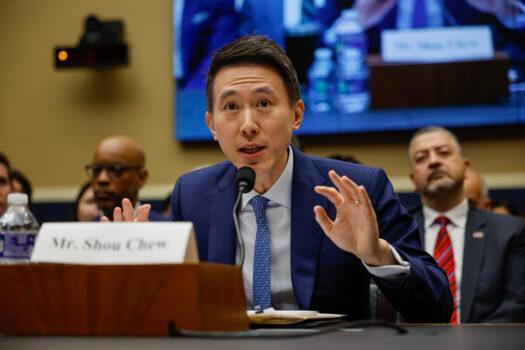
After the White House requested federal government agencies to remove TikTok from all government-owned devices within 30 days, Mao responded that the United States was feeling insecure about an app popular among young people, showing a lack of self-confidence.
In contrast to the CCP’s high-profile support for TikTok, Tencent Chairman, and CEO Ma Huateng was not re-elected to the CCP’s National People’s Congress (NPC) or the Chinese People’s Political Consultative Conference (CPPCC) in March this year, ending his decade-long career as a delegate to the NPC. The CCP selects members of the NPC and CPPCC from various Chinese elites loyal to the regime.
Ma has been a deputy to the National People’s Congress since 2013 and was “re-elected” in January 2018. In 2020, Ma did not attend the CCP’s “two sessions,” citing health reasons. Since that year, the CCP has conducted so-called “anti-monopoly investigations” into the tech giant Tencent. Tencent’s lucrative gaming platform had its licenses suspended, resulting in the company’s market value crash. Tencent also adopted a low-profile posture and withdrew from several equity investments.