The day before Zhang Wanxia’s wedding, her fiancé was taken into police custody and interrogated for hours on end because of his faith.
Suddenly, it became a real possibility to Zhang that this sort of harassment and abuse by the state would become her future. After all, the Chinese Communist Party (CCP) had just declared a ban on Falun Gong, a popular spiritual practice taken up by millions in China, and the regime was determined to eliminate it.
It would only get worse. Zhang would be one of untold numbers of Falun Gong practitioners who would face torture, forced labor, and brainwashing by Chinese authorities from July 20, 1999, onwards, in a persecution that has been documented for 26 years by human rights organizations and international media.
In those early days, Zhang’s efforts to reveal the torture she faced had given the international community a glimpse into the violent persecution the CCP claimed was not happening behind closed doors.
Today, in the United States, Zhang has a warning for Americans and calls on them to stand up for religious freedom.
“The CCP has reached its dead end, its final, desperate struggle before disintegration. However, its last gasp and transnational persecution of Falun Gong pose a significant threat to democratic systems, national security, and freedom of belief in the United States and the world,” Zhang told The Epoch Times.

Meditation Practice
Falun Gong, also known as Falun Dafa, was introduced to the public in China in the early 1990s. Based on Buddhist tradition, the spiritual practice teaches the three principles of truth, compassion, and forbearance, as well as five meditative exercises.It gained widespread popularity. By official counts, at least 70 million people were practicing Falun Gong in China in 1999, and it had spread mainly due to word of mouth. Many Falun Gong practitioners from China have shared publicly that one of the initial draws was the health benefits that bordered on the miraculous, and Zhang is one of them.
Zhang said that in 1997, her mother was diagnosed with severe cirrhosis, or damage to the liver. A doctor even estimated that Zhang’s mother only had six months left to live. Zhang spent hours every day trying to ease her mother’s pain through massage, as the medication was insufficient.
One day, Zhang’s mother took an interest in a group of people who gathered every day in the park near her house. They would do meditative exercises and read together from a book, which she later learned was called “Zhuan Falun,” the main text of Falun Gong, written by the practice’s founder, Mr. Li Hongzhi.
Zhang hadn’t thought much of it at first, as her mother often took up new things only to lose interest soon enough.
Except this time, she didn’t. Her mood improved day by day, and soon she was pain-free. Zhang’s mother had begun doing the exercises with the group every morning, and one day Zhang noticed that after finishing the exercises, she went to the market, bought two bags of groceries, carried them back up to their eighth-floor apartment unassisted, and happily made breakfast.
The cirrhosis had left Zhang’s mother unable to eat most foods, but she was cooking every day, making varied meals full of ingredients she couldn’t eat before.
She regained more than her physical health. As Zhang’s mother sought to live by Falun Gong’s moral principles, Zhang saw her mother become happier, more patient, even-tempered, considerate, and adopt a healthy daily routine. Within three months, her cirrhosis symptoms were all gone.
Zhang said she thought, “What turned my mother into a happy and healthy person? Why is this book so magical? It brought about a complete transformation in my mother.”
Zhang began accompanying her mother to the park every morning to practice Falun Gong exercises with the group and started reading “Zhuan Falun” herself. Zhang said that after she read the book, she realized Falun Gong was not about health and wellness. It’s part of an ancient Chinese tradition called “cultivation practice,” which involves moral and spiritual self-improvement.
Speaking the Truth
Zhang said that when the CCP began persecuting Falun Gong on July 20, 1999, it came with a whole-of-state effort to slander the practice through various media channels. Like many practitioners, Zhang and her mother thought it was only right to counter the propaganda with truth and stand up for something that had brought only positive changes to their lives.Zhang, her mother, her husband-to-be Yin Xinxiao, and Yin’s brother flew to Beijing on that same day to try to submit an appeal to the authorities to overturn the ban. Authorities retaliated by harassing their family members and telling the families they had better tell them to stop practicing Falun Gong.
Zhang said she felt differently; after all, Falun Gong had saved her mother’s life.
“Moreover, there is nothing wrong with truth, compassion, and forbearance,” Zhang told The Epoch Times.
The day before Zhang and Yin’s wedding, Yin was illegally detained and interrogated until the next morning. When he was finally released in the morning, he rushed straight to the wedding venue.
Until 2013, the Chinese regime had a law that allowed it to send people considered suspects to labor camps for three to five years without due process. Zhang’s husband was sent to a labor camp while she was pregnant, and she said that she couldn’t stay silent.
She went to Tiananmen Square in Beijing and said as loudly as she could: “Falun Dafa is good.”
Zhang said she wanted to use all her strength to let everyone know the truth. People all around the square turned to look at her, which meant the police did, too.
“Police officers rushed over from all directions, tackled me, a pregnant woman, to the ground, and dragged me toward the police car,” she said.
Zhang, who was eight months pregnant, grabbed onto the door of the police car as they tried to shove her in the vehicle. She said several people were manhandling her at that point, so she kept shouting. Then one of the police officers punched her in the stomach, Zhang said, and they slapped her several times as she was finally shoved into the car.
“If the CCP’s vicious police treat a pregnant woman who is about to give birth so violently, I can only imagine what many Falun Gong practitioners experience when they come to Tiananmen Square to appeal,” she said.
Zhang was worried for her baby. “The policeman punched me so hard. Normally, I would have gone into premature labor, or at least had a major hemorrhage. The force he used was immense. I could usually feel the baby’s little legs kicking, but when the policeman punched him, he didn’t react at all; he was just so still,” she recalled.
Zhang said she was ultimately able to give birth to her son safely, although she was alone.
Then, three days later, a large group of police raided Zhang’s house in the middle of the night, threatening to send her to a labor camp as well if she did not renounce her faith.
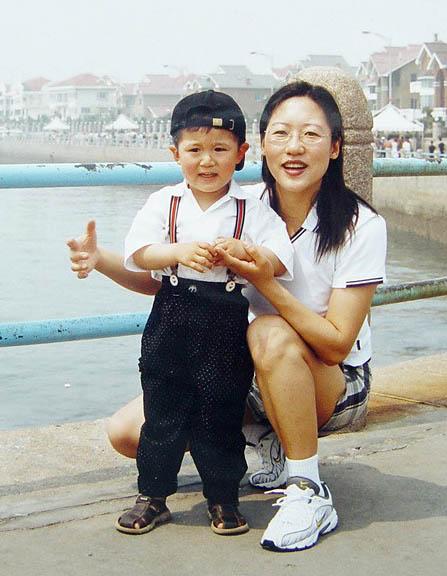
Zhang would raise her infant son with her mother-in-law’s help, working to provide for the family as soon as she was able. She got emotional as she recounted how quiet her son was at 10 months old, as if he knew what a hard time his mother had.
Then, in 2002, police barged into Zhang’s home and illegally detained her.
Labor Camps
Falun Gong practitioners were sent to “reeducation through labor” camps, widely described by human rights experts as brainwashing centers, and this practice sparked international condemnation in the mid and late 2000s.Zhang gave The Epoch Times an account of the torture she experienced there, which she has publicized before. During her detention, she managed to smuggle out a written account of her experience, which she gave to her relatives. It was subsequently investigated and verified by human rights activists and shared internationally.
It began with 15 days of sleep deprivation, during which Zhang was subject to round-the-clock brainwashing sessions. Zhang said she was worn down mentally and physically, but she felt sorry for the people who were reciting CCP propaganda, and tried to tell them the truth about Falun Gong and encourage them to choose their own futures.
Another time, Zhang was handcuffed in the corner of a bathroom next to an open window during freezing weather while thinly dressed. She said she remembers asking to use the toilet and the police officer on guard turning it into a negotiation, and she realized they would use any and every opportunity to try to get her to renounce her faith.
“At that moment, I understood that they were exploiting and restricting people’s most basic physiological and psychological needs to achieve their desired goals,” she said.
On various occasions, she was made to stand for days on end until her feet and legs were swollen. Once, she was handcuffed to a stair railing in a way where her toes barely touched the floor so that she hung painfully from her wrists. Then she was blindfolded, and several imprisoned drug traffickers were brought in to abuse her verbally. Zhang said at one point she couldn’t take it anymore and said she would bite her tongue to kill herself—she immediately regretted it because she believes suicide is a sin.
She said there were times when she witnessed remorse in her torturers as well. There was a policewoman who was feared in the camp, Zhang said, who one day berated Zhang for suffering in the labor camp instead of just renouncing her faith so she could “live a good life.”
“She said a lot at the time, but she just didn’t understand me. I told her about my mother’s health condition before she started practicing Falun Dafa and her recovery process after she started practicing,” Zhang said.
“Finally, I looked at her and calmly asked her a question: ‘If your mother had a terminal illness and wouldn’t live much longer, and a savior saved your mother without charging a penny, would you lie against your conscience and say something against your will when everyone was slandering him? Or would you stand up and tell everyone the truth?’”
Zhang said the policewoman’s eyes turned red as she teared up and had nothing more to say.
“I believe everyone has a kind side,” Zhang said. “But some people have simply lost their way.”
As someone who lives by truth, compassion, and forbearance, Zhang said she felt it was her responsibility to show people a better way. But not everyone she met was open to reason.
At one point, one of the labor camp guards told Zhang that if she was practicing Falun Gong to be a good person, she should be a good worker in the labor camp. Zhang said she responded that she was innocent and that her detention was illegal, something she could not condone.
“If I cooperate with you, I will be condoning and supporting you, and you will arrest more practitioners to work and earn money for you in the labor camp. I cannot do that,” she told him.
In retaliation, the guard increased the workloads of the drug trafficker inmates and said it was all because of Zhang, and then encouraged them to beat her one night.
Zhang was injured so severely that the guards had to bring her to the infirmary, and Zhang said she remembers how shocked the doctor looked as he treated her.
“At that moment, I made up my mind that I must expose their crimes, let the world see their evil, understand the truth, and stop their persecution of me. I can’t let this continue,” she said.
She set about obtaining a pen and paper, and was able to detail the torture she experienced in tiny, dense writing. She added her home phone number and address, and managed to have the note smuggled out of the labor camp.
Her family received the note, but many of her relatives, who do not practice Falun Gong, were in disbelief. Some suspected it was a hoax, but others insisted that it was her handwriting, Zhang said. In the end, they decided to file a lawsuit on Zhang’s behalf for wrongful treatment.
Zhang’s husband and other Falun Gong practitioners began petitioning for her release, and he distributed accounts of what happened to Zhang and collected signatures on a petition to send to various levels of government authorities.
Her story also made it to Minghui.org, a U.S.-based nonprofit that documents the ongoing persecution of Falun Gong. Human rights activists outside China called the labor camp and relevant institutions, confirming the details of her detention and increasing overseas calls for the end of the CCP’s persecution of Falun Gong.
“A detailed list of perpetrators was exposed internationally,” Zhang said. “They were terrified that their atrocities and shameful acts had been exposed internationally, and they dared not continue to persecute so openly.”
She believes it became “a powerful deterrent to evil.” A staff member of the prison inspection commission visited Zhang at the labor camp to ascertain what had happened, and the head of the labor camp was replaced. Zhang said they still would not release her, but the torture subsided even though a month was added to her sentence.
Zhang was released on Oct. 15, 2005, seeing the sun for the first time in years. She said she believes the perpetrators of this persecution will eventually face justice.
Transnational Repression Warning
In recent years, the CCP’s harassment of Falun Gong practitioners outside of China has become pronounced, corroborating whistleblower reports that CCP leader Xi Jinping ordered an escalation of transnational repression efforts in 2022. Zhang sees it as a sign of the CCP attempting to corrode the right to freedom of belief and expression in the United States.“I am deeply saddened, grieved, and indignant because I personally experienced the CCP’s evil and brutality in China; I was a direct victim and a survivor. I do not want the tragedy that has occurred in China to extend to the United States or other countries around the world,” she said.
“I urgently appeal to governments and kind-hearted people worldwide to join forces to stop the CCP’s persecution.”
She said she hopes the people of the United States and the world at large won’t fall for the CCP’s propaganda about Falun Gong.
“Cultivating oneself according to truth, compassion, and forbearance to be a good person is not wrong. The United States has a long tradition of believing in God and protecting religious freedom,” she stated.
“Opposing the CCP’s transnational persecution is a confrontation between justice and evil, religion and atheism,” she added, ultimately safeguarding freedom and human rights.