Radio Free Asia (RFA) has partially resumed broadcasts in Mandarin, Tibetan, and Uyghur to mainland China as announced by its CEO on Feb. 17, after suspension of operations last year due to a significant U.S. government funding cut.
“We are proud to have resumed ... providing some of the world’s only independent reporting on these regions in the local languages,” RFA President and CEO Bay Fang wrote in a post on LinkedIn.
She stated that the restoration of broadcasting was made possible by a private contract with transmission services, but rebuilding the network would require continued funding from new congressional approvals.
RFA, along with Voice of America (VOA), the Office of Cuba Broadcasting, Radio Free Europe, and Middle East Broadcasting Networks, has for many years relied on funding approved by the U.S. Congress and was overseen by the U.S. Agency for Global Media (USAGM).
Last year, former news anchor Kari Lake, appointed acting CEO of USAGM by President Donald Trump, terminated funding to these media outlets, citing waste of taxpayer money and anti-Trump bias. The move has been criticized by lawmakers from both parties and observers who say dismantling these news organizations has weakened Washington’s global influence while Beijing is expanding its own.
RFA was founded in 1996 as a nonprofit headquartered in Washington, primarily serving information-limited regions in Asia, according to public information. Its operating model centers on news reporting, but also includes commentary and feature content covering politics, human rights, society, economics, and culture.


Human rights organizations have long regarded RFA as an important platform for highlighting human rights issues in China and other authoritarian countries, especially for its continuous exposure of the plight of ethnic minorities such as Uyghur Muslims in Xinjiang.
The Chinese communist regime’s state media praised the funding cuts to RFA and VOA last year.
In early February, Trump signed a bipartisan spending bill to allocate $653 million to USAGM, down from $867 million annually over the past two years.
A spokesperson for the Chinese Embassy in Washington declined to comment on the bill but accused RFA of having an anti-China bias.
Currently, RFA’s broadcast in Mandarin is available only online, with the goal of resuming regular radio broadcasts as soon as possible, according to its spokesperson, Rohit Mahajan. RFA’s Tibetan, Uyghur, Korean, and Burmese programs are broadcast via shortwave and medium wave frequencies.
Strategic Importance
Shen Ming-shih, research fellow at the Division of National Security Research at Taiwan’s Institute for National Defense and Security Research, told The Epoch Times that “initially, the Trump administration canceled the broadcast due to budgetary or financial considerations.”“But now, they may have realized disseminating accurate information to people in Xinjiang or other parts of mainland China through broadcasting is very important, given the current situation in China, especially after seeing democratic or revolutionary movements in other countries like those in Iran,” he said.
He added that broadcasting to China is crucial to guide internal forces to rise up against or resist the ruling Chinese Communist Party (CCP).
Sheng Xue, a Canada-based writer and activist, expressed confidence that despite the funding cut to the various media outlets, after a thorough review, those without problems will be allowed to resume, and for those that are necessary to continue but require improvement or adjustment, funding will be restored after changes have been made.
“Therefore, I’m not surprised at all that Radio Free Asia is resuming broadcasting. I think I’ve been waiting for this step all along. After all, Radio Free Asia is an important media outlet breaking through the CCP’s news blockade,” she told The Epoch Times.
This strategic broadcasting has always played an important role, Shen said, “especially Radio Free Asia, which is not just a radio station but also has video content and articles, allowing people inside mainland China to access it via circumvention tools. It may also become their primary source of information from outside mainland China.”
“This proves that Trump indeed recognizes the importance of this strategic communication with China and has restored the budget,” he said of the bill.
Sheng pointed out that radio and television, these low-tech but highly penetrating methods, still have irreplaceable significance.
“They bypass digital surveillance and directly deliver information to the most remote and heavily censored areas. For example, in regions under CCP control like Tibet and Xinjiang, this is a traditional and important means of breaking the CCP’s news and information monopoly,” she said.
Trump’s signing the bill to restore the broadcast “represents a systemic upgrade to the U.S. global public opinion strategy, reached through bipartisan consensus,” Sheng said.
It’s a must-have for countering the CCP’s news blockade and its discourse system, she said.
Both Sheng and Shen noticed that VOA has also increased its news about China.
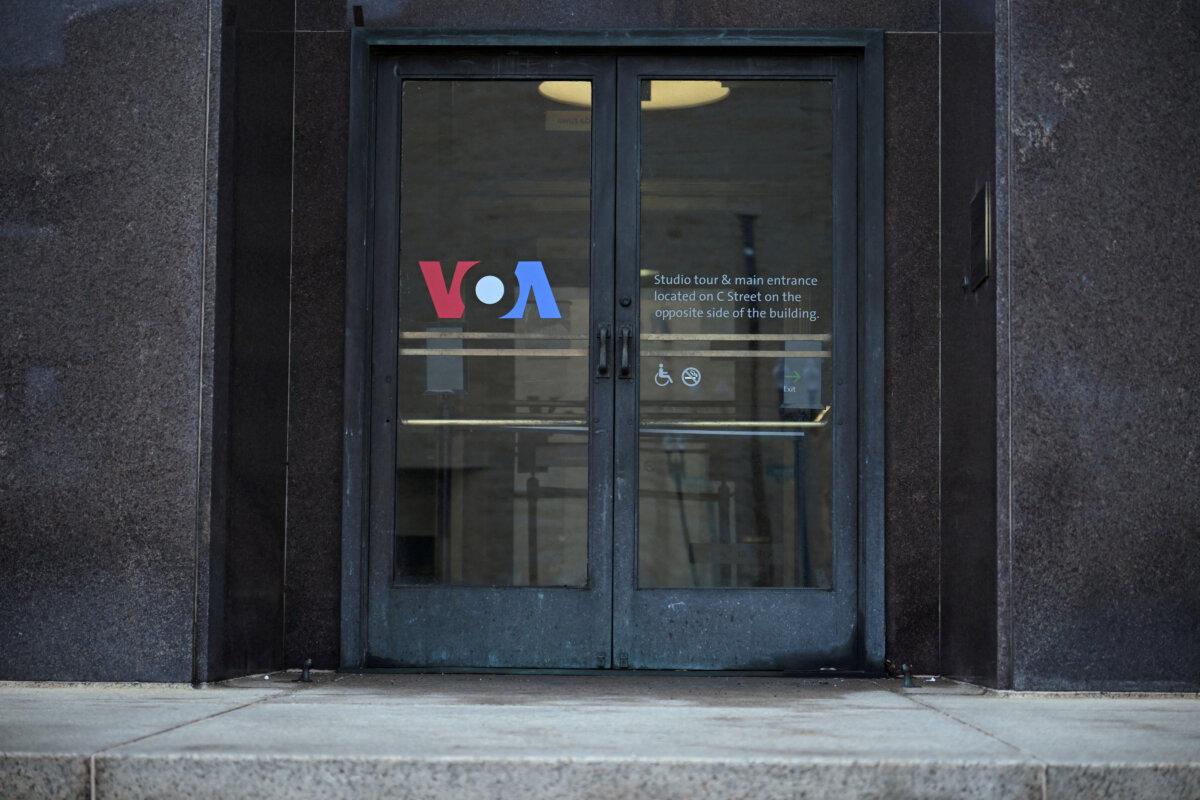
Recently, there has been more and more news from VOA, Shen said.
“The Trump administration may have realized that such psychological offensives through broadcasting are actually very important in promoting changes within mainland China, or even accelerating the communist regime’s collapse.”
He added that RFA has already accumulated experiences in the past.
“If these experiences and achievements can be better utilized, I think it will greatly help promote the peaceful transformation within mainland China,” he said.
Besides traditional media, Sheng said that there are new methods that the United States can use to counter the CCP’s global propaganda.
“The development of artificial intelligence is really progressing rapidly. The United States attaches great importance to this technology and digital sovereignty. Its Starlink, circumvention technology, and other decentralized communication tools make it more difficult for the CCP, terrorist groups, totalitarian governments, and so on to block the spread of free and uncensored information,” Sheng said.